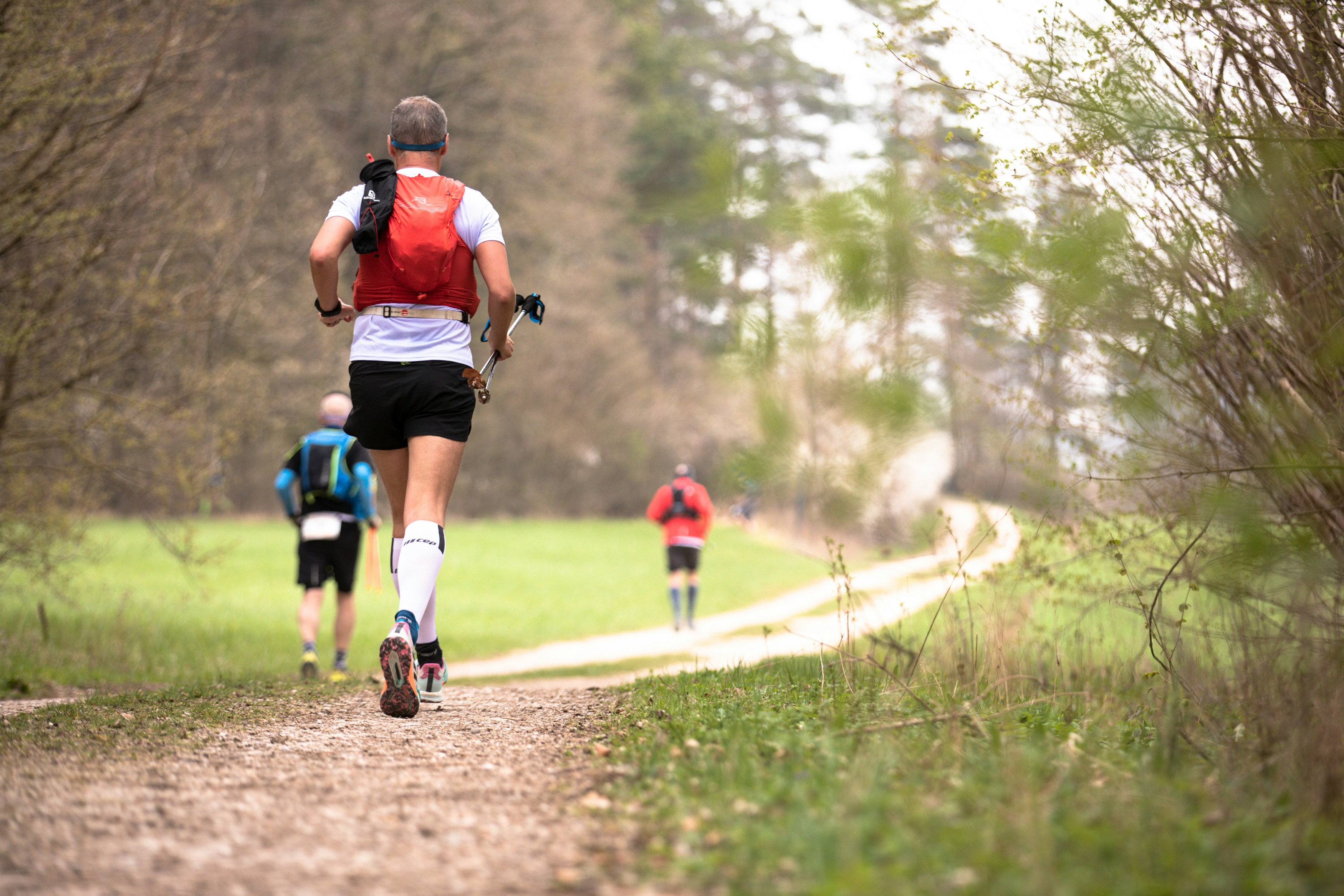

You've injured yourself while running and don't know what to do. Stop completely? Keep going despite the pain? Take anti-inflammatory medication and push through? This uncertainty is frustrating, especially when running is part of your routine and your well-being.
Good news: Most running injuries can be managed effectively with smart adjustments to volume and intensity.¹ It is rarely necessary to stop completely, and often the body can continue to adapt during recovery. What science teaches us about managing injuries during races:- Splitting your workouts (walking + running) speeds up recovery¹
- Several short outings are better than one long one when you are injured.
- Masking pain with medication delays true healing.
- Quality sleep is essential for tissue repair.
This article provides you with concrete recovery strategies. To understand why injuries recur, see our article on recurring running injuries.
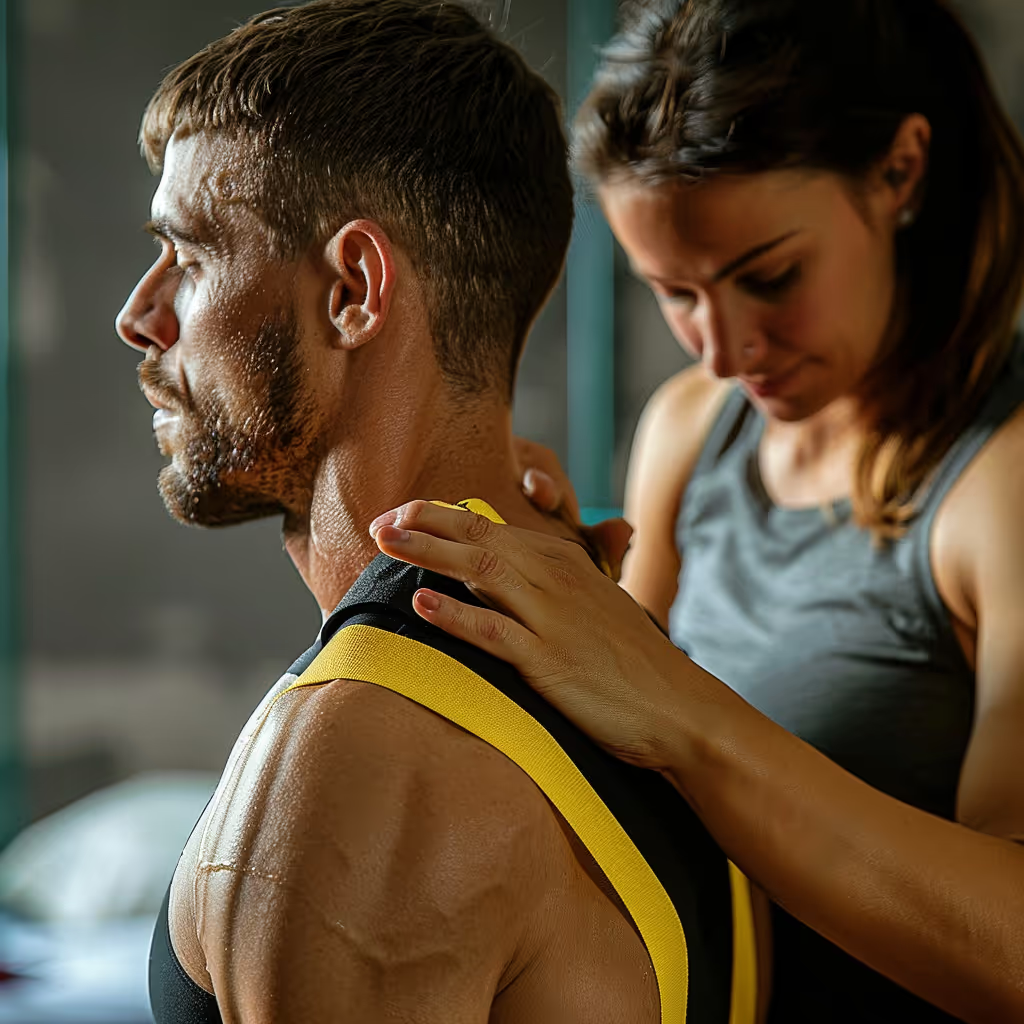
What to do for a running injury? If it seems to persist or you want to resolve the injury as quickly as possible, you should consult a physiotherapist who has expertise in running.
Some will be able to treat themselves with good quantification of mechanical stress, choosing appropriate footwear (see the article on shoes – Link to blog #13) and adopting good running behaviors (see the article on running technique – Link to blog #12).
###
Here are some additional key elements that will help you manage the injury:- Break up running sessions by including walking minutes in the run.
- Reduce the duration of running sessions, but increase the frequency during the week. For example, it is better to run 5 times for 10 minutes a week than twice for 25 minutes when injured. The body adapts faster this way.
- Do not run through pain by masking it with medication. Pain is a warning signal indicating that there is potentially something that deserves to be investigated.
- Listen to your body. It will often guide you to the right dosage for running sessions.
- Practice transfer activities such as swimming, cycling, aquajogging. This allows you to maintain a level of physical activity without putting too much stress on the running injury.
- Optimize your sleep quality. As with any injury, tissue repair occurs mainly when you sleep at night. The better your sleep, the better your chances of improving.
To learn more...
To learn more For more information on running, check out the podcast. "Tell me about health" produced by one of our physical therapists, Alexis Gougeon. Episode #1 focuses on running.Episode #1 discusses the prevention and treatment of running injuries.
Find the episode on YouTube:
Click below to listen to episodes on podcast platforms:
Source:
- Van Gent RN. (2007). Incidence and determinants of lower extremity running injuries in long distance runners: a systematic review. British journal of sports medicine.
10 mini-tips to understand your pain
Those who have had the greatest impact on my patients' lives. 1 per day, 2 min.
(function(){
// GHL form_embed.js reads UTM from parent page URL
// Add UTM params to URL before loading iframe
var path = window.location.pathname;
var parts = path.split('/').filter(Boolean);
var slug = parts[parts.length - 1] || 'homepage';
var source = parts[0] || 'direct';
var url = new URL(window.location.href);
if (!url.searchParams.has('utm_term')) {
url.searchParams.set('utm_term', slug);
url.searchParams.set('utm_source', source);
url.searchParams.set('utm_medium', 'cta-inline-form');
window.history.replaceState({}, '', url.toString());
}
})();
10 mini-tips to understand your pain
Those who have had the greatest impact on my patients' lives. 1 per day, 2 min.
Our clients' satisfaction is our priority.
At Physioactif, excellence defines our approach. But don't take our word for it, see what our patients are saying.











Discover our physiotherapy clinics
We have multiple locations to better serve you.
Blainville
190 Chem. du Bas-de-Sainte-Thérèse Bureau 110,
Blainville, Quebec
J7B 1A7
Laval
Montreal
St-Eustache
Vaudreuil
21 Cité-des-Jeunes Blvd. Suite 240,
Vaudreuil-Dorion, Quebec
J7V 0N3
Book an appointment now