
Every time you bend your knee, your kneecap should slide smoothly in its groove. When this system works well, you don't notice it. When it malfunctions, the pain can stop you in your tracks. Here's the good news: most patellar biomechanical problems do not indicate serious damage. They are often the result of muscle imbalances or changeable movement patterns. Your knee isn't broken. It's functioning with biomechanical constraints that create discomfort.
How does normal patellar biomechanics work?
Normal patellar biomechanics involve the sliding of your kneecap in the femoral trochlea (the groove in the femur). This movement occurs during knee flexion and extension. The quadriceps muscles control this trajectory. Passive soft tissues guide the movement. Understanding these anatomical structures is essential to grasping the biomechanical mechanisms. See our comprehensive guide to the anatomy of the anterior knee for a detailed explanation of these elements.
Your kneecap acts like a mechanical pulley. It increases muscle efficiency by 30 to 50%. When fully extended, it rests above the trochlea. At 20 degrees of flexion, it engages in the groove. At 90 degrees, it is completely lodged in the trochlea.
The forces acting on the joint increase with flexion. When climbing stairs, they reach 3 to 4 times your body weight. When squatting deeply, they can exceed 7 times your body weight. Rest assured: your patellar cartilage is the thickest in the human body. It can reach 7 mm and absorb these loads.
What is patellar tracking?
Patellar tracking refers to the path that your kneecap follows in the femoral trochlea. Optimal tracking keeps the kneecap centered. Poor tracking occurs when the kneecap deviates outward. This creates areas of abnormal pressure. Patellar tracking problems are the main cause of patellofemoral syndrome, the most common condition causing pain in the front of the knee. Read our detailed article on patellofemoral syndrome to understand this condition.
Two categories of factors determine tracking. Active stabilizers are muscles. Passive stabilizers are bones and ligaments. The vastus medialis oblique (VMO), the inner part of the quadriceps, pulls the patella inward. The vastus lateralis (VL) pulls it outward. When the VMO is weak, the patella deviates laterally. Research shows that quadriceps muscle imbalance is a determining factor in tracking problems. Learn how the quadriceps influence knee pain and strategies for restoring muscle balance.
Weak gluteal muscles also play a crucial role. These muscles control the rotation of the femur. When they are weak, the femur rotates inward on one leg. This creates poor tracking.
What factors affect patellar biomechanics?
Patellar biomechanics depend on several factors. Quadriceps muscle balance is important, as is gluteal muscle strength. Lower limb alignment (Q angle) and trochlear depth also play a role.
The Q angle measures the alignment of the lower limb. Women generally have larger Q angles than men. They measure 15-17 degrees compared to 10-15 degrees in men. This could explain why patellofemoral pain is more common in women.
There are also structural factors that cannot be changed. The shape of your femoral trochlea is genetically determined. Rest assured: a shallow trochlea does not prevent you from having a functional knee.
10 mini-tips to understand your pain
Those who have had the greatest impact on my patients' lives. 1 per day, 2 min.
How do patellar biomechanical problems cause pain?
Patellar biomechanical problems cause pain in two ways. They irritate nerve-rich soft tissues. They alter the subchondral bone load (bone under the cartilage). The cartilage itself has no nerve endings. These mechanisms explain why anterior knee pain manifests itself in such varied ways. To understand all the causes and manifestations of this pain, explore our comprehensive guide to anterior knee pain.
When tracking is abnormal, certain areas are subjected to high loads. This can cause edema in the subchondral bone. Bone contains many nerve endings. These are activated when pressure increases.
An important concept emerges. The relationship between biomechanical changes and pain is not direct. Many people with poor tracking feel no pain. Others with normal tracking suffer greatly. That is why a knee that looks problematic on an X-ray may function well.
How can you improve your patellar biomechanics?
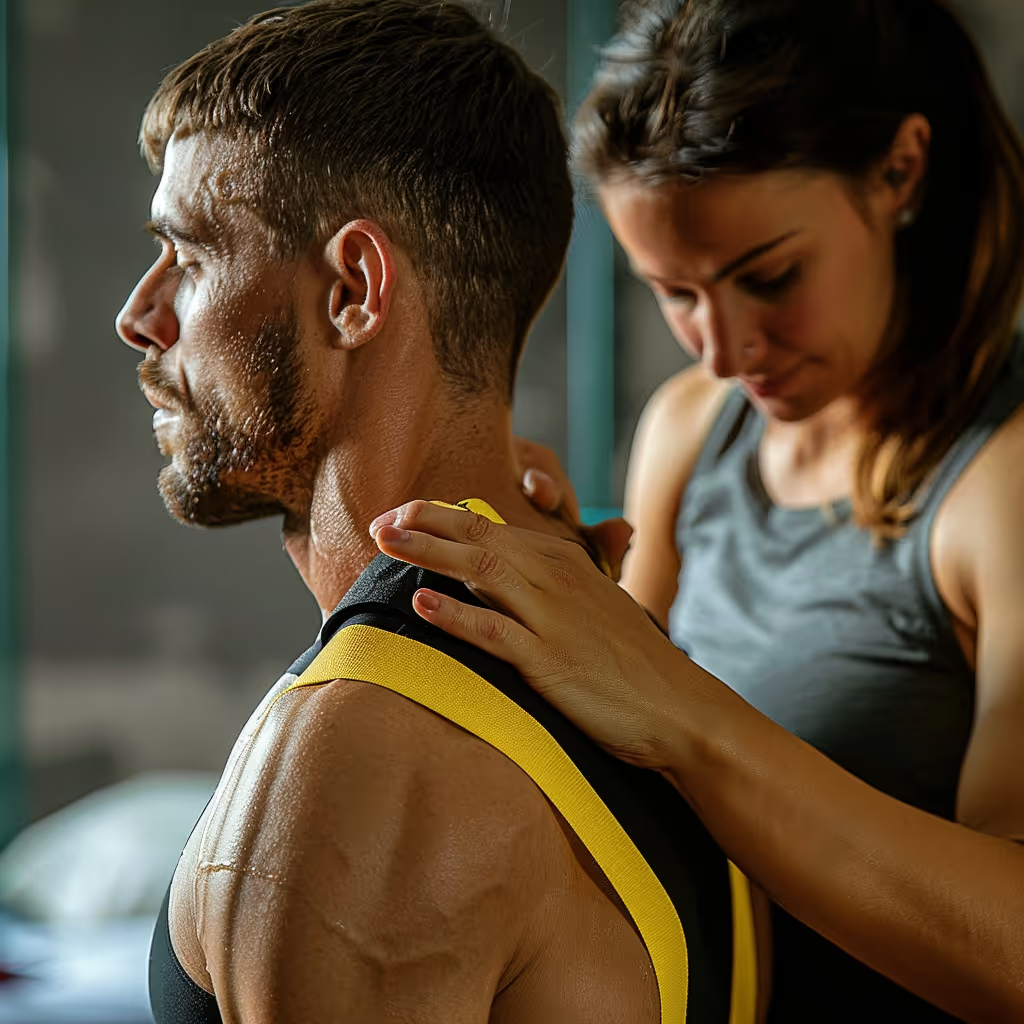
Improving patellar biomechanics relies on muscle strengthening. Target the quadriceps and glutes. Add neuromuscular re-education (relearning movements). Patellar taping can offer temporary relief. Physical therapy offers a structured and personalized approach to correcting these biomechanical imbalances. Discover how our physical therapy programs for anterior knee pain can help you regain optimal movement.
Strengthening the quadriceps is the cornerstone of treatment. Closed-chain exercises (feet fixed to the ground) are better tolerated. Try mini-squats and step-ups. To activate the VMO, do squats with external hip rotation.
Strengthening the glutes is just as important. Single-leg bridges and side steps with elastic bands target these muscles. The goal: to control the position of the femur during movements.
Patellar taping involves applying adhesive tape to pull the kneecap inward. Approximately 50% of people experience immediate relief. This is not a permanent solution. It facilitates therapeutic exercise.
During the acute phase, temporarily reduce painful activities. This allows the irritated tissues to calm down. Do not remain completely at rest. Maintain non-painful activities. Increase your training volume by a maximum of 10% per week.
For most people, conservative treatment improves symptoms within 6 to 12 weeks. Your knee has a remarkable ability to adapt and heal. If you suffer from knee pain, our physical therapists can assess your patellar biomechanics and develop a personalized treatment plan.
Our clients' satisfaction is our priority.
At Physioactif, excellence defines our approach. But don't take our word for it, see what our patients are saying.









Discover our physiotherapy clinics
We have multiple locations to better serve you.
Blainville
190 Chem. du Bas-de-Sainte-Thérèse Bureau 110,
Blainville, Quebec
J7B 1A7
Laval
Montreal
St-Eustache
Vaudreuil
21 Cité-des-Jeunes Blvd. Suite 240,
Vaudreuil-Dorion, Quebec
J7V 0N3
Book an appointment now