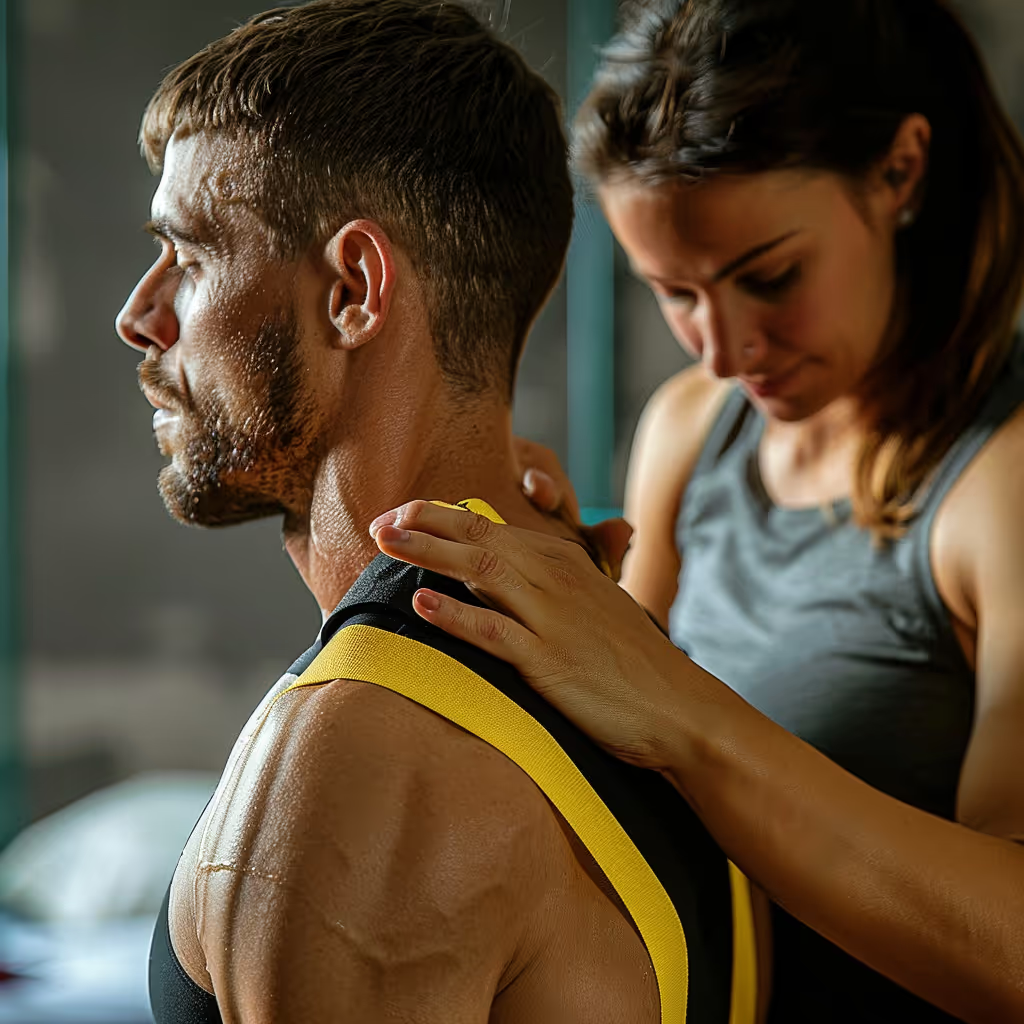
Adductor strain
It is a severe strain or tear of the muscle fibers in the groin or inner thigh.
.png)
.png)
.png)



A sharp pain in the groin during a change of direction. This sudden sensation often indicates an adductor strain, a common injury among soccer, hockey, and football players.
Adductor injuries account for 23% of muscle injuries in professional soccer players. The good news: with the right treatment, most strains heal completely within 4 to 8 weeks.
This guide explains how to recognize an adductor strain, understand its severity, and heal properly.
What is an Adductor Strain?
An adductor strain involves a partial or complete tear of the muscle fibers on the inside of the thigh. This injury occurs during a violent contraction or excessive stretching of the groin muscles.
The adductors form a group of five muscles:
| Muscle | Position | Main role |
|---|---|---|
| Adductor longus | Superficial | Powerful adduction, most frequently injured |
| Adductor brevis | Middle | Adduction and rotation |
| Adductor magnus | Deep | Pelvic stabilization |
| Gracilis | Internal | Knee flexion |
| Pectineus | Superior | Hip flexion |
The adductor longus accounts for 62% of groin injuries in athletes. The musculotendinous junction near the pubis is the most vulnerable area.
Common synonyms: groin muscle tear, adductor strain, myoaponeurotic groin lesion.What Causes an Adductor Strain?
The strain occurs during an explosive contraction or a sudden stretch. Risky movements include: changes of direction, lateral kicks, sprints, and forced splits.
The primary mechanism involves eccentric contraction: the muscle contracts while lengthening. The adductors experience this tension during changes of direction and cross-body kicks.
Typical injury situations:
- Quick changes in direction during sports (soccer, hockey, basketball)
- Side kick or cross-kick in soccer
- Sprinting acceleration, especially during explosive starts
- Forced split when the leg slips or gets stuck
- Falling with legs spread apart, particularly during collisions
Sports activities cause 85% of adductor strains. Soccer carries the highest risk, with 8 to 18% of players experiencing groin injuries each season.
Who is at risk of an adductor strain?
Athletes who play sports involving quick changes in direction are most at risk.
| Risk factor | Increased risk |
|---|---|
| Previous adductor injury | 2 to 4 times higher |
| Adductor weakness (less than 80% of abductor strength) | 4 times higher |
| Insufficient warm-up | 2 times higher |
| Adductor stiffness | Significant |
| Fatigue at the end of a game or season | Significant |
High-risk sports: soccer, ice hockey, football, basketball, tennis, and figure skating.
An adductor/abductor strength ratio below 80% increases the risk of injury by 4 times. A preventative strengthening program reduces this risk by 41%.
10 Quick Tips for Understanding Your Pain
The ones that have made the biggest difference in my patients' lives. 1 a day, 2 minutes.
How to recognize the symptoms of an adductor strain?
The main symptom is a sudden, sharp pain in the groin or inner thigh, often described as a stabbing pain. A bruise may appear within 24 to 72 hours.
Typical signs:
- Sudden, localized pain in the groin at the time of injury
- Popping or tearing sensation in the groin
- Difficulty walking, especially with long strides
- Pain during specific movements: getting into a car, lifting the leg, squeezing the thighs together
- Swelling and bruising on the inner thigh (appearing within 24-72 hours)
- Tenderness to the touch near the groin or along the inner thigh
The pain often radiates towards the inner knee. It increases when squeezing the thighs together or lifting the leg sideways.
Important note: Pain that developed gradually without a specific injury moment likely indicates another condition, such as pubalgia or adductor tendinopathy.What are the different grades of severity for a muscle strain?
Clinicians classify muscle strains into three grades based on severity:
| Grade | Description | Healing | Functional Capacity |
|---|---|---|---|
| Grade 1 | Mild strain, less than 10% of fibers | 1-2 weeks | Normal walking is possible |
| Grade 2 | Partial tear, 10-90% of fibers | 4-8 weeks | Limping, difficulty running |
| Grade 3 | Complete or near-complete rupture | 3-4 months | Very difficult to walk |
Most adductor strains (70-80%) are classified as grade 1 or 2 and respond well to conservative treatment.
How does a physiotherapist diagnose an adductor strain?
Diagnosis is based on the injury history and a clinical examination. The physiotherapist assesses how the injury occurred, locates the pain through palpation, and tests the strength of the adductor muscles.
The evaluation includes:
- History: precise injury mechanism, sensation at the time of injury, symptom progression
- Physical examination: palpation of the groin and inner thigh, observation of gait (walking)
- Strength tests: squeezing the thighs together against resistance (Copenhagen test)
- Stretch tests: pain when the leg is passively moved outwards
Clinical diagnosis is sufficient in the vast majority of cases. Ultrasound or MRI are only used for severe, atypical cases, or those that do not progress as expected.
At Physioactif, our physiotherapists precisely determine the grade of your injury to establish a treatment plan tailored to your specific situation.
Need professional advice?
Our physical therapists can assess your condition and provide you with a personalized treatment plan.
Make an appointmentWhen to consult a physiotherapist for an adductor strain?
Consult a physiotherapist if you experience the symptoms described above. You do not need to see a doctor before consulting for physiotherapy.
Consult within 48-72 hours if:- Sudden groin pain during sports
- Difficulty walking normally
- Visible bruising on the inner thigh
- Severe pain with complete inability to walk
- Visible deformity in the groin
- Associated urinary or testicular symptoms (could indicate a hernia)
Early consultation helps confirm the diagnosis, rule out other conditions, and start rehabilitation at the right time.
How to treat an adductor strain?
Treatment follows the PEACE and LOVE protocol: initial protection followed by a gradual reintroduction of activity. Inflammation is a normal part of the healing process.
Acute Phase (0-72h): PEACE
| Letter | Principle | Application for adductors |
|---|---|---|
| P | Protection | Limit painful movements, take small steps |
| E | Elevation | Elevate your leg while resting |
| A | Avoid anti-inflammatories | Can slow down muscle recovery |
| C | Compression | Compression shorts or elastic bandage |
| E | Education | Understand the healing process |
Recovery phase: LOVE
| Letter | Principle | Application for adductors |
|---|---|---|
| L | Load | Resume walking, then progressive exercises |
| O | Optimism | A positive mindset promotes healing |
| V | Vascularization | Stationary cycling, pain-free swimming |
| E | Exercise | Progressive adductor strengthening |
What is physiotherapy rehabilitation?
Your physiotherapist will create a multi-phase rehabilitation program to optimize healing and prevent relapses.
Phase 1: Protection and Mobility (Days 1-7)
- Walk with small steps, without limping if possible
- Gentle isometric exercises for the adductor muscles
- Gentle hip mobility within pain-free ranges
Phase 2: Progressive Strengthening (Weeks 2-4)
- Strengthening exercises, starting with isometric then concentric
- Modified Copenhagen program (adductor strengthening)
- Pelvic and core stabilization exercises
- Stationary cycling, swimming
Phase 3: Functional Return (Weeks 4-8+)
- Eccentric adductor exercises
- Progressive straight-line running
- Changes of direction at reduced speed
- Sport-Specific Exercises
Phase 4: Return to Sport
- Functional tests: strength, speed, agility
- Full, unrestricted training
- Relapse prevention through a maintenance program
The Copenhagen program reduces adductor injuries by 41% in soccer players. Your physiotherapist will teach you these exercises.
What to do at home for an adductor strain?
First few days (48-72h)
- Walk with small steps to avoid stretching the groin.
- Use compression shorts or an elastic bandage.
- Apply ice for 15-20 minutes several times a day if it provides relief.
- Avoid movements that reproduce the pain.
After 72 hours
Gentle contractions: Squeeze a pillow between your knees for 5-10 seconds, 10 repetitions, 2-3 times a day. Pain should remain below 4/10. Pain-free cardio: Stationary bike or swimming to maintain physical fitness and promote blood circulation. Progression criteria: Increase intensity if pain subsides within 30 minutes after exercise and you can repeat the same exercise the next day. Check if: No improvement after 10 days, or if pain increases despite rest.How long does it take for an adductor strain to heal?
| Grade | Return to daily activities | Return to sport |
|---|---|---|
| Grade 1 | 3-5 days | 1-2 weeks |
| Grade 2 | 1-2 weeks | 4-8 weeks |
| Grade 3 | 3-4 weeks | 3-4 months |
The recurrence rate for adductor injuries is 18-32% if rehabilitation is incomplete. A supervised, gradual return to activity significantly reduces this risk.
How to prevent recurrence?
Prevention relies on specific strengthening and proper warm-up.
Effective prevention program:- Adductor Strengthening: Copenhagen exercises 2-3 times per week
- Muscle Balance: maintain an adductor/abductor ratio greater than 80%
- Dynamic Warm-up: progressive movements before each sports activity
- Load Management: gradual increase in training intensity
The Copenhagen program, performed twice a week during the season, reduces adductor injuries by 41%.
Key takeaways
- An adductor strain causes sudden groin pain during an explosive movement.
- Most strains (grades 1-2) heal within 1 to 8 weeks with the right treatment.
- Complete rest does not speed up healing. Progressive and controlled loading promotes better recovery.
- Preventive strengthening significantly reduces the risk of injury and recurrence.
- Consult a physiotherapist for an accurate diagnosis and a tailored program.
References
- Werner J, Hagglund M, Walden M, Ekstrand J. UEFA injury study: a prospective study of hip and groin injuries in professional football over seven consecutive seasons. Br J Sports Med. 2009;43(13):1036-1040.
- Serner A, et al. Study of acute groin injuries in male football players. Br J Sports Med. 2015;49(18):1165-1171.
- Tyler TF, Silvers HJ, Gerhardt MB, Nicholas SJ. Groin injuries in sports medicine. Sports Health. 2010;2(3):231-236.
- Hagglund M, Walden M, Ekstrand J. Risk factors for lower extremity muscle injury in professional soccer. Am J Sports Med. 2013;41(2):327-335.
- Kiel J, Kaiser K. Adductor Strain. StatPearls Publishing. 2023.
- Harøy J, et al. The Adductor Strengthening Programme prevents groin problems among male football players. Br J Sports Med. 2019;53(3):150-157.
- Serner A, et al. Characteristics of acute groin injuries in the adductor muscles. Knee Surg Sports Traumatol Arthrosc. 2020;28(12):3808-3819.
- Thorborg K, et al. Clinical examination, diagnostic imaging, and testing of athletes with groin pain. J Orthop Sports Phys Ther. 2018;48(4):239-249.
Videos in this category
.jpg)
Other conditions

Hip osteoarthritis is the normal wear and tear of the hip joint. It is often said that osteoarthritis is the wear and tear of the cartilage between our bones. That is true, but it involves more than just the cartilage. Cartilage is a tissue that acts as a cushion between the surfaces of our bones and allows our joints to glide smoothly and move fluidly.
This is normal wear and tear of the knee joint. It’s often said that osteoarthritis is the wearing down of the cartilage between our bones. That’s true, but it’s more than just the cartilage. Cartilage is a tissue that acts as a cushion between the surfaces of our bones and allows our joints to glide smoothly and move fluidly.
It is an inflammation of the subacromial bursa in the shoulder joint.
A bursa is a small, thin sac filled with fluid that is found in many of the body's joints. This small sac acts as a cushion within the joint and lubricates the structures that are subject to increased friction.
It is a tissue that surrounds the shoulder and helps keep the shoulder bone in place within the joint. The capsule helps keep the joint stable.
Neck pain is a general term used to describe pain in the neck that has no specific cause, such as an accident or a sudden awkward movement. Neck pain is therefore synonymous with “my neck hurts, and nothing in particular happened.”
In both types of injury, pain is felt in the neck and then radiates into the arm, or vice versa.
It is a severe strain or tear of the muscle fibers in the hamstrings, which are located at the back of the thigh.
Make an appointment now
We offer a three-pronged quality assurance approach: optimized treatment time, a second opinion from a physical therapist, and ongoing expertise to ensure effective care tailored to your needs.

Customer satisfaction is our top priority
At Physioactif, excellence guides everything we do, but our patients are the best ones to tell you about it. Take a look at their verified reviews to get a real sense of their experience.









Discover our physical therapy clinics
We have locations in several areas to better serve you.
Blainville
190 Bas-de-Sainte-Thérèse Road, Suite 110,
Blainville, Quebec
J7B 1A7
Located in Blainville, near Rosemère, the Physioactif clinic is easily accessible to residents of the area and the surrounding communities
Laval
3224 Jean-Béraud Ave., Suite 220, Laval,
QC H7T 2S4
Located in Chomedey, in the heart of Laval, the Physioactif clinic is easily accessible to people in the area
Montreal
8801 Lajeunesse Street,
Montreal,
QC H2M 1R8
Located in Ahuntsic, near Villeray, the Physioactif clinic is easily accessible to residents of both neighborhoods
Saint-Eustache
180 25th Avenue, Suite
201 Saint-Eustache
QC J7P 2V2
Located in Saint-Eustache, the Physioactif clinic is easily accessible to residents of the area and the surrounding communities
Vaudreuil
21 Cité-des-Jeunes Boulevard, Suite 240,
Vaudreuil-Dorion, Quebec
J7V 0N3
Located in Vaudreuil-Dorion, the Physioactif clinic is easily accessible to people in the area
Make an appointment now