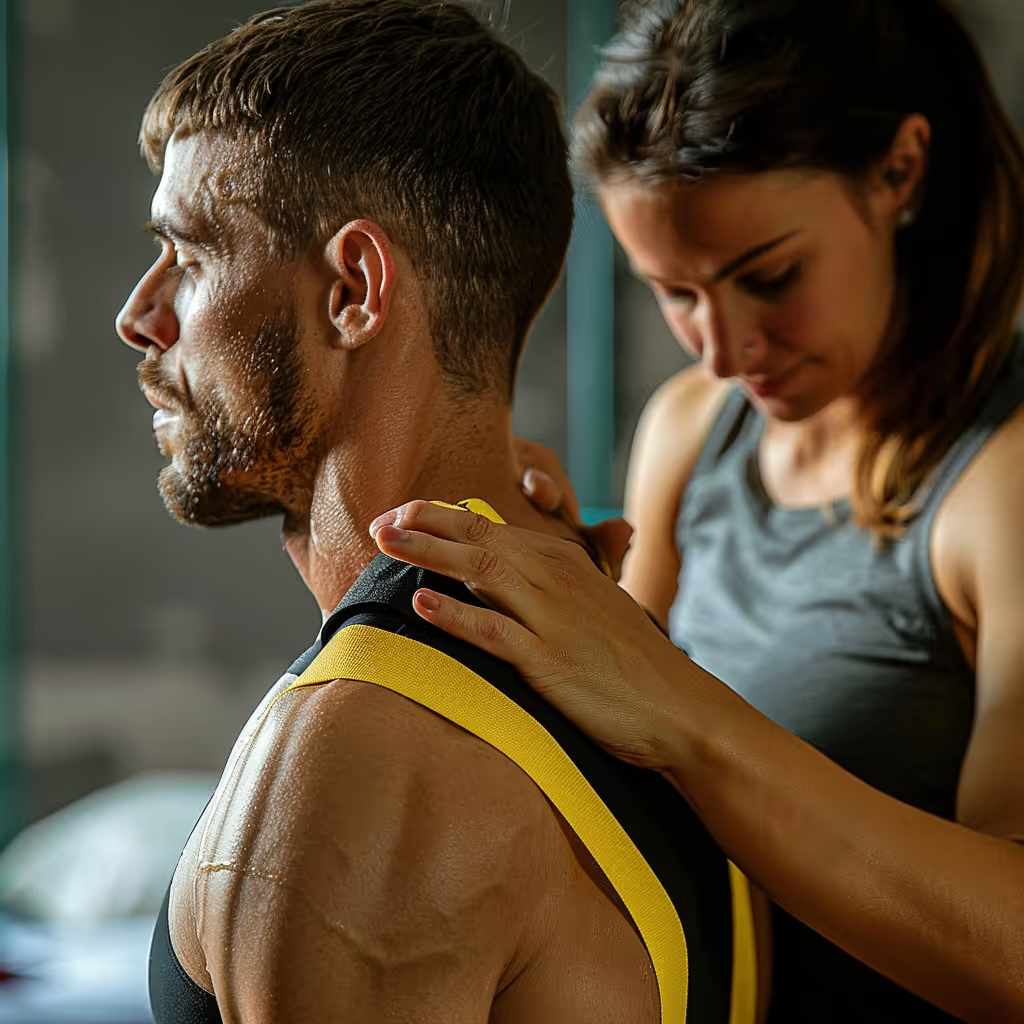


You have tried several treatments for your pain, and perhaps some have helped temporarily, but nothing seems to "fix" the problem for good. This search for a miracle cure can be exhausting, especially when the pain affects your work, leisure activities, and relationships.
Good news: Research shows that people who actively engage in their pain management achieve better long-term outcomes.¹ You have more control than you think. What science teaches us about pain management:- Active approaches (exercise, cognitive strategies) work better than passive approaches alone.
- Even slight movement activates your natural pain modulation systems.
- Pacing (balancing activities) prevents the cycle of overactivity and collapse.
- Combining several strategies is more effective than a single approach.
This guide presents concrete strategies that you can apply today. To understand why these approaches work, check out our article on the neuroscience of pain.
Becoming an active participant in your pain management
Chronic pain can make you feel like you're losing control of your life. But research is clear: people who actively engage in managing their pain have better outcomes than those who passively wait for someone to "cure" them.
This article presents concrete strategies that you can apply today. None of them are magic, but together they can make a real difference.
Active approaches vs. passive approaches
The difference that changes everything
Passive approaches:What is done to you: massage, manipulation, medication, electrotherapy. These can provide temporary relief, but generally do not produce lasting changes on their own.
Active approaches:What you do—exercise, stress management, lifestyle adjustments, cognitive strategies—are what produce the best long-term results.
The ideal approach is often a combination of both: passive approaches to help you get started, and active approaches to maintain your gains.
Movement: Your best ally
Why move when you're in pain?
It may seem counterintuitive, but movement is one of the most powerful tools for managing chronic pain:
- It activates your natural pain modulation systems
- It reconditions your body
- It shows your nervous system that movement is safe.
- It improves your mood and sleep
- It increases your confidence in your abilities
How to move smartly
Start smallIf you have been inactive for a long time, start with 5-10 minutes of light activity. Walk, swim, or simply move gently.
Progress graduallyIncrease the volume and intensity in small increments. The 10% per week rule is a good general guideline.
Respect the concept of "pacing" (see next section)Do not alternate between hyperactivity and collapse.
Accepting a certain amount of discomfortA little pain during exercise does not mean you are hurting yourself. The goal is to stay within a manageable range, not to avoid all sensation.
Understanding your "job envelope"Each person has a capacity for activity that their tissues can tolerate without any problems; this is your "functional envelope." When you are in pain, this envelope temporarily shrinks. The goal is to stay within this envelope while gradually expanding it over time.
Gradual exposure
If you have avoided certain movements out of fear, gradual exposure is the key strategy:
- Identify the movement or activity you are avoiding
- Break it down into small steps
- Start with the easiest version
- Gradually progress toward the full version
- Celebrate every milestone
A physical therapist can guide you through this process safely.
10 mini-tips to understand your pain
Those who have had the greatest impact on my patients' lives. 1 per day, 2 min.
(function(){
// GHL form_embed.js reads UTM from parent page URL
// Add UTM params to URL before loading iframe
var path = window.location.pathname;
var parts = path.split('/').filter(Boolean);
var slug = parts[parts.length - 1] || 'homepage';
var source = parts[0] || 'direct';
var url = new URL(window.location.href);
if (!url.searchParams.has('utm_term')) {
url.searchParams.set('utm_term', slug);
url.searchParams.set('utm_source', source);
url.searchParams.set('utm_medium', 'cta-inline-form');
window.history.replaceState({}, '', url.toString());
}
})();
10 mini-tips to understand your pain
Those who have had the greatest impact on my patients' lives. 1 per day, 2 min.
Pacing: Managing your energy
The boom and bust cycle
Many people with chronic pain alternate between:
- Boom: When the pain subsides, we overcompensate to make up for lost time.
- Bust: We pay the price with a surge of pain and a collapse.
This cycle keeps your nervous system in a state of hypervigilance and perpetuates the pain.
The pacing strategy
Pacing involves maintaining a stable and predictable level of activity:
Plan rather than reactDecide in advance what you are going to do, rather than letting yourself be guided by your current level of pain.
Divide tasksRather than doing everything at once, divide it into manageable portions with breaks.
Respect your limitsStop before you get exhausted, even when you feel fine.
Be consistentDo roughly the same amount of activity every day, rather than extreme highs and lows.
Practical example
Before pacing:Monday: Complete deep cleaning (4 hours)
Tuesday-Thursday: Collapsed on the couch because of the pain
Friday: Feeling better, starting the cycle again
With pacing:Monday: 30 minutes of cleaning, break, 30 minutes
Tuesday: 30 minutes of cleaning, break, 30 minutes
... and so on
Sleep: An underestimated pillar
Why sleep matters
Poor quality sleep:
- Amplifies pain perception
- Reduces your ability to manage it
- Affects your mood and energy levels
- Keeps your nervous system alert
The vicious cycle is common: pain disrupts sleep, and poor sleep increases pain.
Strategies for better sleep
Basic sleep hygiene:- Regular bedtimes and wake-up times
- Cool, dark, and quiet room
- Limit screen time 1-2 hours before bedtime
- Avoid caffeine after noon
- Avoid alcohol before bedtime
- Find comfortable positions (support pillows)
- Relaxation techniques before bedtime
- Don't stay awake in bed for too long.
Consult a professional. Severe sleep disorders may require specialized evaluation.
Breathing and relaxation
Why it works
Stress keeps your nervous system in "alert" mode, which amplifies pain. Relaxation techniques activate the parasympathetic nervous system ("rest and recovery" mode), which can:
- Reduce muscle tension
- Reducing pain perception
- Improve sleep
- Reduce anxiety
Diaphragmatic breathing
A simple but effective technique:
- Sit or lie down comfortably.
- Place one hand on your chest and the other on your stomach.
- Breathe in slowly through your nose; your belly should rise, not your chest.
- Exhale slowly through your mouth
- Repeat for 5-10 minutes.
Practice regularly, not just when you are in pain. It is training for your nervous system.
Other techniques
- Progressive muscle relaxation: Contract and then relax each muscle group.
- Mindfulness meditation: Observing your sensations without judgment
- Visualization: Imagine a calm and safe place.
Need professional advice?
Our physical therapists can assess your condition and offer you a personalized treatment plan.
Book an appointmentManaging your thoughts
The power of beliefs
Your thoughts and beliefs directly influence your experience of pain. Catastrophic thoughts ("This is terrible, I can't stand it") amplify the perception of danger and therefore the pain.
Cognitive strategies
Notice automatic thoughtsWhen the pain increases, what thoughts come to mind spontaneously? Identifying them is the first step.
Challenging negative thoughts- Is that really true?
- What is the evidence?
- Is there another way of looking at the situation?
Rather than dwelling on what you cannot change, focus on the actions you can take now.
Practicing acceptanceAcceptance does not mean resignation. It means ceasing to fight against reality so that we can act effectively.
Social support
Don't remain isolated
Isolation is a major aggravating factor in chronic pain. Maintain social connections:
- Improves mood
- Reduces pain perception
- Provides meaning and motivation
Strategies
- Communicate with your loved ones about what you are going through
- Maintain social activities, even if adapted
- Join support groups if available
- Accept help when it is offered
When to consult a professional
Physical therapy for chronic pain
A physical therapist trained in pain management can:
- Assess your overall condition
- Guide you through a tailored exercise program
- Teaching you pacing and gradual exposure strategies
- Work on the psychosocial factors that contribute to your pain
The interdisciplinary team
For complex pain, an interdisciplinary approach may involve:
- Physiotherapist
- Family doctor or pain specialist
- Psychologist specializing in pain
- Occupational therapist
- Nutritionist
Building your "toolbox"
Customize your strategies
Not all strategies work equally well for everyone. The goal is to build your own "toolbox," a set of strategies that you can use depending on the situation.
For flare-ups of pain
- Diaphragmatic breathing
- Heat or ice (whichever provides relief)
- Gentle movements
- Distraction through an enjoyable activity
- Reminder: "It will pass, just like the other times."
On a daily basis
- Smooth movement
- Pacing of activities
- Sleep routine
- Stress management
- Social connection
Key takeaways
- Active approaches produce the best long-term results.
- Movement is a powerful tool; start small and progress gradually.
- Pacing avoids the boom and bust cycle that perpetuates pain.
- Sleep is essential; prioritize sleep hygiene.
- Breathing and relaxation calm the nervous system.
- Your thoughts matter; cognitive strategies reduce the perception of threat.
- Social support is protective
- Build your personalized toolbox
Whether your pain affects your back, neck, shoulders, or knees, these principles apply. You have more power than you think.
Additional resources
Our clients' satisfaction is our priority.
À Physioactif, l’excellence guide chaque intervention, mais ce sont nos patients qui en parlent le mieux. Consultez plutôt leurs avis vérifiés pour vous faire une idée concrète de leur expérience.











Discover our physiotherapy clinics
We have multiple locations to better serve you.
Blainville
190 Chem. du Bas-de-Sainte-Thérèse Bureau 110,
Blainville, Quebec
J7B 1A7
Située à Blainville, à proximité de Rosemère, la clinique Physioactif est facilement accessible pour les résidents du secteur et des alentours
Laval
3224 Jean-Béraud Ave. Suite 220 Laval,
QC H7T 2S4
Située à Chomedey, au cœur de Laval, la clinique Physioactif est facilement accessible pour les personnes à proximité
Montreal
8801 Lajeunesse Street,
Montreal,
QC H2M 1R8
Située à Ahuntsic, à proximité de Villeray, la clinique Physioactif est facilement accessible pour les résidents des deux quartiers
St-Eustache
180 25th Avenue Suite
201 Saint-Eustache
QC J7P 2V2
Située à Saint-Eustache, la clinique Physioactif est facilement accessible pour les résidents du secteur et des environs
Vaudreuil
21 Cité-des-Jeunes Blvd. Suite 240,
Vaudreuil-Dorion, Quebec
J7V 0N3
Établie à Vaudreuil-Dorion, la clinique Physioactif est facilement accessible pour les gens du secteur
Book an appointment now