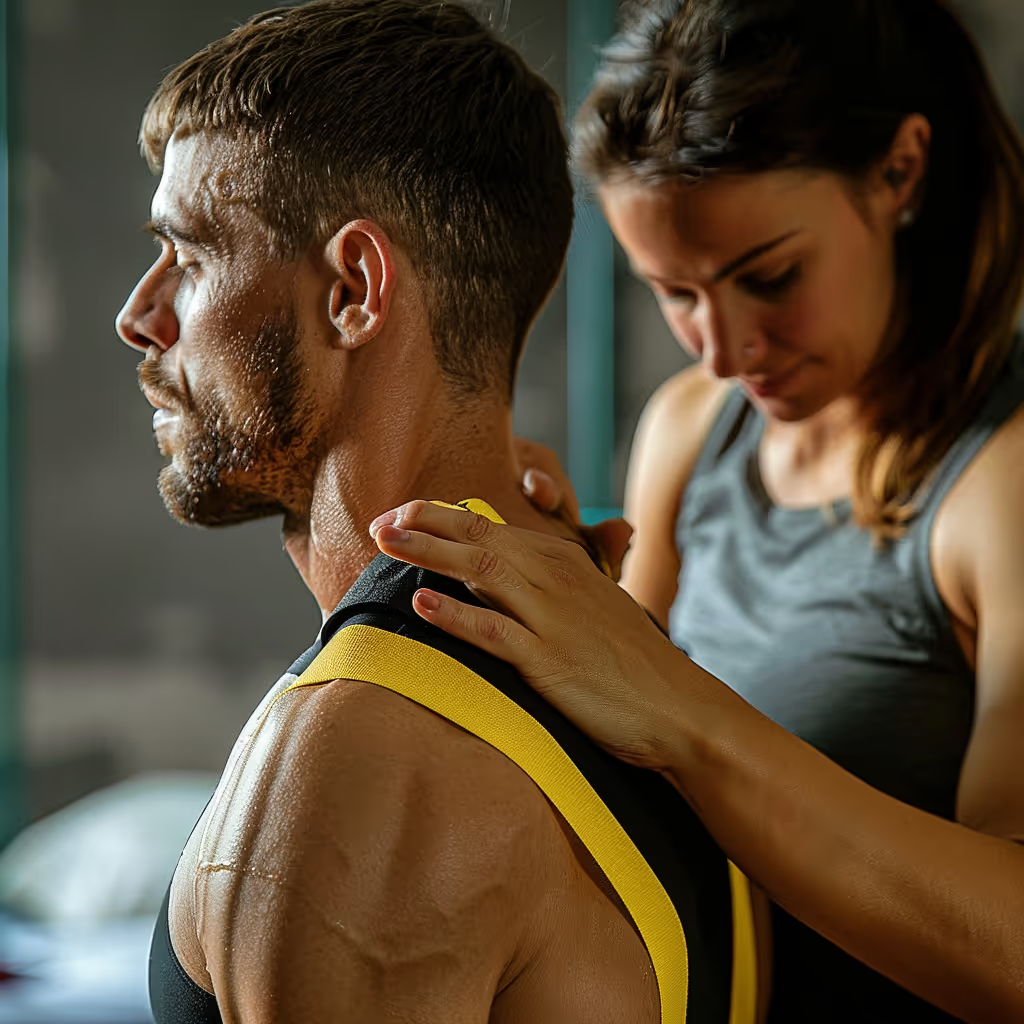
Quadriceps Strain
This is a significant stretch or tear of the muscle fibers in the quadriceps, which is the large muscle at the front of the thigh.
.png)
.png)
.png)


Synonyms of burnout
- Muscle tear
- Muscle strain
- Myofascial lesion
- Muscle strain
What is a quadriceps strain?
A quadriceps strain is an excessive stretching or tearing of the muscle fibers in the quadriceps, the large muscle located at the front of the thigh. This injury occurs when the muscle is subjected to a force that exceeds its capacity to adapt.
The quadriceps consists of four muscles that work together to extend the knee and flex the hip. The rectus femoris, which crosses two joints, is most often affected by strains.
Burns are classified into three grades according to their severity:
| Grade | Description | Healing time |
|---|---|---|
| Grade 1 | Etirement leger, moins de 5% des fibres touchees | 1-3 weeks |
| Grade 2 | Dechirure partielle, 5-50% des fibres | 3-6 weeks |
| Grade 3 | Dechirure complete ou quasi-complete | 6-12 semaines ou plus |
What causes a quadriceps strain?
A muscle strain occurs when a significant force of contraction or stretching exceeds the muscle's capacity. The most common mechanisms are:
- A quick change of direction during a sport
- A sudden movement of the hip or leg, such as kicking a soccer ball
- A jump or a jump landing
- Rapid acceleration during the race, as in a sprint start
- Stretching that is too intense or poorly controlled
Sports that combine fast running and changes of direction are the most risky: soccer, football, rugby, hockey, and basketball.
What are the risk factors for a quadriceps strain?
Several factors increase the risk of injury to the quadriceps:
Modifiable factors:- Insufficient warm-up before activity
- Muscle fatigue or overtraining
- Imbalance of strength between the thigh muscles
- Lack of flexibility in the quadriceps
- Poor sports technique
- History of quadriceps injury (the most significant risk factor)
- Age advances (muscles lose elasticity)
- Certain anatomical features
Athletes who have already had a strain are 2 to 6 times more likely to have another one in the following year.
10 mini-tips to understand your pain
Those who have had the greatest impact on my patients' lives. 1 per day, 2 min.
What are the symptoms of a quadriceps strain?
Symptoms appear immediately at the time of injury:
- Sudden, sharp pain in the front of the thigh, often described as a stabbing pain
- Sensation of snapping or tearing at the moment of the accident
- The pain may radiate to the knee or hip.
- Difficulty walking, especially with long strides
- Weakness when lifting the leg or climbing stairs
- Walking, especially with long strides
- Getting in or out of the car
- Lifting your leg to put on stockings or pants
- Quadriceps stretch
- Bruise (blue) that may appear within 24-48 hours
- Swelling at the front of the thigh
- In severe cases, visible deformation or a hollow in the muscle
How is a quadriceps strain diagnosed?
The diagnosis is based primarily on the history of the injury and clinical examination. Your physical therapist or doctor will evaluate:
- The mechanism of injury (how it happened)
- The precise location of the pain
- Quadriceps strength compared to the other leg
- Flexibility and range of motion
- The presence of swelling or bruising
- Confirm the severity of the injury
- Guiding decisions on returning to sport for elite athletes
- Check for any other associated injuries.
In most cases, a thorough clinical examination is sufficient to establish the diagnosis and begin treatment.
When should you see a physical therapist for a quadriceps strain?
You should see a physical therapist if:
- You have the symptoms described above after a specific event.
- You have been limping for more than 48 hours.
- Do you have difficulty performing your daily activities?
- You want to optimize your recovery and avoid relapses.
- You have significant deformation of the thigh.
- The pain is unbearable and does not subside.
- You cannot put any weight on your leg at all.
- You have signs of vascular damage (cold, pale, or numb leg)
Need professional advice?
Our physical therapists can assess your condition and offer you a personalized treatment plan.
Book an appointmentWhat are the physiotherapy treatments for a quadriceps strain?
As with all traumatic injuries, we must first allow the body to do its natural healing work.
Inflammation is a normal and necessary process for proper healing. Therefore, there is no miracle cure to speed up healing.However, it is very important to ensure that all factors that could slow down healing are eliminated:
- Concerns or fears related to the injury
- An improper balance of exercise and activities
- Poor movement technique
- Stiffness in the joints or muscles
What your physical therapist will evaluate
- Your joint mobility in the hip and knee
- The flexibility and strength of your muscles
- The quality of your functional movements
- Your walking pattern
What your physical therapist will do
- Gentle movements to reduce pain and maintain mobility
- Progressive exercises to regain quadriceps strength and function
- Education on balancing activities to optimize healing
- Gradual return to sport with objective progression criteria
Rehabilitation generally follows three phases:
| Phase | Objectives | Duree approximative |
|---|---|---|
| Phase 1 | Reduire la douleur et l'enflure, maintenir la mobilite | 1-2 weeks |
| Phase 2 | Retrouver la force et l'endurance, reprendre la marche normale | 2-4 weeks |
| Phase 3 | Retour aux activites sportives, prevention des rechutes | 2-6 weeks |
What can you do at home for a quadriceps strain?
For acute muscle injuries, follow the PEACE and LOVE principles.
PEACE (in the early days)
P - Protection: Avoid movements that significantly increase pain. Use crutches if you are limping. E - Elevation: Elevating your leg when lying down helps reduce swelling. A - Avoid anti-inflammatory drugs: Avoid anti-inflammatory drugs for the first 48-72 hours. Inflammation is necessary for healing. C - Compression: Use a compression bandage or tape to wrap around your thigh. This helps to limit swelling. E - Education: Understand that your body needs time to heal. Avoid excessive passive treatments.LOVE (after the first few days)
L - Load:- Start walking again and gradually put weight on your leg.
- Wait until you are no longer limping before increasing the duration of your walks.
- From the second day onwards, you can begin to gently contract the muscle if the pain remains below 4/10.
- Stationary bike with light resistance
- Walking in water
- Swimming (light legs)
Criteria for determining whether you are dosing correctly
You are balancing your activities well if:
- Pain after exercise subsides in less than 30 minutes.
- There are no cramps or sudden sharp pains during exercise.
- The next day, you will be able to do the same exercise again.
How long does it take for a quadriceps strain to heal?
The healing time depends on the severity of the injury:
| Severite | Healing time | Back to sports |
|---|---|---|
| Grade 1 (leger) | 1-3 weeks | 2-4 weeks |
| Grade 2 (modere) | 3-6 weeks | 4-8 weeks |
| Grade 3 (severe) | 6-12 weeks | 3-6 months |
- Your age and overall physical condition
- The quality of your rehabilitation
- Respecting the stages of progress
- The absence of complications such as re-injury
Most quadriceps strains heal completely with conservative treatment involving physical therapy. Surgery is rarely necessary, except for complete tears in athletes.
How can you prevent quadriceps strains?
Prevention is important, especially if you have already had an injury:
Proper warm-up:- At least 10-15 minutes before intense activity
- Include dynamic movements that mimic your sport
- Eccentric strengthening of the quadriceps (the muscle lengthens as it contracts)
- Stability and pelvic control exercises
- Stretch regularly, but not before intense activity.
- Gradually increase the intensity (no more than 10% per week).
- Allow for adequate recovery periods
- Avoid intensive training when you are tired.
- Maintain proper hydration and nutrition
- Get enough sleep
- Quickly treat minor discomforts before they become injuries
References
- Garrett WE Jr. Muscle strain injuries. Am J Sports Med. 1996;24(6 Suppl):S2-8.
- Cross TM, Gibbs N, Houang MT, Cameron M. Acute quadriceps muscle strains: magnetic resonance imaging features and prognosis. Am J Sports Med. 2004;32(3):710-719.
- Orchard JW, Seward H, Orchard JJ. Results of 2 decades of injury surveillance and public release of data in the Australian Football League. American Journal of Sports Medicine. 2013;41(4):734-741.
- Hagglund M, Walden M, Ekstrand J. Previous injury as a risk factor for injury in elite soccer: a prospective study over two consecutive seasons. Br J Sports Med. 2006;40(9):767-772.
- Heiderscheit BC, Sherry MA, Silder A, Chumanov ES, Thelen DG. Hamstring strain injuries: recommendations for diagnosis, rehabilitation, and injury prevention. J Orthop Sports Phys Ther. 2010;40(2):67-81.
- Dubois B, Esculier JF. Soft-tissue injuries simply need PEACE and LOVE. Br J Sports Med. 2020;54(2):72-73.
- Kary JM. Diagnosis and management of quadriceps strains and contusions. Current Review in Musculoskeletal Medicine. 2010;3(1-4):26-31.
.jpg)
.jpg)
.jpg)
Other conditions

Hip osteoarthritis is a normal wear and tear of the hip joint. Osteoarthritis is often described as the wearing away of cartilage between our bones. While this is true, it involves more than just cartilage. Cartilage is a tissue that acts like a cushion between the surfaces of our bones, allowing our joints to glide smoothly and move with ease.
It is a normal wear and tear of the knee joint. Osteoarthritis is often described as the wearing away of cartilage between our bones. While this is true, it involves more than just cartilage. Cartilage is a tissue that acts like a cushion between the surfaces of our bones, allowing our joints to glide smoothly and move with ease.
A bursa is like a small, very thin, fluid-filled sac found in several joints throughout the body. This small sac acts as a cushion in the joint and lubricates structures that are exposed to more friction.
It is an inflammation of the subacromial bursa in the shoulder joint.
It is a tissue that surrounds the shoulder and allows the shoulder bone to stay in place within the joint. The capsule helps to stabilize the joint.
Cervicalgia is a general term to describe neck pain that does not have a specific cause, such as an accident or sudden movement. Cervicalgia is therefore synonymous with ''I have a pain in my neck and nothing in particular happened''.
In both injuries, there is pain felt in the neck that then radiates into the arm, or vice versa.
It is a significant stretch or tear of the muscle fibers in the groin or inner thigh muscles.
It is a significant stretch or tear of the muscle fibers in the hamstring muscles located at the back of the thigh.
Book an appointment now
We offer a triple quality guarantee: optimized time, double physiotherapy assessment, and ongoing expertise for effective care tailored to your needs.

Our clients' satisfaction is our priority.
At Physioactif, excellence defines our approach. But don't take our word for it, see what our patients are saying.











Discover our physiotherapy clinics
We have multiple locations to better serve you.
Blainville
190 Chem. du Bas-de-Sainte-Thérèse Bureau 110,
Blainville, Quebec
J7B 1A7
Laval
Montreal
St-Eustache
Vaudreuil
21 Cité-des-Jeunes Blvd. Suite 240,
Vaudreuil-Dorion, Quebec
J7V 0N3
Book an appointment now