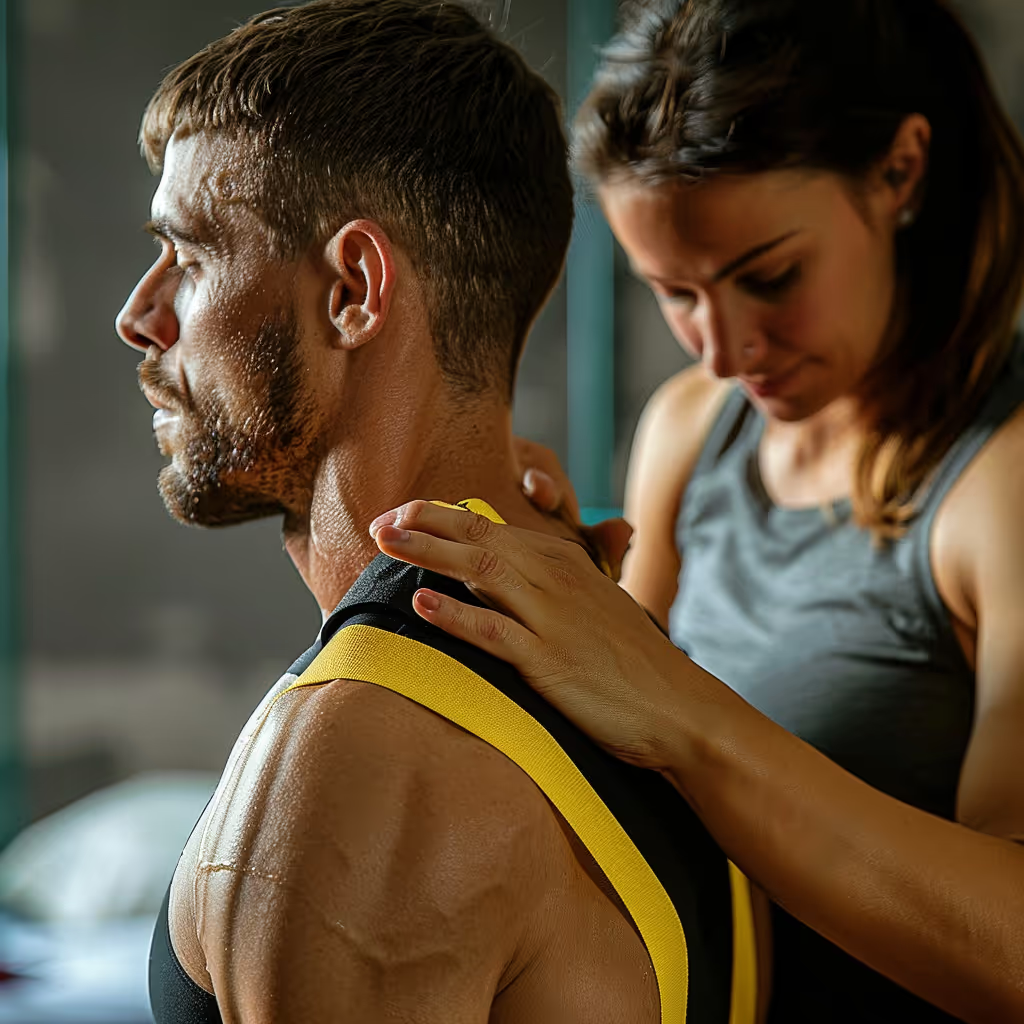
Perhaps a friend has told you that a physical therapist "repositioned" their shoulder with a spectacular crack. Or that an acquaintance swears that their vertebrae were "out of place" before manual treatment. Does it hurt? Is it dangerous? Does anything really get repositioned?
Here's the reality: manual therapy is safe and often very helpful, but it's not magic. It works in a more interesting (and less dramatic) way than most people imagine.
Nothing is "put back" in your body. Your vertebrae are not misaligned. These simplistic mechanical explanations have been largely abandoned. Manual therapy acts on your nervous system, temporarily changing the way your brain processes pain signals. This distinction explains why it works best in combination with exercise and why its effects are temporary when used alone.
## What is manual therapy and how does it work?
**Short answer**: Manual therapy encompasses the techniques that physical therapists apply with their hands to joints, muscles, and tissues. It works primarily through your nervous system by modulating pain signals, creating a temporary window for movement and exercise.
Manual therapy encompasses the techniques that physical therapists apply with their hands to your joints, muscles, and tissues. It includes joint mobilization (gentle movements), manipulation (rapid movements, sometimes with cracking), myofascial release (sustained pressure), therapeutic massage, and neuromuscular techniques. It is one tool among many and is never used alone.
Physiotherapists do not "put anything back in place." These mechanical explanations have been abandoned by research. If manual therapy works, it is by influencing your nervous system, not by changing physical structures.
Your spinal cord contains a filtering system ("gate control").
1 which modulates pain signals before they reach your brain. Manual techniques provide rich sensory information that can temporarily "close the door" to pain signals. This is similar to the reflex of rubbing an area that hurts.
Your brain also has systems that actively reduce pain.
2Manual therapy stimulates these mechanisms, triggering the release of your own natural painkillers. These effects are real but temporary.
This is where exercise becomes crucial. Manual therapy creates a 20- to 60-minute window during which your pain is reduced and your mobility improved. If you use this period to practice movements that were previously uncomfortable, you begin to "retrain" your nervous system in a lasting way. You create new movement patterns and strengthen tissues.
Manual therapy differs from massage and chiropractic care. Massage aims for general relaxation. Chiropractic care focuses on the spine. Manual therapy in physical therapy is part of a comprehensive plan that includes assessment, therapeutic exercise, pain education, and self-management strategies. To understand how this approach applies to specific conditions, see our [guide to physical therapy for shoulder pain](https://www.physioactif.com/guide-complet/physiotherapie-pour-douleur-epaule).
## What are the main techniques used in manual therapy?
**Short answer**: Techniques include joint mobilizations (gentle progressive movements), manipulations (rapid movements, sometimes with cracking), myofascial release (sustained pressure), therapeutic massage (targeted kneading), and neuromuscular techniques (nervous system normalization). Each technique has specific indications depending on your condition.
Your physical therapist has five main categories of manual techniques at their disposal.
### Joint mobilizations
Mobilizations are slow movements applied to a joint. The physical therapist gently moves your joint in different directions, gradually improving its range of motion. These techniques are graded: light movements (grades I-II) to reduce pain, vigorous movements (grades III-IV) to stretch the capsule and increase mobility. It is generally comfortable, sometimes relaxing.
### Manipulations
Manipulations are rapid movements that sometimes produce the famous "cracking" sound. This sound comes from gas bubbles that form in the joint fluid. The cracking has no therapeutic significance and does not mean that something has been "put back in place." Your physical therapist prepares the joint before applying a manipulation, if indicated.
### Myofascial release
Myofascial release applies sustained pressure to your muscles and fascia. The physical therapist maintains constant pressure for 30 to 90 seconds. You may feel a "melting" sensation under the pressure. The effects come from changes in your nervous system (decreased sensitivity) rather than physical changes in the tissue.
### Therapeutic massage
Therapeutic massage targets muscle areas with kneading, friction, and compression. It aims to reduce tissue sensitivity, improve circulation, and prepare for movement. This approach may cause temporary discomfort, but should never be outright painful.
### Neuromuscular techniques
Neuromuscular techniques target nerve irritation. They include nerve mobilization (gentle sliding) and compression release techniques. To understand the mechanisms of [neuromuscular pain](https://www.physioactif.com/ressources/education-douleur), see our guide on pain education. You may feel a slight tingling sensation, which is a sign that the nerve is being stimulated.
The table below compares the five techniques according to their main characteristics:
| Technique |
Description |
Intensity |
Typical duration |
Expected sensations |
| Joint mobilizations |
Slow, controlled movements applied to a joint |
Mild to moderate (graded according to tolerance) |
5-10 minutes per region |
Comfortable stretching, sometimes relaxing |
| Manipulations |
Rapid movements, short amplitude (sometimes cracking) |
Brief (1-2 seconds per maneuver) |
1-3 repetitions per joint |
Rapid pressure, joint cavitation |
| Myofascial release |
Sustained pressure on fascia and muscles |
Moderate to firm (adjusted according to area) |
3-5 minutes per area |
Deep pressure, gradual release |
| Massage therapy |
Kneading, friction, compression of soft tissues |
Variable (mild to severe) |
10-15 minutes per region |
Muscle relaxation, improved circulation |
| Neuromuscular techniques |
Approaches targeting nerve irritation |
Mild to moderate (precise) |
5-8 minutes per area |
Mild tingling, reduced sensitivity |
Your physical therapist selects and combines these techniques based on your specific condition, preferences, and response to treatment. No single technique is universally superior. The art lies in choosing the right one for your unique situation.
## What conditions can be treated with manual therapy?
**Short answer**: Manual therapy treats a wide range of musculoskeletal conditions: back/neck pain, shoulder, knee, hip, and foot problems, cervicogenic headaches. Effective for lumbar sprains, tendinitis, and capsulitis. Certain conditions require precautions (osteoporosis, recent fractures, inflammatory arthritis).
Manual therapy can be used to treat a wide range of musculoskeletal conditions.
### Back and neck pain
[Back problems](https://www.physioactif.com/guide-complet/physiotherapie-douleur-dos) are one of the most common applications. [Lumbar sprains](https://www.physioactif.com/diagnostic-et-traitement/pathologies/entorse-lombaire) respond well to spinal mobilization combined with specific exercises.
3Studies show that manual therapy speeds up recovery when applied early. To better understand the anatomy of the back and the mechanisms of herniated discs, consult our specialized guides. For chronic [neck pain](https://www.physioactif.com/guide-complet/douleur-cervicale-guide-complet)
4, these techniques restore cervical mobility and release muscle tension.
### Shoulder problems
[Shoulder pain](https://www.physioactif.com/guide-complet/douleur-epaule-guide-complet) benefits from manual therapy combined with a progressive exercise program. The [complex anatomy of the shoulder](https://www.physioactif.com/ressources/anatomie-epaule) requires a precise approach. [Shoulder tendonitis](https://www.physioactif.com/diagnostic-et-traitement/pathologies/tendinite-epaule) often involves joint restrictions. Mobilization restores optimal positioning, reducing stress on the tendons. For [retractile capsulitis](https://www.physioactif.com/diagnostic-et-traitement/pathologies/capsulite-retractile), progressive manual therapy is a key element.
### Other areas of the body
Pain in the [knee](https://www.physioactif.com/guide-complet/syndrome-femoro-patellaire), hip, foot, elbow, and wrist can be treated with appropriate techniques. For plantar fasciitis (https://www.physioactif.com/diagnostic-et-traitement/pathologies/fasciite-plantaire), foot mobilization combined with myofascial techniques provides effective relief. Headaches of cervical origin respond well to manual therapy applied to the neck. TMJ disorders can also be treated. For elbow problems such as [epicondylitis](https://www.physioactif.com/diagnostic-et-traitement/pathologies/epicondylite) or wrist problems such as carpal tunnel syndrome (https://www.physioactif.com/diagnostic-et-traitement/pathologies/syndrome-tunnel-carpien), precise mobilization of the small joints is essential.
### Sports conditions
[Athletes](https://www.physioactif.com/guide-complet/physiotherapie-sportive) use manual therapy to optimize their recovery. The techniques help manage muscle tension and prevent overuse injuries.
The following table shows the main regional applications:
| Body region |
Current conditions |
Manual therapy applications |
| Back and lumbar spine |
Lumbar sprain, herniated disc, chronic pain, chest stiffness |
Spinal mobilization, paraspinal relaxation, progressive exercises |
| Neck and cervical spine |
Chronic neck pain, stiff neck, cervicogenic headaches, whiplash |
Gentle neck mobilization, relaxation of neck and shoulder muscles |
| Shoulder |
Rotator cuff tendinitis, adhesive capsulitis, bursitis, impingement syndrome |
Glenohumeral mobilizations, soft tissue techniques, restoration of range of motion |
| Knee and hip |
Patellofemoral syndrome, osteoarthritis, tendinitis, trochanteric bursitis |
Joint mobilization, ITB/quadriceps release, biomechanical correction |
| Foot and ankle |
Ankle sprain, plantar fasciitis, tarsal tunnel syndrome |
Talo-tibial mobilization, foot myofascial techniques, proprioception exercises |
| Elbow, wrist, hand |
Epicondylitis, carpal tunnel syndrome, De Quervain's tendinitis |
Small joint mobilization, neuromuscular techniques, ergonomics |
### Important contraindications
Certain conditions require precautions or represent contraindications to certain techniques. Your physical therapist will conduct a thorough assessment to identify these situations before applying manual techniques.
| Condition |
Why contraindicated |
Alternative approach |
| Severe osteoporosis, advanced osteopenia |
Risk of fracture with high-speed handling |
Gentle mobilization, progressive load exercises, strengthening |
| Fractures récentes (<6 semaines) |
Incomplete bone healing, instability |
Immobilization, followed by very gradual mobilization after recovery |
| Active inflammatory arthritis (rheumatoid arthritis flare-up) |
Acute inflammation, tissue fragility, risk of injury |
Gentle techniques, inflammation management, low-impact exercises |
| Cervical vascular disorders (vertebral artery dissection) |
Risk of stroke with cervical manipulation |
Avoid cervical manipulation, favor mobilization, pre-treatment imaging |
Les contre-indications sont rares, mais le dépistage rigoureux représente un standard de pratique obligatoire au Québec. Votre sécurité est toujours la priorité.
10 mini-tips to understand your pain
Those who have had the greatest impact on my patients' lives. 1 per day, 2 min.
## Comment se déroule une séance chez Physioactif?
**Réponse courte**: Séance commence par évaluation (posture, mouvements, palpation), puis application techniques personnalisées avec ajustements constants selon votre feedback. Physiothérapeute enseigne exercices spécifiques pour prolonger bénéfices et vous autonomiser. Fréquence varie: problèmes aigus 3-6 séances, chroniques 8-12+ séances.
Une séance commence toujours par une évaluation pour adapter le traitement à votre progression.
### Évaluation initiale
Lors de votre première visite, votre physiothérapeute recueille des informations sur votre condition, antécédents médicaux et objectifs. L'évaluation inclut l'observation de votre posture, l'analyse de vos mouvements et des tests pour identifier les restrictions articulaires. Cette évaluation détermine si la thérapie manuelle convient et quelles techniques seraient bénéfiques.
### Application des techniques
Votre physiothérapeute applique les techniques appropriées selon votre tolérance. Les mobilisations commencent par des mouvements doux pour préparer les tissus, puis augmentent progressivement l'amplitude. Vous devriez ressentir un étirement ou une pression, jamais une douleur intense.
Les manipulations, si indiquées, sont appliquées après avoir préparé les tissus. Le relâchement myofascial implique des pressions soutenues. Ces techniques créent un inconfort temporaire qui s'atténue à mesure que les tissus se relâchent. Votre physiothérapeute ajuste la pression selon vos commentaires.
### Exercices et conseils
Une séance inclut des [exercices spécifiques](https://www.physioactif.com/ressources/exercices-therapeutiques-physiotherapie) pour prolonger les bénéfices. Ces exercices peuvent inclure des étirements pour maintenir la mobilité, du renforcement pour stabiliser les régions traitées, ou du contrôle moteur pour corriger les patrons dysfonctionnels. Vous recevez des conseils sur les modifications d'activités et les stratégies d'autogestion.
### Fréquence et durée du traitement
Le nombre de séances varie selon votre condition. Les problèmes aigus répondent souvent en 3 à 6 séances. Les conditions chroniques peuvent nécessiter 8 à 12 séances ou plus. Initialement, des séances rapprochées (2 à 3 fois par semaine) peuvent être nécessaires. À mesure que vous progressez, les séances s'espacent. L'objectif est de vous rendre autonome rapidement.
## Est-ce que la thérapie manuelle fait mal et est-elle sécuritaire?
**Réponse courte**: Thérapie manuelle ne devrait jamais être franchement douloureuse. Certaines techniques créent sensation étirement ou pression inconfortable, mais vous restez toujours en contrôle. Craquements sont phénomènes acoustiques normaux, sans danger. Complications graves extrêmement rares (<1 cas sur plusieurs millions traitements).
La thérapie manuelle pratiquée par un physiothérapeute qualifié est remarquablement sécuritaire. Les complications graves sont extrêmement rares.
### Sensations pendant le traitement
La thérapie manuelle ne devrait pas être douloureuse, mais peut créer un inconfort temporaire. Vous ressentez un étirement ou une pression qui doit rester tolérable. Une certaine intensité est normale (un « bon mal »), mais une douleur aiguë ne l'est pas. Votre physiothérapeute ajuste l'intensité selon vos commentaires. Vous êtes toujours en contrôle.
### Le craquement est-il dangereux?
Le craquement provient de bulles de gaz qui se forment dans le liquide articulaire. Ce n'est pas l'os qui craque. C'est le même mécanisme que lorsque vous faites craquer vos jointures. Le craquement n'a aucune valeur thérapeutique. Plusieurs traitements efficaces ne produisent aucun craquement. Vous pouvez demander d'éviter les manipulations. Il existe presque toujours des alternatives.
Votre physiothérapeute effectue un dépistage rigoureux avant les manipulations
5Certain conditions such as severe osteoporosis, recent fractures, or vascular problems are contraindications. Serious side effects are extremely rare.
6Serious complications occur in less than 1 case per several million treatments.
### Post-treatment soreness
Some people experience increased sensitivity within 24 to 48 hours after a session. This reaction is normal. If discomfort persists beyond 48 hours, contact your physical therapist.
### Safety and qualifications
In Quebec, physical therapists are members of the OPPQ.
7They undergo university training and must complete continuing education. Screening for contraindications and a comprehensive assessment are mandatory before any manual treatment.
## What are the scientifically proven benefits?
**Short answer**: Research shows that manual therapy produces short-term benefits for several musculoskeletal conditions (low back pain, neck pain, shoulder pain), especially when combined with exercise. It is more effective than no treatment and comparable to other active interventions. Effects are temporary when used alone, but long-lasting when combined with exercise.
Scientific evidence shows real benefits for several conditions.
### Short-term pain reduction
For certain conditions (acute low back pain, neck pain, shoulder problems), studies show that manual therapy reduces pain and improves function in the short term.
8. Des méta-analyses montrent des réductions mesurables comparativement à l'absence de traitement. Pour comprendre comment la douleur fonctionne, consultez notre [guide sur l'éducation à la douleur](https://www.physioactif.com/ressources/education-douleur).
### Amélioration de la mobilité
La thérapie manuelle améliore l'amplitude de mouvement de manière mesurable. Ces gains sont souvent immédiats, créant une fenêtre pour l'exercice. Les études montrent des augmentations de 5 à 15 degrés après une séance. Ces gains permettent des mouvements auparavant trop douloureux.
### Combinaison avec l'exercice
Les études montrant les meilleurs résultats à long terme utilisent la thérapie manuelle intégrée à des exercices actifs^9,10^. La recherche sur la [douleur lombaire](https://www.physioactif.com/guide-complet/physiotherapie-douleur-dos) montre que la combinaison produit des résultats supérieurs à chaque approche isolément. Pour des [exemples d'exercices thérapeutiques](https://www.physioactif.com/ressources/exercices-therapeutiques-physiotherapie), explorez nos ressources.
Pensez à la thérapie manuelle comme un outil qui ouvre une porte. L'[exercice thérapeutique](https://www.physioactif.com/ressources/exercices-therapeutiques-physiotherapie) vous permet de franchir cette porte. Elle crée une fenêtre de 20 à 90 minutes durant laquelle vous pouvez bouger différemment et « réentraîner » votre système nerveux.
Pour la [douleur chronique](https://www.physioactif.com/ressources/douleur-chronique-approche-physiotherapie), l'approche combinée manuel + exercice + éducation produit les meilleurs résultats.
### Limites et réalisme
Certaines personnes répondent très bien à la thérapie manuelle. D'autres en tirent peu de bénéfices. Votre physiothérapeute évalue continuellement votre réponse. Si vous ne répondez pas bien après 2 à 3 séances, il modifie le plan.
Les effets diminuent avec le temps si la thérapie manuelle est utilisée seule. À long terme, l'exercice produit généralement des résultats supérieurs. La thérapie manuelle est un facilitateur temporaire, pas une solution permanente.
Need professional advice?
Our physical therapists can assess your condition and offer you a personalized treatment plan.
Book an appointment
## La thérapie manuelle est-elle remboursée?
**Réponse courte**: Thérapie manuelle fait partie intégrante traitements physiothérapie, généralement couverte par assurances collectives (300$-1500$ par année selon plan). Régimes publics (CNESST, SAAQ) couvrent si critères admissibilité rencontrés. Chez Physioactif, reçus assurances fournis, options paiement flexibles disponibles.
La thérapie manuelle fait partie intégrante des traitements de physiothérapie et est généralement couverte par les assurances dans la même mesure que les autres services de physiothérapie.
### Assurances collectives
La plupart des régimes d'assurance collective au Québec offrent une couverture pour la physiothérapie, typiquement entre 300$ et 1500$ par année selon votre plan. La thérapie manuelle n'est pas facturée séparément. Elle fait partie de votre séance de physiothérapie. Vérifiez les détails de votre couverture avant de commencer les traitements. Certains régimes nécessitent une prescription médicale, tandis que d'autres permettent l'accès direct sans référence.
### Régimes publics (CNESST, SAAQ)
Les régimes publics comme la CNESST (accidents de travail) et la SAAQ (accidents d'automobile) couvrent généralement les traitements de physiothérapie incluant la thérapie manuelle lorsque les critères d'admissibilité sont rencontrés. Si votre condition résulte d'un accident de travail ou d'automobile, vous pourriez être admissible à une couverture complète. Votre physiothérapeute peut vous guider dans le processus de réclamation.
### Coûts chez Physioactif
Chez Physioactif, nous fournissons des reçus d'assurance détaillés après chaque séance. Ces reçus incluent tous les codes nécessaires pour votre réclamation d'assurance. Nos tarifs sont transparents et compétitifs. Une séance de physiothérapie incluant la thérapie manuelle coûte le même prix qu'une séance standard.
### Options de paiement
Si vous n'avez pas d'assurance privée, nous offrons des options de paiement flexibles. Ne retardez pas les traitements nécessaires à cause de préoccupations financières. Une intervention précoce améliore généralement les résultats et peut réduire le coût total du traitement. Investir dans quelques séances de physiothérapie maintenant peut vous éviter des mois de douleur chronique et des traitements plus coûteux plus tard.
## Quelles sont les questions fréquentes sur la thérapie manuelle?
**Réponse courte**: Questions fréquentes incluent: durée effets (temporaires sans exercice, durables avec), peut-elle remplacer chirurgie (parfois oui, essayer d'abord traitement conservateur), différence chiropratique (approche holistique physiothérapie vs symptômes), fréquence séances (2-3×/semaine initialement, espacement progressif), convient personnes âgées (oui, adaptations nécessaires).
### Combien de temps durent les effets?
La durée varie. Pour les problèmes aigus, une séance peut offrir un soulagement prolongé si suivie d'exercices. Pour les conditions chroniques, les bénéfices s'accumulent progressivement. Immédiatement après une technique, vous ressentez un soulagement qui peut durer quelques heures à plusieurs jours. Pour maintenir les bénéfices à long terme, effectuez les exercices prescrits et modifiez les facteurs contributifs.
### La thérapie manuelle peut-elle remplacer la chirurgie?
Pour certaines conditions, oui. Des études montrent que pour les [hernies discales](https://www.physioactif.com/diagnostic-et-traitement/pathologies/hernie-discale), la sténose spinale légère, et plusieurs conditions d'épaule, un traitement conservateur produit des résultats comparables à la chirurgie^11,12^. Certaines situations nécessitent absolument une chirurgie. Votre physiothérapeute vous réfère lorsque nécessaire. L'approche idéale consiste à essayer d'abord un traitement conservateur.
### Quelle est la différence entre la thérapie manuelle et la chiropratique?
Les techniques peuvent être similaires, mais l'approche diffère. Les physiothérapeutes intègrent la thérapie manuelle dans un plan complet incluant exercices, éducation et stratégies d'autogestion. La distinction principale réside dans l'approche holistique visant à identifier et corriger les causes sous-jacentes.
### À quelle fréquence devrais-je recevoir des traitements?
Pour les problèmes aigus, des séances rapprochées (2 à 3 fois par semaine) pendant les premières semaines donnent souvent les meilleurs résultats. À mesure que vos symptômes s'améliorent, les séances s'espacent: une fois par semaine, puis aux deux semaines, et finalement au besoin.
### La thérapie manuelle convient-elle aux personnes âgées?
Oui, très bénéfique mais nécessite des adaptations. Pour l'ostéoporose, les techniques sont modifiées. Les mobilisations douces sont privilégiées. La [physiothérapie gériatrique](https://www.physioactif.com/guide-complet/physiotherapie-geriatrique) intègre ces adaptations. Les bénéfices incluent l'amélioration de la mobilité, la réduction de la douleur associée à l'[arthrose](https://www.physioactif.com/diagnostic-et-traitement/pathologies/arthrose), et le maintien de la fonction pour les activités quotidiennes.
### Dois-je me préparer avant une séance?
Aucune préparation spéciale. Portez des vêtements confortables. Évitez les crèmes épaisses le jour du rendez-vous. Apportez vos résultats d'imagerie récents si disponibles. Arrivez quelques minutes avant pour les formulaires.
---
## Références
1. Melzack R, Wall PD. [Pain mechanisms: a new theory](https://pubmed.ncbi.nlm.nih.gov/5320816/). Science. 1965;150(3699):971-979.
2. Bialosky JE, Bishop MD, Price DD, Robinson ME, George SZ. [The mechanisms of manual therapy in the treatment of musculoskeletal pain: a comprehensive model](https://pubmed.ncbi.nlm.nih.gov/19342476/). Man Ther. 2009;14(5):531-538. doi:10.1016/j.math.2008.09.001
3. Rubinstein SM, van Middelkoop M, Assendelft WJ, de Boer MR, van Tulder MW. [Spinal manipulative therapy for chronic low-back pain](https://pubmed.ncbi.nlm.nih.gov/30883666/). Cochrane Database Syst Rev. 2019;2019(3):CD008112. doi:10.1002/14651858.CD008112.pub2
4. Gross A, Langevin P, Burnie SJ, et al. [Manipulation and mobilisation for neck pain contrasted against an inactive control or another active treatment](https://pubmed.ncbi.nlm.nih.gov/26397370/). Cochrane Database Syst Rev. 2015;2015(9):CD004249. doi:10.1002/14651858.CD004249.pub4
5. Ordre professionnel de la physiothérapie du Québec. [Champ de pratique et activités réservées](https://oppq.qc.ca/devenir-membre/champ-dexercice/). Consulté le 21 janvier 2026.
6. Carnes D, Mars TS, Mullinger B, Froud R, Underwood M. [Adverse events and manual therapy: a systematic review](https://pubmed.ncbi.nlm.nih.gov/20427238/). Man Ther. 2010;15(4):355-363. doi:10.1016/j.math.2009.12.006
7. Ordre professionnel de la physiothérapie du Québec. [Formation et exigences professionnelles](https://oppq.qc.ca). Consulté le 21 janvier 2026.
8. Bialosky JE, Beneciuk JM, Bishop MD, et al. [Unraveling the mechanisms of manual therapy: modeling an approach](https://pubmed.ncbi.nlm.nih.gov/28535891/). J Orthop Sports Phys Ther. 2018;48(1):8-18. doi:10.2519/jospt.2018.7476
9. Coulter ID, Crawford C, Hurwitz EL, et al. [Manipulation and mobilization for treating chronic low back pain: a systematic review and meta-analysis](https://pubmed.ncbi.nlm.nih.gov/29280051/). Spine J. 2018;18(5):866-879. doi:10.1016/j.spinee.2017.11.003
10. Hidalgo B, Hall T, Bossert J, Dugeny A, Cagnie B, Pitance L. [The efficacy of manual therapy and exercise for treating non-specific neck pain: a systematic review](https://pubmed.ncbi.nlm.nih.gov/28826901/). J Back Musculoskelet Rehabil. 2017;30(6):1149-1169. doi:10.3233/BMR-169615
11. Saal JA, Saal JS. [Nonoperative treatment of herniated lumbar intervertebral disc with radiculopathy. An outcome study](https://pubmed.ncbi.nlm.nih.gov/2802325/). Spine. 1989;14(4):431-437.
12. Kuijper B, Tans JT, Beelen A, Nollet F, de Visser M. [Cervical collar or physiotherapy versus wait and see policy for recent onset cervical radiculopathy: randomised trial](https://pubmed.ncbi.nlm.nih.gov/19828513/). BMJ. 2009;339:b3883. doi:10.1136/bmj.b3883
---
La thérapie manuelle est une approche sécuritaire basée sur des mécanismes neurophysiologiques bien compris. Elle réduit temporairement la douleur, améliore la mobilité et crée une fenêtre pour l'exercice.
Retenez ces points: Rien n'est « replacé » dans votre corps. Les techniques agissent sur votre système nerveux, pas sur vos structures. Les effets sont temporaires sans exercice. La combinaison manuel + exercice produit les meilleurs résultats. Les craquements sont normaux et sans danger. Vous restez en contrôle.
Vous avez besoin de bouger, de vous renforcer, de comprendre votre condition et de développer votre autonomie. La thérapie manuelle facilite ce processus: un facilitateur temporaire qui ouvre la porte au mouvement actif.
Si vous souffrez d'une condition musculosquelettique, une évaluation peut déterminer si la thérapie manuelle convient. Nos physiothérapeutes intègrent ces techniques dans un plan personnalisé incluant toujours l'exercice et l'éducation.
.png)
.png)
.png)