Whiplash
Physioactif has 5 physiotherapy clinics in the Greater Montreal area that specialize in the treatment of whiplash following an accident. Our expert physiotherapists will help you regain your mobility and reduce your pain with targeted techniques and a personalized approach.
.png)
.png)
.png)


Relieve your neck and regain your comfort after a whiplash
Whiplash can disrupt your daily life, causing intense pain, headaches, and restricted movement that affect your work and quality of life. Our expert physiotherapists use gentle and progressive techniques, specially adapted to treat whiplash and help you regain comfortable neck mobility.

Rapid reduction of neck pain and tension
Treatment adapted to the phase of your injury (acute, subacute, or chronic)
Reduction of associated headaches and muscle tension
Key Steps in Physical Therapy
A physical therapist’s goal is to assess movement and physical function issues, and then plan and implement treatments to restore your mobility and completely eliminate pain. This will help you regain the quality of life you once had.
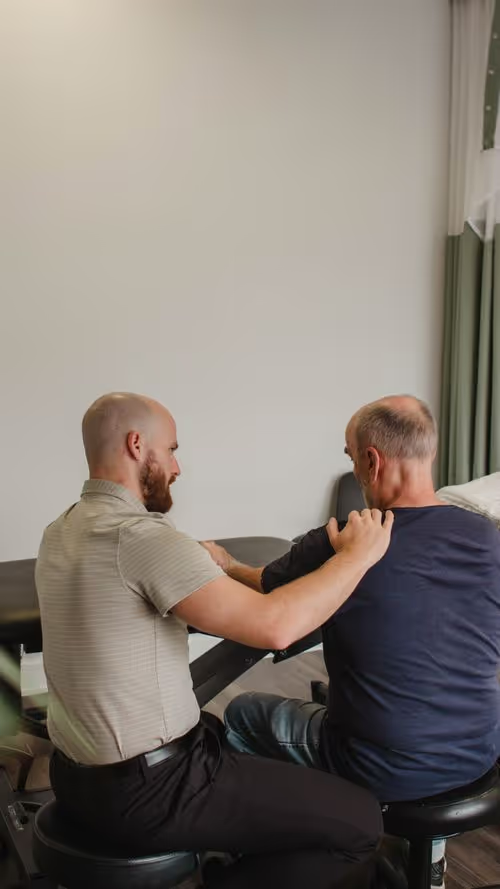
Comprehensive Physical Therapy Assessment
A comprehensive evaluation lasting about an hour to determine whether the pain is coming from a nerve, a tendon, or a joint.
We also analyze the factors contributing to the problem, such as work, sports, and past injuries.
You’ll leave with a clear understanding of your condition and the next steps.

Treatment, relief, education
Treatments that combine manual therapy and targeted exercises tailored to your condition
We tailor the treatment to your progress and your specific limitations.
You’ll know what to do between sessions to recover faster.

Relapse Prevention and Return to Activities
Once the pain has subsided, we’ll help you gradually resume your activities to prevent relapses, with a clear plan to maintain your progress.
You’ll be able to manage your condition on your own in the long term.
What many patients discover after a few sessions
Customer satisfaction is our top priority
At Physioactif, excellence guides everything we do, but our patients are the best ones to tell you about it. Take a look at their verified reviews to get a real sense of their experience.


Our Quality and Satisfaction Guarantees
We offer a three-pronged quality assurance approach: optimized treatment time, a second opinion from a physical therapist, and ongoing expertise to ensure effective care tailored to your needs.

Over 30 insurance plans accepted for physical therapy services
We handle the claim directly so you can focus your energy on your recovery, not on paperwork.









We offer a full range of healthcare services tailored to your individual needs. Whether you’re seeking treatment for a specific condition or looking to maintain your overall well-being, we’re here to help.
Our clinics
We have locations in several areas to better serve you.
Frequently Asked Questions About Physical Therapy
What are your rates for a consultation?
At Physioactif, our rates are $150 for the initial consultation, or $166 for a senior physical therapist. The initial consultation lasts about 60 minutes and allows the physical therapist to conduct a thorough assessment and establish a clear diagnosis. Follow-up consultations cost $110 or $119 for a senior physiotherapist. They are then tailored to your personalized treatment plan: exercises, manual therapy, advice, and education. We accept various payment methods and can provide you with the necessary receipts for your private insurance.
Physical Therapy Treatment: Find Out How It Works
It’s important to know that physical therapy treatments are tailored to each individual and their specific injury. First, the physical therapist will ask you about any changes you’ve noticed since your last appointment. The physical therapist will also check how you’ve been doing with your exercises. If necessary, the exercises will be modified, corrected, or progressed to ensure the best possible improvement in your condition. Next, the physical therapist will perform a few tests to reassess your condition. If your condition requires manual therapy, the physical therapist will treat your joints, muscles, or nerves. Finally, the physical therapist will check if you have any questions or concerns regarding your condition. Read this blog post for more details on how a treatment session unfolds.
Physical Therapy Assessment: Learn About the Physioactif Process
Before your evaluation begins, you will be asked to fill out a questionnaire about your overall health, including any medical conditions, past injuries, surgeries, and a list of medications you are taking. This will give the physical therapist a comprehensive understanding of your health and enable them to better assist you. During the evaluation, you will discuss your condition with the physical therapist. This will be followed by a physical assessment, which will lead to a diagnosis by the physical therapist. Afterward, a treatment plan will be developed in collaboration with the physical therapist. You will leave with your treatment plan sheet, which will also include the exercises you need to do at home. Read this blog post for more details on how the assessment works.
How can I tell if I'm receiving the right physical therapy?
As with any profession, the quality of physical therapy can vary greatly from one clinic to another. Here are a few key indicators to help you determine whether you are receiving high-quality physical therapy care:a. The physical therapist spends the entire duration of your appointment with you.b. You have a home exercise program tailored to your condition that you fully understand.c. You have received a diagnosis and can briefly explain the cause of your problem.d. You know what to do when you’re in pain to relieve it because your physical therapist has given you advice.e. During your appointments, you are not hooked up to electrotherapy devices.f. You have received a clearly defined treatment plan that has been personalized by the physical therapist.g. Other factors that may hinder recovery (stress, sleep, anxiety, worries, etc.) have been assessed and discussed with you.h. Your treatment is not exclusively passive; in other words, you are not just receiving manual therapy without a plan of exercises, advice, and education about your condition. Read this blog post for more details on what constitutes effective physical therapy care.
Physical therapy hasn't helped me in the past—is there still hope?
Yes, there is hope! Whether you’ve seen other physical therapists, osteopaths, chiropractors, acupuncturists, massage therapists, or other practitioners, you’ll find solutions with our physical therapists at Physioactif. We’re used to treating complex issues and helping people who haven’t seen results with other professionals. Thanks to this reputation, every week we see patients who come to us even after having consulted 3–4 other professionals who couldn’t resolve their problem. You’ll see from the very first meeting that care at Physioactif is different from what you’ve experienced elsewhere. From diagnosis to exercises and treatments, you’ll notice a difference with Physioactif compared to other professionals who have treated you in the past. We encourage you to come to us full of hope, because we can’t wait to help you!
Do you provide insurance coverage, and do you handle workplace and traffic accident claims?
Yes, your physical therapy treatments may be covered by your insurance. Most insurance plans cover part of the cost of physical therapy. To find out if this applies to you, contact your insurer or review the details of your insurance plan. During your appointment at the clinic, we will work with you to verify your coverage. If your pain is the result of a work-related accident, then the CNESST covers your physical therapy. To do so, you must first see a doctor and obtain a prescription for physical therapy from the doctor. If your pain is the result of a traffic accident, then the SAAQ covers your physical therapy. To do so, you must first see a doctor and obtain a prescription for physical therapy from the doctor.
I've been in pain for a long time—is it too late?
No, it’s never too late. No matter how long you’ve been dealing with your injury or pain, it’s always possible to improve your condition. In fact, studies show that the duration of your pain doesn’t prevent you from getting better. The majority of the clients we see are people who have been in pain for at least several months. So we’re very comfortable helping people who’ve been in pain for 6 months, 1 year, 5 years, and even 20 years! The most important thing is to start at the beginning—that means getting a physical therapy evaluation to get an accurate diagnosis. After that, you’ll work with your physical therapist to create a treatment plan to start getting better.
Can physical therapy help me?
Physical therapy treats injuries, pain, and discomfort related to bones, muscles, joints, vertebrae, tendons, ligaments, menisci, and nerves—in short, all the structures in the body that allow us to move. If you have pain or discomfort that bothers you or limits your activities, work, or leisure time, then physical therapy is the solution for you. Here are some examples of conditions that physical therapy can treat: back, neck, knee, and shoulder pain; headaches and migraines; jaw pain, concussions, dizziness and lightheadedness, urinary incontinence/prolapsed bladder/pain during sex, sprains, strains, tendonitis, stiff neck, whiplash, fractures, tears, sciatica, herniated discs, contusions, plantar fasciitis, osteoarthritis, arthritis, car accidents, workplace accidents, sports injuries.
What is the difference between an osteopath, a chiropractor, a physical therapist, a massage therapist, an acupuncturist, and a kinesiologist?
Osteopaths receive non-university training and make a diagnosis using their hands to palpate various parts of the body (organs, bones, muscles, etc.). Their approach is based on the belief that the body has the ability to heal itself and that manipulating organs, bones, and muscles can restore function to affected tissues. Physical therapists have a university education and make a diagnosis based on the history of the injury, the nature of the pain, and a physical examination. They then develop a treatment plan that includes specific exercises, advice on managing activities, postures, and sports, and apply manual therapy treatments as needed.Chiropractors have a university education and often make a diagnosis using X-rays of the spine or a joint, as well as their hands. The fundamental principle has been to use “chiropractic adjustments” to restore the electrical current in nerves that is blocked by joint misalignment. This approach is no longer as prevalent as it once was, since the scientific basis for this practice has been invalidated. The massage therapist has non-university training and uses various massage techniques to work on the muscles in order to reduce pain or stiffness. The acupuncturist has college-level training based on traditional Chinese medicine. Acupuncturists use techniques to stimulate an energy called “Qi,” often with needles, to restore energy flow and alleviate pain or treat illnesses.Kinesiologists have a university education and are health professionals specializing in training and physical activity. They use physical activity as a tool to improve physical abilities, prevent risk factors associated with a sedentary lifestyle, and optimize athletic or physical performance. For more details on the differences between these professionals, read this blog post
Do I need a prescription?
No. Anyone can see a physical therapist directly. All you need to do is call the clinic to make an appointment. You do not need to be evaluated by a doctor before starting physical therapy. Physical therapists are experts in assessing pain and do not need a doctor’s referral.However, some insurance companies that cover physical therapy expenses require a doctor’s prescription before reimbursing costs. If this applies to your insurance company, then you’ll need an appointment with a doctor and a prescription if you want to be reimbursed by your insurer. Check with your insurer to see if this applies to you.
How does physical therapy work?
Physical therapy is a medical discipline that helps improve your quality of life and enables you to return to your desired activities when you are in pain. This is achieved through exercises, guidance, lifestyle changes, and hands-on therapy. During the first appointment, the physical therapist conducts a comprehensive assessment of your condition, including a physical examination with tests and certain manipulations. Then, the physical therapist makes a diagnosis and works with you to develop a treatment plan to help you achieve your goals. The physical therapist will monitor your progress over a set period to optimize your recovery until your goals are met. During follow-up, exercises are often necessary to improve your condition, and these can be done at home. At the clinic, the physical therapist performs the necessary treatments and adjusts the treatment plan as needed to ensure proper healing of the injury.
Learn more about this treatment
Information about this treatment
Exercises for this condition
.jpg)
.jpg)
.jpg)
.jpg)
.jpg)
.jpg)
.jpg)
.jpg)
.jpg)
%20(1).jpg)
.jpg)
.jpg)
%20(1).jpg)
.jpg)
.jpg)
.jpg)
Make an appointment now