Initial Assessment
An assessment of the injury and its impact on your mobility, with a recovery goal agreed upon with you.
The physical aftereffects of a crime—such as pain, tension, or stiffness—shouldn’t dictate your daily life. IVAC Physical Therapy welcomes you into a safe environment, adapts to your condition and your pace, identifies the source of your pain, and then develops a clear treatment plan.


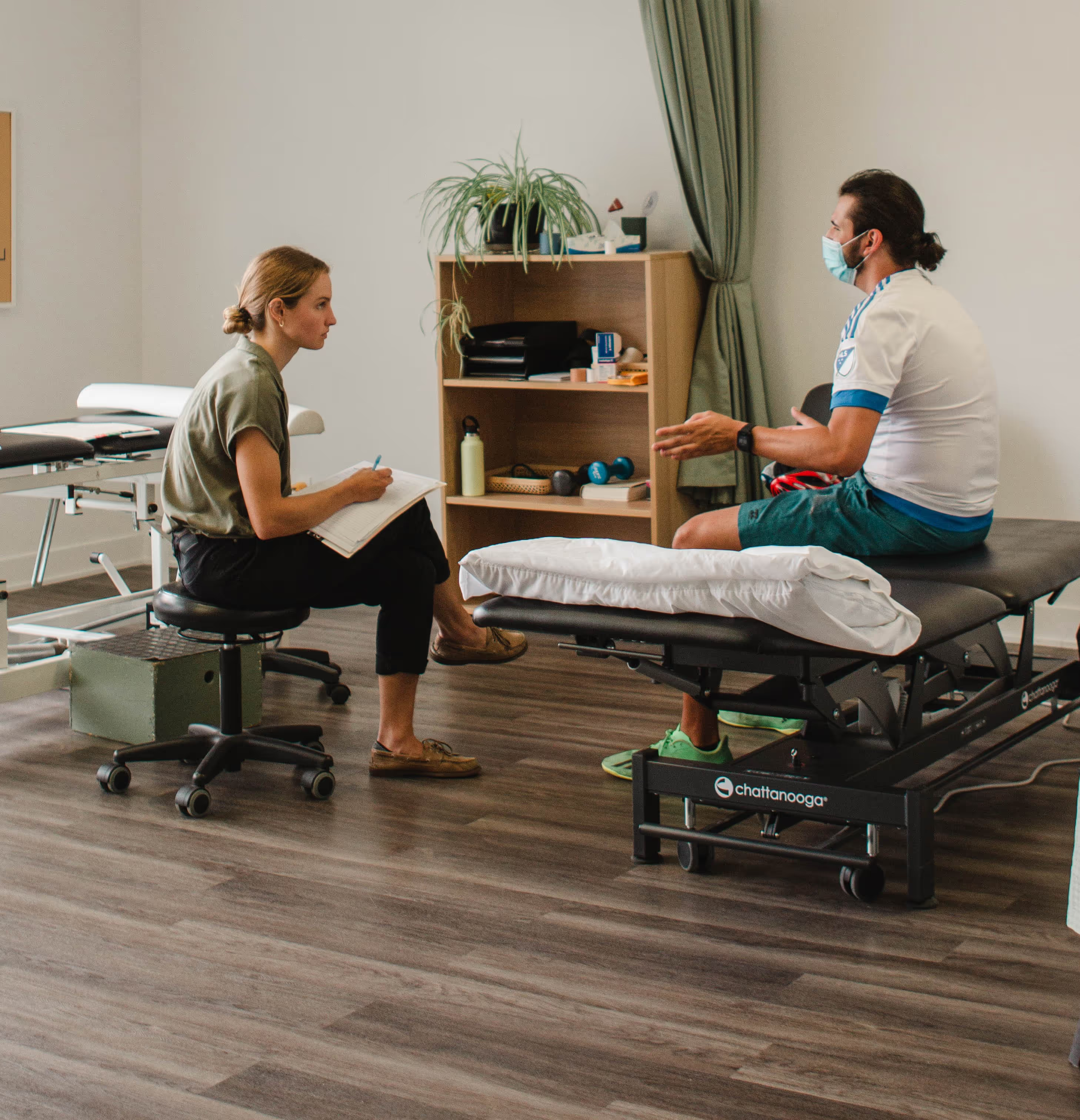

We begin your care with a thorough assessment of how the injury is affecting your mobility and function, whether it involves muscle pain, stiffness, or more severe impairments. This diagnosis serves as the foundation for a treatment plan with measurable goals. Three key approaches work together to relieve pain and restore movement:
This rigor stems from a team that teaches at the university, participates in conferences, and contributes to peer-reviewed research.
If previous attempts haven't made a difference, we'll go back to the root of the problem. From simple cases to complex issues, the plan adapts to your pace and your reality.

Manual therapy to release tense areas
Gradual rehabilitation of the affected structure
A Gradual Return to Your Activities
Each treatment plan follows four clear steps, from assessment to your return to your normal activities.
An assessment of the injury and its impact on your mobility, with a recovery goal agreed upon with you.
An approach tailored to your condition, with exercises tailored to your needs and a clear timeline, as part of the IVAC program.
Manual therapy, rehabilitation, and targeted techniques, tailored to your progress.
Goals to achieve before school resumes and a plan to build on what has been learned.
At Physioactif, excellence guides everything we do, but our patients are the best ones to tell you about it. Take a look at their verified reviews to get a real sense of their experience.


Medical care related to a criminal act may be covered by the Crime Victims Compensation Program (IVAC) once the claim is approved and linked to the incident. Physioactif assists you in filing the claim and explains the process. CNESST and SAAQ claims are also accepted, and coverage is supplemented by more than 30 private insurance providers.
We handle the claim directly so you can focus your energy on your recovery, not on paperwork.





Here's what sets our approach apart in the aftermath of a crime.
Recognized expertise: academic training, conference presentations, and peer-reviewed publications.
Measurable goals: Progress is assessed based on concrete benchmarks, beyond just pain.
Internal second opinion: A senior physical therapist reevaluates a persistent condition or a rehabilitation process that has stalled.
Convenient access: 6 clinics in the Greater Montreal area, a 4.9 out of 5 rating on Google, coverage by more than 30 insurance plans, and direct access without a referral.
We have locations in several areas to better serve you.
180 25th Avenue, Suite
201 Saint-Eustache
QC J7P 2V2
Located in Saint-Eustache, the Physioactif clinic is easily accessible to residents of the area and the surrounding communities
190 Bas-de-Sainte-Thérèse Road, Suite 110,
Blainville, Quebec
J7B 1A7
Located in Blainville, near Rosemère, the Physioactif clinic is easily accessible to residents of the area and the surrounding communities
3224 Jean-Béraud Ave., Suite 220, Laval,
QC H7T 2S4
Located in Chomedey, in the heart of Laval, the Physioactif clinic is easily accessible to people in the area
8801 Lajeunesse Street,
Montreal,
QC H2M 1R8
Located in Ahuntsic, near Villeray, the Physioactif clinic is easily accessible to residents of both neighborhoods

The initial consultation costs $150, or $166 with a senior physical therapist, and lasts approximately 60 minutes. It is used to make a diagnosis, identify the cause of your injury, and develop a treatment plan. Follow-up appointments cost $110, or $119 with a senior physical therapist, and the costs associated with an approved IVAC claim may be covered.
It treats muscle pain, stiffness, joint problems, and persistent pain following a significant event, including stress-related tension and more severe conditions. Physioactif also treats pain that persists after incomplete rehabilitation and pain that recurs despite treatment. Our physical therapists first identify the affected area, then tailor the treatment to your condition and your pace.
Pain that resists treatment often points to an underlying cause that has never been identified: the pain subsides before function is restored. Physioactif specializes in these types of situations and offers an in-house second opinion when previous rehabilitation has failed. Our physical therapists start from the assessment stage, drawing on the latest knowledge, to provide you with a meaningful plan and prevent relapses.
It all depends on the affected areas and when treatment begins, but many patients notice that certain symptoms begin to subside as early as the first few sessions. Early intervention remains the best way to prevent pain from becoming chronic. Physioactif works with you to set realistic goals, respects your pace, and then guides you through a gradual progression until you can resume your activities.
In Quebec, physical therapy is available through direct access: no referral is required to schedule an appointment at Physioactif. However, some private insurers may require a doctor’s prescription for reimbursement, so be sure to check the terms of your plan. Physioactif also accepts cases from the CNESST for work-related injuries and from the SAAQ for traffic accidents.
A physical therapist is a healthcare professional trained and supervised to assess, diagnose, and treat physical injuries resulting from a criminal act. As a member of the OPPQ, they identify the affected structure, develop a treatment plan, and set recovery milestones—an approach based on clinical assessment. Other approaches exist in Quebec, including occupational therapy for functional rehabilitation; Physioactif will guide you toward the care that best suits your condition.