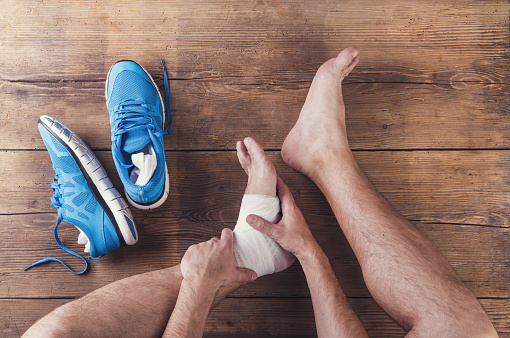


You’ve just been injured—whether it’s a sprained ankle, a pulled muscle, or another acute injury. You’re wondering what to do next. Heat or cold? Our article explains whether you should apply heat or cold. Rest or movement? Anti-inflammatories or not? These are common questions, and the answers have changed significantly in recent years.
An ankle sprain isn't always a minor injury. Even after initial treatment, up to 40% of people develop chronic ankle instability.1
Good news: Clinicians have proposed a simple mnemonic to guide first aid following a acute injury. Current recommendations favor a gradual return to activity tailored to the injury. What science teaches us about managing acute injuries:- Complete rest and prolonged immobilization are rarely necessary. A gradual return to movement is often recommended. For ankle sprains, a recent analysis of several studies found no clear difference between active treatment and immobilization in terms of pain or the ability to performdaily activities.², ³
- Inflammation is part of the body's response to an injury, but this fact alone does not determine the choice of medication.
- Ice can provide temporary pain relief for some people. It remains a comfort measure, as studies do not support the conclusion that it improves recovery4.
- Realistic expectations and clear information can help you gradually resume your activities.
This guide explains the PEACE and LOVE protocol step by step. For specific advice based on your injury, consult our guide on ankle sprains.
10 Quick Tips to Understand Your Pain
One tip a day for 10 days to help you better understand your pain. About a 2-minute read.
What is PEACE and LOVE?
PEACE and LOVE is a mnemonic that summarizes the recommended steps to take after an acute injury, such as a sprain or a strain5. You may be familiar with the older acronyms GREC, PRICE, RICE, or POLICE. PEACE and LOVE is a guideline developed by clinicians to guide care following an acute injury.
Why change the acronym?
Firstly, because science is constantly evolving, and recommendations must always be adjusted based on new studies. Secondly, because the old acronyms don't consider all the factors to manage when an injury occurs.
So, how do we concretely follow PEACE and LOVE?
We follow the PEACE and LOVE approach in alphabetical order: first, we apply PEACE during the initial days, then LOVE as activities resume.
The first step is PEACE. You start it right after you get injured. It focuses on the first few days following the injury.
P = Protection
The brace temporarily limits movements and activities that significantly worsen your symptoms. Pain, swelling, stability, and your ability to use the limb guide your progress.
Depending on the injury, crutches, an ankle brace, or a brace may help you during this phase.
After an ankle sprain, being able to walk without pain is not enough to rule out a fracture. Seek medical attention right away if you can’t take four steps, if a bone in your ankle or foot is very painful to the touch, if there is significant swelling, or if you have any doubts. Go to the emergency room if your ankle is misshapen, if you lose feeling in your foot or ankle, or if your foot becomes cold, blue, or gray.
Complete rest is generally not necessary. A short period of rest followed by a gradual return to activity helps limit the loss of mobility and strength.
A ligament is a band of tissue that connects two bones. For most ankle sprains, support and gradual exercise are the preferred treatments. For some severe sprains, a healthcare professional may recommend a short period of immobilization—often ten days or less—beforerehabilitation.¹, ⁶
Your symptoms and your ability to move should determine the duration of your protection, based on the advice of the professional evaluating you.
E = Elevation
When possible, elevate the injured area above the heart, especially when you are sitting or lying down. Why? This helps to reduce some of the swelling in certain tissues.
A = Avoid Anti-inflammatories
In PEACE, Point A advises against automatically using anti-inflammatory medications after an acute injury. While these medications can reduce pain and swelling in the short term, they carry risks, and their effect on healing remainsuncertain.¹, ²
The choice of medication depends on your pain, your health, and any other medications you are taking. Ask a pharmacist or doctor for advice before taking any medication.
Should you put ice on an acute injury?
Ice is optional after an acute injury. You can use it briefly if it relieves your pain, but you can also skip it if it doesn't help4.
C = Compression
You can use a compression bandage or adhesive tape—sometimes called taping—if it provides you with comfort or support. The evidence does not clearly show that compression reduces swelling or speeds up recovery7.
E = Education:
Education helps you understand the injury, choose an appropriate progression, and recognize the signs that indicate the need for an evaluation.
Avoid passive treatments that are of little use
- The evidence supports an active exercise program more than a strategy based primarily on electrotherapy, such as electrical stimulation or ultrasound1.
Avoid Unnecessary Tests
- The Ottawa Rules help a trained professional determine whether an X-ray is necessary after an ankle or foot injury8.
- The examination also takes into account your medical history, your symptoms, and the signs observed.
- An image may show changes that do not necessarily explain the pain. See our article on the role of medical imaging to learn more.
Avoiding Unnecessary Medications
- Medication can help relieve pain, but the right choice depends on your health, your other medications, and the injury. A pharmacist or doctor can advise you.
The second stage is LOVE. It is started gradually once the acute phase has passed, in the days following the injury. These stages should be supervised by a physical therapist. Here are the principles to follow:
L = Load
- We want to gradually reintroduce weight-bearing and movement to the injured area. Start moving the injured area and using the injured limb in your daily tasks without increasing the pain. For an ankle sprain, here's what to do Dealing with an Ankle Sprain step by step.
- As soon as the pain decreases, we must gradually resume our normal activities without increasing the pain too much.
- Good news: After a sprain, the pain usually subsides fairly quickly. It tends to decrease most noticeably in the two weeks following the injury.1
- A significant increase in pain, swelling, or discomfort at night when resuming activities is a sign that the dosage is too high or too fast.
O = Optimism
- Realistic expectations and a clear plan can help you participate in your rehabilitation. Confidence does not guarantee a faster recovery.
- It's common to feel anxious after an injury. Talk to your physical therapist to get explanations tailored to your situation.
V = Vascularization
- Light or moderate cardiovascular activity, tailored to your symptoms, helps maintain your physical fitness. The evidence does not show that it speeds up tissue healing.
- Depending on the affected limb, here are some examples of cardio activity to start with:
- Walking
- Use a stationary bike
- Run if you don't have pain
- Swim without pain
- Running in Water
- Going up/down stairs
- Dance at an intensity that leaves you slightly out of breath
- Jump rope
- Any other cardio activity that does not increase pain
- Start with a short, pain-free session, then gradually increase the duration based on your tolerance and physical condition.
For example, you can rest your injured ankle on a small bench next to a stationary bike and pedal with your other leg, as long as this position remains comfortable. This option allows you to build your endurance without putting any weight on your ankle.
E = Exercise
- Work with a physical therapist to regain your mobility, strength, balance, and control of movement.
- In physical therapy, a supervised exercise program is preferable to passive treatments. It helps the ankle regain its stability.1, 9
Is PEACE and LOVE good for all injuries?
PEACE and LOVE is not suitable for all injuries: it offers guidance for sudden muscle or ligament injuries following a specific incident. It does not replace the evaluation of a fracture or other serious injury, nor is it the primary treatment plan for overuse or gradual injuries.
In what situations should PEACE and LOVE be applied?
PEACE and LOVE is applied when a muscle or ligament injury occurs during a specific incident. Here are some examples:
- A sprained ankle.
- A muscle strain, such as a hamstring strain while running.
- A sprained wrist after falling onto my hand.
- A knee sprain caused by a fall or a sudden, awkward movement.
In what situations is “PEACE and LOVE” not the main approach to take?
"PEACE and LOVE" is not the primary approach to take when pain sets in without a specific injury or when the condition requires a different course of treatment. Here are some examples:
- Pain that developed gradually without any specific cause.
- Pain that started when I woke up, such as a very stiff back or neck.
- Shoulder pain that developed without any specific injury.
- A concussion, which requires an evaluation and advice specific to this injury.
- An overuse injury.
For more information specific to your injury, check out our guides onankle sprains,knee sprains,wrist sprains, and hamstring strains. You can also browse our pages on acute pain and pain in the wrist and hand.
Need professional advice?
Our physical therapists can assess your condition and provide you with a personalized treatment plan.
Make an appointmentSources
The sources for this article include the following recommendations and studies.
Links open in a new tab.
- Vuurberg G, Hoorntje A, Wink LM, van der Doelen BFW, van den Bekerom MP, Dekker R, et al. Diagnosis, treatment, and prevention of ankle sprains: update of an evidence-based clinical guideline. Br J Sports Med. 2018;52(15):956. (Back to sections: 1, 2, 3, 4, 5, 6)
- Doherty C, Bleakley C, Delahunt E, Holden S. Treatment and prevention of acute and recurrent ankle sprains: an overview of systematic reviews with meta-analysis. Br J Sports Med. 2017;51(2):113-125. (Back to sections: 1, 2)
- Vilchez-Cavazos F, Quiroga-Garza A, Acosta-Olivo CA, Rodríguez-Corpus LA, Espinosa-Uribe AG, Peña-Martínez VM, et al. Functional treatment versus immobilization for the management of acute ankle sprains: a systematic review and meta-analysis. J Bodyw Mov Ther. 2025;44:48-55. (Back to section: 1)
- van den Bekerom MP, Struijs PA, Blankevoort L, Welling L, van Dijk CN, Kerkhoffs GM. What is the evidence for rest, ice, compression, and elevation therapy in the treatment of ankle sprains in adults? J Athl Train. 2012;47(4):435-43. (Back to sections: 1, 2)
- Dubois B, Esculier JF. Soft-tissue injuries simply need PEACE and LOVE. Br J Sports Med. 2020;54(2):72-73. (Back to section: 1)
- Petersen W, Rembitzki IV, Koppenburg AG, Ellermann A, Liebau C, Brüggemann GP, et al. Treatment of acute ankle ligament injuries: a systematic review. Arch Orthop Trauma Surg. 2013;133(8):1129-41. (Back to section: 1)
- Borra V, Berry DC, Zideman D, Singletary E, De Buck E. Compression Wrapping for Acute Closed Extremity Joint Injuries: A Systematic Review. J Athl Train. 2020;55(8):789-800. (Back to section: 1)
- Beckenkamp PR, Lin CC, Macaskill P, Michaleff ZA, Maher CG, Moseley AM. Diagnostic accuracy of the Ottawa Ankle and Midfoot Rules: a systematic review with meta-analysis. Br J Sports Med. 2017;51(6):504-510. (Back to section: 1)
- Wagemans J, Bleakley C, Taeymans J, Schurz AP, Kuppens K, Baur H, et al. Exercise-based rehabilitation reduces reinjury following acute lateral ankle sprain: A systematic review update with meta-analysis. PLoS One. 2022;17(2):e0262023. (Back to section: 1)
Customer satisfaction is our top priority
At Physioactif, excellence guides everything we do, but our patients are the best ones to tell you about it. Take a look at their verified reviews to get a real sense of their experience.










Discover our physical therapy clinics
We have locations in several areas to better serve you.
Blainville
190 Bas-de-Sainte-Thérèse Road, Suite 110,
Blainville, Quebec
J7B 1A7
Located in Blainville, near Rosemère, the Physioactif clinic is easily accessible to residents of the area and the surrounding communities
Boucherville
690 Rue de Montbrun, Suite S,
Boucherville, Quebec
J4B 8H2
Located in Boucherville, the Physioactif clinic is easily accessible to people in the area
Laval
3224 Jean-Béraud Ave., Suite 220, Laval,
QC H7T 2S4
Located in Chomedey, in the heart of Laval, the Physioactif clinic is easily accessible to people in the area
Montreal
8801 Lajeunesse Street,
Montreal,
QC H2M 1R8
Located in Ahuntsic, near Villeray, the Physioactif clinic is easily accessible to residents of both neighborhoods
Saint-Eustache
180 25th Avenue, Suite
201 Saint-Eustache
QC J7P 2V2
Located in Saint-Eustache, the Physioactif clinic is easily accessible to residents of the area and the surrounding communities
Vaudreuil
21 Cité-des-Jeunes Boulevard, Suite 240,
Vaudreuil-Dorion, Quebec
J7V 0N3
Located in Vaudreuil-Dorion, the Physioactif clinic is easily accessible to people in the area
Make an appointment now