

If you're in pain, you might wonder whether to apply ice or heat. This question comes up constantly, and for good reason, as the answers you find are often contradictory. You might have heard that you should always put ice on an injury, only to read elsewhere that it's actually bad. This confusion is completely normal.
The choice depends on your situation. Heat and cold can provide temporary relief, but their effects vary depending on the pain and the individual.1, 2 A very sensitive area may not tolerate one or the other well. Stop any treatment that increases the pain. The precautions described below are still necessary, even if the sensation feels pleasant to you.
In 2010, Garra and his colleagues randomly assigned 60 adults with a recent muscle injury in the back or neck to two groups. All participants received ibuprofen, a medication for pain and inflammation. They then applied a hot or cold pack for 30 minutes. Pain decreased slightly in both groups, with no clear difference between them. Not all participants reported relief. The study does not allow us to distinguish the effect of the compresses from that of the medication.3
10 Quick Tips to Understand Your Pain
One tip a day for 10 days to help you better understand your pain. About a 2-minute read.
- Relief from a compress does not prove that the injury heals faster.
- Heat can provide comfort or a sense of relaxation; its benefits depend on the situation.
- Results on ice vary depending on the injury and how it is applied. Observations in rats are not sufficient to predict healing in humans.4, 5
- Your preference can guide your choice only if the app follows safety precautions.
This guide will help you choose between hot and cold based on your specific situation. To understand how to manage acute injuries, please consult our article on PEACE and LOVE.
Hot or cold: Is there a one-size-fits-all answer?
The choice between heat and cold depends on your type of pain, your tolerance, and the precautions you need to take. A compress can complement other methods of managing your pain at home. It is not a substitute for having a serious injury evaluated or for gradually resuming activities.
Gentle heat can help you feel comfortable or relaxed. Cold can also be used to provide temporary relief after certain injuries. If none of these options help, don’t push it. A reduction in pain alone does not mean the injury has healed.
The temperature measured at depth depends on the method of application. In a study of 21 uninjured students, a hot pack applied to the calf for 15 minutes increased muscle temperature by 3.8 °C at 1 cm and by 0.74 °C at 3 cm below the muscle surface.6 These measurements relate to temperature, not to pain relief or healing time. They do not describe the effect of cold on a joint.
What should you use for muscle pain—heat or cold?
Heat can help relieve certain types of muscle pain. For lower back pain lasting less than three months, a review of nine studies found that certain heat applications provided some short-term relief. The results do not prove the same benefit for all types of muscle pain.1
A stiff neck or painful muscle spasm may make you want to try heat. The goal is comfort or relaxation. Use gentle heat, with a towel between the heat source and your skin. For a regular heat pack, limit application to about 20 minutes and remove it sooner if it becomes uncomfortable. Never fall asleep with the heat pack on. Wait until your skin returns to its normal temperature before reapplying. Precautions for heat and ice.
Avoid applying heat to a fresh sprain or muscle strain, especially if the area is swollen. Recent muscle pain in the lower back is a different situation where gentle heat may provide relief. Tips based on the type of pain.
A 2025 study compared cold, hot, and lukewarm baths in 34 men following laboratory-induced muscle damage. Hot water reduced pain—measured by applying pressure to the muscle—compared to water at an intermediate temperature. No clear difference in strength recovery was observed between the groups. The prolonged, supervised baths in this study differ from a home compress; they do not constitute a protocol to be replicated at home. Human study by Dablainville and colleagues.
Should you apply ice to an acute injury, such as a sprained ankle?
Ice can provide relief after an ankle sprain, but it is not a complete treatment on its own. Research does not support the claim that a cold compress speeds up the healing of an injury that causes acute—that is, recent—pain.2, 7 Severe pain or pain that is getting worse requires evaluation, even if ice provides temporary relief.
After a sprained ankle, the concern that applying ice might slow down healing also warrants some qualification. In rats with a muscle contusion—that is, damage caused by a blow—ice modified certain inflammatory processes and left more muscle fibers still developing after 28 days. However, there was no clear difference in the surface area of the muscle fibers between the groups.4 A contusion induced in rats does not allow us to conclude that an ice pack slows the healing of a sprain in a person. The effects on tissue repair depend on the specific context being studied.5
The Collins review published in 2008 identified six human trials, four of which had significant limitations. Of the two highest-quality trials, one—which used a cooling gel—reported a benefit, while the other found no clear difference. Based on this body of evidence, it was not possible to draw a firm conclusion regarding improved recovery following a recent injury.2 Uncertain results do not mean that ice has no effect in all situations.
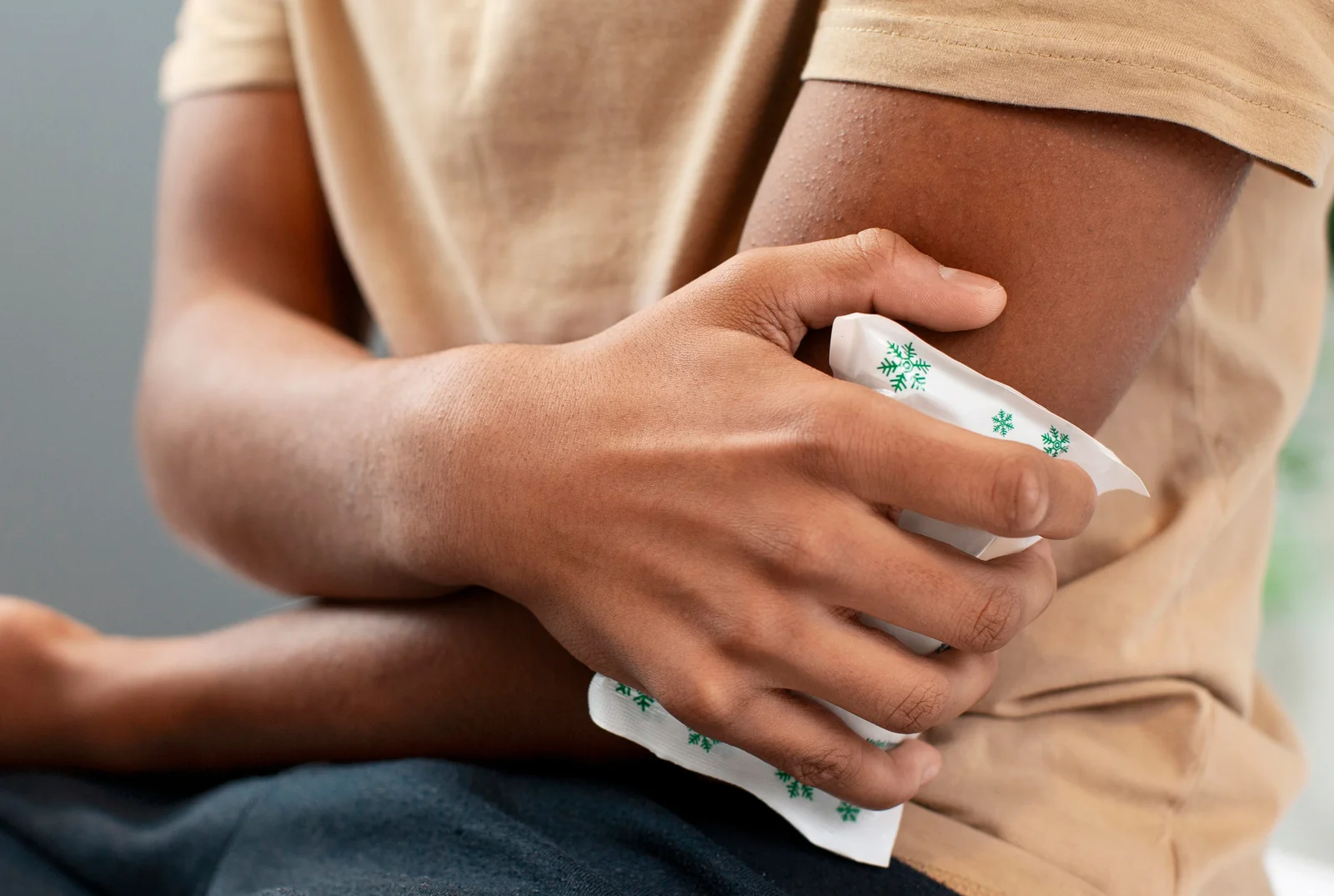
To apply cold: wrap an ice pack or a bag of frozen vegetables in a damp towel. Never apply it directly to the skin. For a small bony area such as the ankle, limit application to 10 to 15 minutes; a large muscular area can tolerate up to 20 minutes. Also follow the instructions on any commercial cold pack. Check the skin every five minutes and remove the pack sooner if you experience pain, blue discoloration, tender spots, or excessive numbness. Wait until the skin returns to its normal temperature before reapplying. Precautions for applying cold therapy.
Whether for heat or cold: Do not apply a compress to a wound. Sensitivity and blood circulation in the area must be normal. If you have reduced sensation or circulation issues, seek advice before using a compress. Do not fall asleep while using a compress. For children, seek age-appropriate advice and ensure adult supervision. Precautions common to all compresses.
The choice of a compress is based on three criteria:
- Relief from a compress does not guarantee that the injury will heal faster.
- Choose an option that helps you relax and suits your situation, while taking the necessary precautions.
- After a recent injury, first adjust any activities that worsen the pain. When you can resume movement depends on the injury and your tolerance; the compress is still a helpful supplement.
For ankle sprains, the guideline by Vuurberg and colleagues distinguishes between ice alone and treatments that combine multiple interventions. The evidence does not support the use of ice alone to improve pain at rest, swelling, or the ability to use the ankle. However, the guideline reports less swelling with cold therapy and exercises than with heat therapy and exercises in a small study of 30 people. It recommends appropriate exercises with ankle support as needed. Clinical guideline by Vuurberg and colleagues, 2018.
In a trial involving 101 people with mild or moderate sprains, adding exercises as early as the first week improved ankle function in weeks 1 and 2. Both groups received advice on ice and compression. No clear difference was observed in pain or swelling. This result supports the value of early, tailored exercises in this type of care; it does not rule out a benefit from ice. Trial by Bleakley and colleagues.
When should you see a doctor instead of continuing with compresses?
Severe pain or pain that worsens after an injury warrants prompt evaluation. An inability to put weight on the limb or difficulty walking more than a few steps also warrants a visit to the doctor. Seek medical attention as soon as possible if there is significant swelling or bruising—or if it is getting worse—if the affected area is stiff or difficult to move, if home care does not improve the condition, or if a high fever, an unusual sensation of heat or cold, or chills develop after the injury.
Go to the emergency room after an injury if you heard a popping sound, if the area is misshapen, if you feel numbness or tingling, or if the skin turns blue, gray, or cold. These signs may indicate an injury that requires further evaluation. Do not simply continue applying compresses while you wait. Signs that require evaluation after a sprain or muscle injury.
Need professional advice?
Our physical therapists can assess your condition and provide you with a personalized treatment plan.
Make an appointmentSources
Links open in a new tab.
- French SD, Cameron M, Walker BF, Reggars JW, Esterman AJ. Superficial heat or cold for low back pain. Cochrane Database Syst Rev. 2006;2006(1):CD004750. (Back to sections: 1, 2)
- Collins NC. Is ice right? Does cryotherapy improve outcomes for acute soft tissue injuries? Emerg Med J. 2008;25(2):65-8. (Back to sections: 1, 2, 3)
- Garra G, Singer AJ, Leno R, Taira BR, Gupta N, Mathaikutty B, et al. Heat or cold packs for neck and back strain: a randomized controlled trial of efficacy. Acad Emerg Med. 2010;17(5):484-9. (Back to section: 1)
- Singh DP, Barani Lonbani Z, Woodruff MA, Parker TJ, Steck R, Peake JM. Effects of Topical Icing on Inflammation, Angiogenesis, Revascularization, and Myofiber Regeneration in Skeletal Muscle Following Contusion Injury. Front Physiol. 2017;8:93. (Back to sections: 1, 2)
- Duchesne E, Dufresne SS, Dumont NA. Impact of Inflammation and Anti-inflammatory Modalities on Skeletal Muscle Healing: From Fundamental Research to the Clinic. Phys Ther. 2017;97(8):807-817. (Back to sections: 1, 2)
- Draper DO, Harris ST, Schulthies S, Durrant E, Knight KL, Ricard M. Hot-Pack and 1-MHz Ultrasound Treatments Have an Additive Effect on Muscle Temperature Increase. J Athl Train. 1998;33(1):21-4. (Back to section: 1)
- van den Bekerom MP, Struijs PA, Blankevoort L, Welling L, van Dijk CN, Kerkhoffs GM. What is the evidence for rest, ice, compression, and elevation therapy in the treatment of ankle sprains in adults? J Athl Train. 2012;47(4):435-43. (Back to section: 1)
- Vuurberg G, Hoorntje A, Wink LM, van der Doelen BFW, van den Bekerom MP, Dekker R, et al. Diagnosis, treatment, and prevention of ankle sprains: an update of an evidence-based clinical guideline. Br J Sports Med. 2018;52(15):956.
- Dubois B, Esculier JF. Soft-tissue injuries simply need PEACE and LOVE. Br J Sports Med. 2020;54(2):72-73.
Customer satisfaction is our top priority
At Physioactif, excellence guides everything we do, but our patients are the best ones to tell you about it. Take a look at their verified reviews to get a real sense of their experience.








Discover our physical therapy clinics
We have locations in several areas to better serve you.
Blainville
190 Bas-de-Sainte-Thérèse Road, Suite 110,
Blainville, Quebec
J7B 1A7
Located in Blainville, near Rosemère, the Physioactif clinic is easily accessible to residents of the area and the surrounding communities
Boucherville
690 Rue de Montbrun, Suite S,
Boucherville, Quebec
J4B 8H2
Located in Boucherville, the Physioactif clinic is easily accessible to people in the area
Laval
3224 Jean-Béraud Ave., Suite 220, Laval,
QC H7T 2S4
Located in Chomedey, in the heart of Laval, the Physioactif clinic is easily accessible to people in the area
Montreal
8801 Lajeunesse Street,
Montreal,
QC H2M 1R8
Located in Ahuntsic, near Villeray, the Physioactif clinic is easily accessible to residents of both neighborhoods
Saint-Eustache
180 25th Avenue, Suite
201 Saint-Eustache
QC J7P 2V2
Located in Saint-Eustache, the Physioactif clinic is easily accessible to residents of the area and the surrounding communities
Vaudreuil
21 Cité-des-Jeunes Boulevard, Suite 240,
Vaudreuil-Dorion, Quebec
J7V 0N3
Located in Vaudreuil-Dorion, the Physioactif clinic is easily accessible to people in the area
Make an appointment now