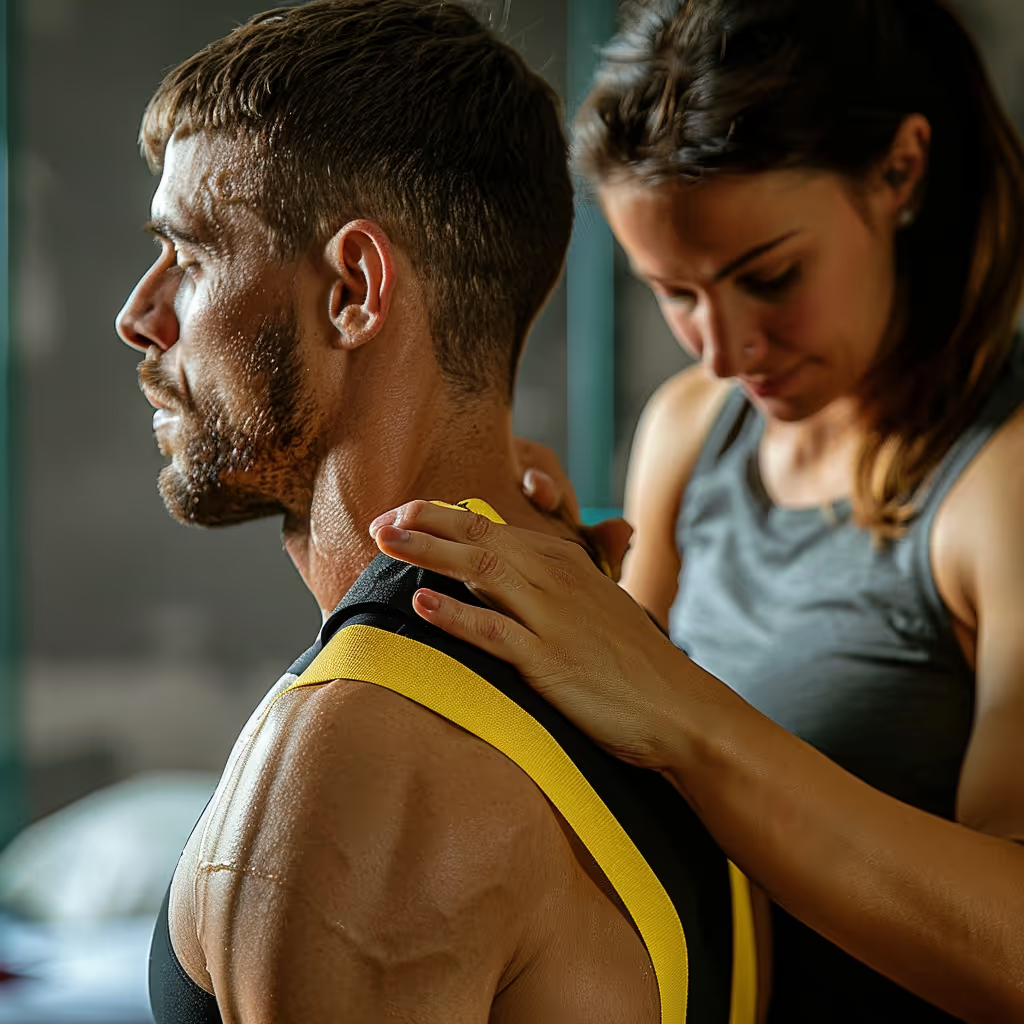


The shoulder allows the arm to move in many directions—for example, above the head, in front of the body, or behind the back. This mobility depends on several joints, muscles, tendons, and ligaments. Understanding their roles can help you better understand the explanations you receive during an evaluation, but anatomy alone does not determine the cause of pain or the appropriate treatment.
Why is the shoulder so mobile?
The shoulder allows for a wide range of motion thanks to the rounded head of the humerus—the upper arm bone—which articulates with a shallow socket in the shoulder blade called the glenoid cavity. The shape of the bones, the joint capsule, the ligaments, and the muscles all work together to provide mobility and stability.1, 2
Imagine a golf ball resting on a tee, the small stand used at the tee box. That’s what your shoulder looks like. The head of the humerus (the upper part of your arm bone) is a sphere that fits into the glenoid cavity of the shoulder blade. This cavity is shallow and small.
This configuration allows the arm to move in front of the body, to the side, behind, and in a circular motion. The range of motion—that is, the extent of possible movement—varies depending on the direction, the person, and the movement.
10 Quick Tips to Understand Your Pain
One tip a day for 10 days to help you better understand your pain. About a 2-minute read.
The shoulder joint is shallower than the hip joint. The joint capsule—a tissue sheath—along with the ligaments (bands of tissue that connect bones) and muscles, therefore help guide the head of the humerus. A physical therapy evaluation can assess your range of motion, strength, symptoms, and the activities that are important to you. It does not assume that your shoulder is unstable.
What joints make up the shoulder?
The joints of the shoulder are the glenohumeral joint, between the arm and the shoulder blade; the acromioclavicular joint, between the shoulder blade and the collarbone; and the sternoclavicular joint, between the collarbone and the sternum. The shoulder blade also glides over the rib cage: this is the scapulothoracic relationship. These coordinated movements allow the arm to move in multiple directions.3
The Glenohumeral Joint
The glenohumeral joint connects the head of the humerus to the glenoid cavity of the scapula. It works with the other joints and movements of the shoulder complex to help lift and rotate the arm.
A rim of fibrous cartilage called the labrum surrounds the glenoid cavity. This sturdy rim increases its depth and contributes to its stability.1 A labrum tear can occur, for example, during a dislocation, when the head of the humerus slips out of the socket. The severity of this tear depends on the symptoms, the physical examination, and the type of injury.
The capsule surrounds the joint and helps keep it stable. In adhesive capsulitis, also known as frozen shoulder, this capsule thickens and becomes stiffer. The degree of pain and loss of movement varies from person to person.4, 5
For frozen shoulder, a review of 32 trials compared exercises and manual therapy techniques, in which a practitioner mobilizes the joints or tissues with their hands. The programs varied widely; many of the comparisons remain inconclusive. The choice of techniques takes into account the available movements, your goals, and your measured progress.6
A trial involving 30 shoulders compared standard care with and without instrument-assisted tissue mobilization. After 12 sessions over four weeks, the group receiving this mobilization showed improvements in range of motion and certain movements. Pain and functional limitations also improved, but the trial did not establish a clear advantage between the groups for these two outcomes. These improvements do not demonstrate that the technique directly alters the joint capsule.7
Persistent shoulder pain can go hand in hand with disrupted sleep, limited activities, and emotional distress. This association does not prove that the pain causes each of these problems.8 Emotional well-being and mobility are distinct goals. Research on massage and anxiety focuses on the former, which can also be discussed during your treatment.9
The Acromioclavicular (AC) Joint
The acromion (part of the shoulder blade) connects to the collarbone. This small joint is located on top of your shoulder. You can feel it by following your collarbone to its end.
This joint helps the collarbone and shoulder blade move in coordination when you raise your arm.3 A fall directly onto the shoulder can cause an acromioclavicular sprain, which is an injury to the ligaments in that area.10 It can also fracture the end of the collarbone. A medical evaluation is used to distinguish between these injuries.
After a fall or impact, a dislocated shoulder or an inability to move the arm requires urgent medical evaluation. Support the arm in a comfortable position and do not attempt to reset the shoulder yourself. Schedule a physical therapy appointment immediately.11
The Sternoclavicular Joint
The clavicle connects to the sternum, the bone at the center of the thorax. The sternoclavicular joint is the main bony connection between the arm and the trunk skeleton12. It also moves during full arm elevation, when the clavicle rises, moves forward, and rotates backward3.
The Scapulothoracic Joint
The scapula glides over the rib cage. This gliding surface does not have the two cartilage-covered surfaces and joint capsule found in a joint such as that between the humerus and the scapula. Its movement depends, in particular, on the clavicle, the neighboring joints, the muscles, the position of the thorax, and the movement being performed.
The movement of the shoulder blade varies from person to person and depending on the movement performed. A review found scapular dyskinesia—that is, a variation in shoulder blade movement—in 48% of people without symptoms and 60% of people with symptoms. The studies used different measurement methods. Therefore, a variation is not automatically a problem or the cause of pain.13 A physical therapist can evaluate this in conjunction with your strength, symptoms, and activities to determine whether working on this movement might help address your difficulties.
What are the three main bones of the shoulder?
The shoulder is made up of three bones: the humerus (arm bone), the shoulder blade or scapula (a triangular bone in the back), and the clavicle (a horizontal bone in the front). These bones articulate with each other to form the shoulder complex.
The Humerus
The humerus is the long bone of the arm. Its rounded head forms the spherical part of the main joint. Just below it are two bony prominences: the greater tubercle, on the side, and the lesser tubercle, at the front. These prominences serve as attachment points for the tendons of the rotator cuff.
The Shoulder Blade (Scapula)
This is the flat, triangular bone in your back. It contains several important parts:
- The glenoid cavity: the shallow surface where the head of the humerus fits.
- The acromion: the bony projection that forms the roof of the shoulder.
- The coracoid process: a beak-shaped projection in the front.
The scapula rests against the rib cage and glides along it during arm movements. It is not directly connected to the spine by a bony joint. The clavicle, nearby joints, and several muscles contribute to its position and movement.
The Collarbone
It is the horizontal bone that runs from the sternum (in the center of the chest) to the acromion. You can easily feel it under the skin. The clavicle provides a bony support that keeps the arm away from the body.
These three bones form the foundation of the joint complex. The articular surfaces, the joint capsule, the ligaments, the muscles, and the tendons all work together to provide movement and stability. Here are some of the major muscles of the shoulder.
What is the rotator cuff, and what is its function?
The rotator cuff consists of four muscles that contribute to shoulder movement and stability. Their tendons surround part of the joint between the humerus and the scapula. These muscles are the supraspinatus, infraspinatus, teres minor, and subscapularis. They help rotate the arm and guide the humeral head in coordination with the joint capsule, ligaments, and other shoulder muscles.14, 15
The tendons, which connect muscles to bones, surround part of the head of the humerus and attach to the joint capsule. The rotator cuff muscles work with the deltoid and the muscles of the scapula to generate and guide movement.
The Supraspinatus
The supraspinatus originates from the depression located above the bony ridge of the scapula, called the supraspinous fossa. Its tendon passes under the acromion and attaches to the greater tubercle of the humerus. The muscle helps raise the arm and guide the head of the humerus. Changes in the tendons may be visible on imaging studies in people with or without symptoms.16 Changes in the bursa and the acromioclavicular joint can also occur without pain.17 The course of the supraspinatus muscle is therefore not sufficient to explain a rotator cuff tear or pain.
The Infraspinatus
The infraspinatus muscle is located in the depression beneath the bony ridge of the scapula, known as the infraspinatus fossa. Its tendon attaches to the greater tubercle of the humerus. The muscle helps with external rotation, which turns the arm outward.
The Teres Minor
This muscle works with the infraspinatus for external rotation. It is located just below the infraspinatus.
The Subscapularis
The subscapularis is located on the front of the scapula, between the scapula and the ribs. Its tendon attaches to the lesser tubercle of the humerus. The muscle helps with internal rotation, which turns the arm inward.
The four rotator cuff muscles work together to rotate and stabilize the humeral head while the deltoid and other muscles generate the movement. Their contribution varies depending on the angle, direction, and task.
Rotator cuff tendinopathy
Rotator cuff tendinopathy refers to a tendon problem associated with pain and difficulty performing certain movements, such as raising your arm. The healthcare professional will assess your symptoms, how they’ve progressed, your range of motion, and your strength. Several factors can contribute to the problem; a single instance of overuse or a tendon that is thought to be weak does not, on its own, explain it.18
The recommendations by Desmeules and his colleagues, published in 2025, propose an active exercise program as an initial treatment to reduce pain and difficulties with daily activities. The exercises can focus on movement control and strength, using appropriate resistance.19
A review of 22 trials published in 2024 compares different programs. Movement control exercises show a small benefit in terms of activity limitations, with no clear benefit for short-term pain compared to less specific exercises. The best choice for several other program characteristics remains uncertain. The physical therapist therefore tailors the exercises to your goals and your response.20
What Other Muscles Control Shoulder Movements?
The deltoid, trapezius, pectoralis major, and latissimus dorsi also contribute to shoulder movement. Together with the rotator cuff and several other muscles, they generate and guide movement in proportions that vary depending on the direction and task.
The Deltoid
This is the large muscle that forms the rounded shape of your shoulder. It has three parts: anterior (front), middle (side), and posterior (back).
The deltoid muscle plays a major role in raising the arm. Its action is coordinated with that of the rotator cuff, the shoulder blade muscles, the joint capsule, and the joints of the shoulder complex.
The Trapezius
The trapezius is a large muscle located close to the skin. It extends from the base of the skull and the neck vertebrae to the middle of the back, and then toward the collarbone and shoulder blade. Its various parts help orient and stabilize the shoulder blade. Their function varies depending on the movement of the arm and the other muscles involved.
The trapezius muscle may feel tender or tight, with or without neck or shoulder pain. Time spent at the computer alone is not enough to determine the cause; the evaluation takes into account posture, tasks, breaks, and other factors that affect the symptoms.
10 Quick Tips to Understand Your Pain
One tip a day for 10 days to help you better understand your pain. About a 2-minute read.
The Pectoralis Major
This large muscle at the front of the chest pulls the arm toward the front of the body and helps rotate it inward. Its length and role in the movement can be assessed, but a forward-tilted shoulder position alone does not prove that it is shortened.
The Latissimus Dorsi
This large back muscle brings the arm towards the body and backward. It also helps with internal rotation.
These muscles coordinate the movement of the arm and shoulder blade. An evaluation can measure strength, endurance, and range of motion as they relate to your symptoms and activities. A difference in results between one side and the other is not automatically the cause of the pain.
What is a subacromial bursa?
The subacromial bursa is a small sac filled with fluid that facilitates gliding between the rotator cuff tendons and the acromion.21 The shoulder contains several bursae; this one also extends laterally, beneath the deltoid muscle.
Bursitis is an inflammation of the bursa. A bursa may thicken or contain more fluid. These changes may accompany changes in the tendons, but they also occur in people who are pain-free. Studies do not show a consistent link between these imaging findings and symptoms, and their results remain highly uncertain.16, 17 Therefore, an imaging test alone cannot determine the source or severity of your pain.
The distances between the structures beneath the acromion change depending on the position of the arm and vary from person to person. Symptoms may also change with certain movements, when lying down, or when lifting weights. The evaluation examines these situations and the activities that cause you problems.
For pain related to the rotator cuff or the area under the acromion, the treatment plan may combine explanations, tailored exercises, and a temporary adjustment to your activities. Ice can be used for comfort if it provides relief. The healthcare professional will adjust the number and difficulty of the exercises based on your progress with movements and activities.
How does the shoulder combine mobility and stability?
The shoulder combines the mobility provided by its shallow socket with the stability provided by the muscles, tendons, joint capsule, and ligaments. Weakness or fatigue may be a factor in some people, but it does not automatically cause pain or instability.
Compare your shoulder to your hip. Both are ball-and-socket joints. The hip socket is deeper and covers a larger portion of the head of the femur than the glenoid cavity covers the head of the humerus. This shape contributes to the stability of the hip.
The glenoid cavity covers part of the head of the humerus. Stability is provided by the shape of the surfaces, the joint capsule, the ligaments, and the coordinated action of the muscles, including those of the rotator cuff. Their contribution varies depending on the position and the task.
For a long time, a model explained certain types of pain by positing that the head of the humerus moves upward, pinching the tendons and bursa beneath the acromion. This mechanism is called subacromial impingement. A review compared the distance between the acromion and the humerus in people with and without subacromial pain. At the measured positions, the review found no difference between the groups nor any consistent link between this distance, pain, and difficulties with daily activities. Therefore, impingement alone is not sufficient to explain a person’s symptoms.22
Raising your arm requires your muscles to lift its weight against gravity. This load is normal. Your tolerance depends on the activity, your current abilities, your symptoms, and your recovery. A tailored program can gradually build it up.
In a study of 420 pain-free volunteers aged 50 to 79, full-thickness tears of a rotator cuff tendon became more common with age.23 An imaging result alone is therefore not sufficient to predict symptoms or their progression. However, studies that followed individuals over time have linked the enlargement of certain tears to the onset of symptoms. The review summarizing these studies considers the overall evidence regarding the links between imaging findings and symptoms to be highly uncertain.16 Management combines useful imaging, symptoms, and steps you can take.
An active exercise program can help build strength, endurance, range of motion, and the ability to perform your daily activities according to your individual challenges. The choice of exercises does not imply that your bones are unstable or that a misalignment needs to be corrected. The physical therapist monitors your pain and your progress in the movements that are important to you.
Key takeaways about shoulder anatomy?
The shoulder combines a wide range of motion with stability provided by the articular surfaces, the joint capsule, the ligaments, the muscles, and the tendons. Their functions work in coordination throughout the joints of the shoulder complex.
The muscles of the deltoid contribute to the movement and guidance of the humeral head. Their action is coordinated with that of the deltoid, the scapular muscles, the joint capsule, the ligaments, and the articular surfaces.
The rotator cuff tendons and the bursa share the space beneath the acromion. The position of the arm affects this space, but its size alone does not explain the pain.
Understanding anatomy can help you follow the explanations and ask questions. The professional interprets changes in a tendon in relation to your symptoms and the movements you can perform. He or she selects exercises based on your goals and reassesses their effects.
These guidelines do not mean that there is something wrong with your shoulder, and they are not a substitute for an evaluation. They do not always identify a single cause for the pain. Your care plan takes into account your symptoms, activities, preferences, and observed progress.
To learn more about shoulder problems and treatment options, check out our comprehensive guide to shoulder pain. If you’re currently experiencing pain, find out what a physical therapy evaluation and treatment plan might involve.
Need professional advice?
Our physical therapists can assess your condition and provide you with a personalized treatment plan.
Make an appointmentReferences
Links open in a new tab.
- Almajed YA, Hall AC, Gillingwater TH, Alashkham A. Anatomical, functional, and biomechanical review of the glenoid labrum. J Anat. 2022;240(4):761-771. (Back to sections: 1, 2)
- Goetti P, Denard PJ, Collin P, Ibrahim M, Hoffmeyer P, Lädermann A. Shoulder biomechanics in normal and selected pathological conditions. EFORT Open Rev. 2020;5(8):508-518. (Back to section: 1)
- Perry NPJ, Omonullaeva NK, Bacevich BM, Nascimento RJ, O'Donnell EA, Price MD, et al. Anatomy and Biomechanics of the Acromioclavicular Joint: The Significance of Posterior Rotational and Translational Stability. Clin Sports Med. 2023;42(4):557-571. (Back to sections: 1, 2, 3)
- Fox AJS, Fox OJK, Schär MO, Chaudhury S, Warren RF, Rodeo SA. The glenohumeral ligaments: Superior, middle, and inferior: Anatomy, biomechanics, injury, and diagnosis. Clin Anat. 2021;34(2):283-296. (Back to section: 1)
- Le HV, Lee SJ, Nazarian A, Rodriguez EK. Adhesive capsulitis of the shoulder: a review of pathophysiology and current clinical treatments. Shoulder Elbow. 2017;9(2):75-84. (Back to section: 1)
- Page MJ, Green S, Kramer S, Johnston RV, McBain B, Chau M, et al. Manual therapy and exercise for adhesive capsulitis (frozen shoulder). Cochrane Database Syst Rev. 2014;2014(8):CD011275. (Back to section: 1)
- Aggarwal A, Saxena K, Palekar TJ, Rathi M. Instrument-assisted soft tissue mobilization in adhesive capsulitis: A randomized clinical trial. J Bodyw Mov Ther. 2021;26:435-442. (Back to section: 1)
- Cho CH, Jung SW, Park JY, Song KS, Yu KI. Is shoulder pain lasting three months or longer associated with depression, anxiety, and sleep disturbances? J Shoulder Elbow Surg. 2013;22(2):222-8. (Back to section: 1)
- Moyer, CA. Affective massage therapy. Int J Ther Massage Bodywork. 2008;1(2):3-5. (Back to section: 1)
- Nuber GW, Bowen MK. Acromioclavicular Joint Injuries and Distal Clavicle Fractures. J Am Acad Orthop Surg. 1997;5(1):11-18. (Back to section: 1)
- nhs.uk. Dislocated shoulder. 2017. (Back to section: 1)
- Epperson TN, Black AC, Varacallo MA. Anatomy, Shoulder and Upper Limb, Sternoclavicular Joint. StatPearls. 2023. (Back to section: 1)
- Salamh PA, Hanney WJ, Boles T, Holmes D, McMillan A, Wagner A, et al. Is It Time to Normalize Scapular Dyskinesis? The Incidence of Scapular Dyskinesis in Those With and Without Symptoms: A Systematic Review of the Literature. Int J Sports Phys Ther. 2023;V18(3):558-576. (Back to section: 1)
- Akhtar A, Richards J, Monga P. The biomechanics of the rotator cuff in health and disease—A narrative review. J Clin Orthop Trauma. 2021;18:150-156. (Back to section: 1)
- Escamilla RF, Yamashiro K, Paulos L, Andrews JR. Shoulder muscle activity and function in common shoulder rehabilitation exercises. Sports Med. 2009;39(8):663-85. (Back to section: 1)
- Tran G, Cowling P, Smith T, Bury J, Lucas A, Barr A, et al. What Imaging-Detected Pathologies Are Associated With Shoulder Symptoms and Their Persistence? A Systematic Literature Review. Arthritis Care Res (Hoboken). 2018;70(8):1169-1184. (Back to sections: 1, 2, 3)
- Ibounig T, Rämö L, Haas R, Jones M, Järvinen TLN, Taimela S, et al. Imaging abnormalities of the acromioclavicular joint and subacromial space are common in asymptomatic shoulders: a systematic review. J Orthop Surg Res. 2025;20(1):7. (Back to sections: 1, 2)
- Lewis JS. Rotator cuff tendinopathy. Br J Sports Med. 2009;43(4):236-41. (Back to section: 1)
- Desmeules F, Roy JS, Lafrance S, Charron M, Dubé MO, Dupuis F, et al. Rotator Cuff Tendinopathy: Diagnosis, Nonsurgical Medical Care, and Rehabilitation—A Clinical Practice Guideline. J Orthop Sports Phys Ther. 2025;55(4):235-274. (Back to section: 1)
- Lafrance S, Charron M, Dubé MO, Desmeules F, Roy JS, Juul-Kristensen B, et al. The Efficacy of Exercise Therapy for Rotator Cuff-Related Shoulder Pain According to the FITT Principle: A Systematic Review With Meta-analyses. J Orthop Sports Phys Ther. 2024;54(8):499-512. (Back to section: 1)
- Kennedy MS, Nicholson HD, Woodley SJ. Clinical anatomy of the subacromial and related shoulder bursae: A review of the literature. Clin Anat. 2017;30(2):213-226. (Back to section: 1)
- Park SW, Chen YT, Thompson L, Kjoenoe A, Juul-Kristensen B, Cavalheri V, et al. No relationship between the acromiohumeral distance and pain in adults with subacromial pain syndrome: a systematic review and meta-analysis. Sci Rep. 2020;10(1):20611. (Back to section: 1)
- Moosmayer S, Smith HJ, Tariq R, Larmo A. Prevalence and characteristics of asymptomatic rotator cuff tears: an ultrasonographic and clinical study. J Bone Joint Surg Br. 2009;91(2):196-200. (Back to section: 1)
Customer satisfaction is our top priority
At Physioactif, excellence guides everything we do, but our patients are the best ones to tell you about it. Take a look at their verified reviews to get a real sense of their experience.








Discover our physical therapy clinics
We have locations in several areas to better serve you.
Blainville
190 Bas-de-Sainte-Thérèse Road, Suite 110,
Blainville, Quebec
J7B 1A7
Located in Blainville, near Rosemère, the Physioactif clinic is easily accessible to residents of the area and the surrounding communities
Boucherville
690 Rue de Montbrun, Suite S,
Boucherville, Quebec
J4B 8H2
Located in Boucherville, the Physioactif clinic is easily accessible to people in the area
Laval
3224 Jean-Béraud Ave., Suite 220, Laval,
QC H7T 2S4
Located in Chomedey, in the heart of Laval, the Physioactif clinic is easily accessible to people in the area
Montreal
8801 Lajeunesse Street,
Montreal,
QC H2M 1R8
Located in Ahuntsic, near Villeray, the Physioactif clinic is easily accessible to residents of both neighborhoods
Saint-Eustache
180 25th Avenue, Suite
201 Saint-Eustache
QC J7P 2V2
Located in Saint-Eustache, the Physioactif clinic is easily accessible to residents of the area and the surrounding communities
Vaudreuil
21 Cité-des-Jeunes Boulevard, Suite 240,
Vaudreuil-Dorion, Quebec
J7V 0N3
Located in Vaudreuil-Dorion, the Physioactif clinic is easily accessible to people in the area
Make an appointment now