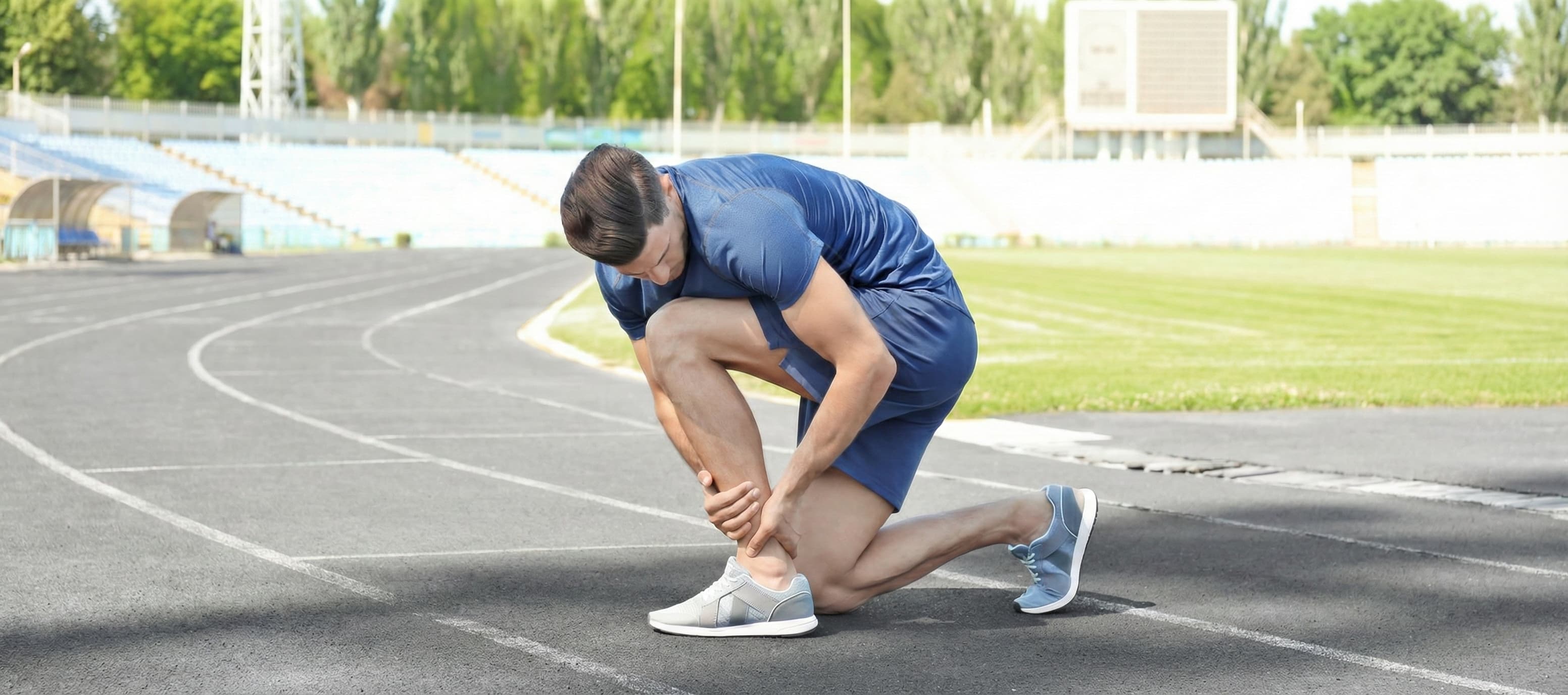

You get a cramp that stops you in the middle of your workout. You’ve been told to drink more water, eat bananas for potassium, and avoid lactic acid. You’ve tried everything, but the cramps keep coming back. It’s frustrating not to find a solution that really works.
Key takeaways: The mechanisms underlying exercise-induced cramps remain unclear. Neuromuscular fatigue appears to play an important role, though other factors cannot be ruled out.1 What science teaches us about muscle cramps:- In clinical practice, muscle fatigue is generally considered to be the primary trigger of cramps, rather than dehydration. Research has not yet confirmed this: the available data suggest a mechanism involving neuromuscular overload and fatigue, without ruling out other factors, and the exact cause remainsuncertain.², ³
- Lactic acid does not cause muscle soreness; that's a persistent myth.
- Proper recovery can help manage fatigue; no supplement prevents all cramps
- Hydration is still important, but dehydration does not account for all exercise-related cramps
This article debunks common beliefs about cramps and muscle soreness. To understand muscle pain in general, consult our article on overuse injuries.
10 Quick Tips to Understand Your Pain
One tip a day for 10 days to help you better understand your pain. About a 2-minute read.
Is muscle fatigue the real cause of cramps?
Muscle fatigue appears to contribute to exercise-related cramps, but it does not account for every case.
Exercise-related cramps can occur even when hydration and sodium levels are comparable to those of people who do not experience cramps. Neuromuscular fatigue remains a major explanation, but the exact cause has not been confirmed. One hypothesis is an imbalance in neural control: the signals that cause the muscle to contract may override those that promote relaxation.2
To learn more about the mechanisms of muscle pain, check out our comprehensive guide to muscle pain.
Lactic Acid: Friend or Foe?
Lactic acid does not cause the muscle soreness that follows exercise. Several substances produced by the muscle may collectively contribute to the burning sensation during intense exercise.
Lactic acid, on the other hand, is a substance produced by the muscles during intense physical exertion. Contrary to a persistent misconception, it does not directly cause post-exercise muscle pain (soreness)4. During intense exercise, several substances produced by the muscles can interact and contribute to the burning sensation.5 This burning sensation subsides quickly once exercise stops, unlike soreness, which sets in the next day and has a different cause.
Massage can provide short-term relief from muscle soreness: a systematic review notes that it reduces the intensity of muscle pain experienced in the days following intense exercise and helps restore strength to some extent6. It is a form of symptom management, not a curative treatment.6
If your muscle soreness persists and won't go away, our page on muscle pain explains what we treat at the clinic in this regard.
Is a lack of water the cause of cramps?
Dehydration alone does not explain exercise-related cramps.
Furthermore, water is essential for the proper functioning of the body, including the muscles. It accounts for a good half of body weight—though the proportion varies from person to person—and plays a key role in regulating vital functions. A significant lack of water impairs performance and makes physical exertion more difficult. It can therefore have an indirect effect by causing fatigue to set in more quickly. Among 210 triathletes monitored during an Ironman race, changes in weight and blood sodium levels did not distinguish between athletes who experienced cramps and those who did not: a shorter total race time and a history of cramps were the two factors independently associated with cramping. This study did not test whether drinking more water can relieve a cramp once it has occurred1. Dehydration alone is therefore not sufficient to explain exercise-related cramps.
How to Prevent Cramps?
In clinical practice, it is generally believed that reducing muscle fatigue—by allowing the body time to recover after exercise—helps prevent cramps. Research has not yet confirmed this specific approach: methods that delay exercise-induced fatigue are considered promising, but the exact cause of cramps and the best way to prevent them remain unclear, and no single strategy prevents all of them2.
A gradual increase in intensity, recovery periods, adequate hydration, and regular sleep can support your training. These measures do not guarantee that you will not experience cramps, since their causes and prevention vary from person to person.
If your cramps occur mainly during exercise, our article on sports physical therapy discusses how to prevent exercise-related injuries.
What are the sources for this article?
This article is based on an anatomy and physiology textbook and on scientific studies on exercise-related cramps and muscle soreness, which are listed here.
Links open in a new tab.
- Schwellnus MP, Drew N, Collins M. Increased running speed and a history of cramps, rather than dehydration or changes in serum sodium, predict exercise-associated muscle cramping: a prospective cohort study of 210 Ironman triathletes. Br J Sports Med. 2011;45(8):650-6. (Back to sections: 1, 2)
- Nelson NL, Churilla JR. A narrative review of exercise-associated muscle cramps: Factors contributing to neuromuscular fatigue and implications for management. Muscle Nerve. 2016;54(2):177-85. (Back to sections: 1, 2, 3)
- Giuriato G, Pedrinolla A, Schena F, Venturelli M. Muscle cramps: A comparison of the two leading hypotheses. J Electromyogr Kinesiol. 2018;41:89-95. (Back to section: 1)
- Schwane JA, Watrous BG, Johnson SR, Armstrong RB. Is Lactic Acid Related to Delayed-Onset Muscle Soreness? Phys Sportsmed. 1983;11(3):124-31. (Back to section: 1)
- Pollak KA, Swenson JD, Vanhaitsma TA, Hughen RW, Jo D, White AT, et al. Exogenously applied muscle metabolites synergistically evoke sensations of muscle fatigue and pain in human subjects. Exp Physiol. 2014;99(2):368-80. (Back to section: 1)
- Guo J, Li L, Gong Y, Zhu R, Xu J, Zou J, et al. Massage Alleviates Delayed-Onset Muscle Soreness after Strenuous Exercise: A Systematic Review and Meta-Analysis. Front Physiol. 2017;8:747. (Back to sections: 1, 2)
- McKinley, M. P., O'Loughlin, V. D., & Bidle, T. S. (2019). Anatomy and Physiology: An Integrated Approach (2nd ed.; French adaptation by M. Cordeau, M. Devito, M.-A. Laflamme, S. Morin, L. Tarini, and N. Trudel). Chenelière Éducation.
Customer satisfaction is our top priority
At Physioactif, excellence guides everything we do, but our patients are the best ones to tell you about it. Take a look at their verified reviews to get a real sense of their experience.










Discover our physical therapy clinics
We have locations in several areas to better serve you.
Blainville
190 Bas-de-Sainte-Thérèse Road, Suite 110,
Blainville, Quebec
J7B 1A7
Located in Blainville, near Rosemère, the Physioactif clinic is easily accessible to residents of the area and the surrounding communities
Boucherville
690 Rue de Montbrun, Suite S,
Boucherville, Quebec
J4B 8H2
Located in Boucherville, the Physioactif clinic is easily accessible to people in the area
Laval
3224 Jean-Béraud Ave., Suite 220, Laval,
QC H7T 2S4
Located in Chomedey, in the heart of Laval, the Physioactif clinic is easily accessible to people in the area
Montreal
8801 Lajeunesse Street,
Montreal,
QC H2M 1R8
Located in Ahuntsic, near Villeray, the Physioactif clinic is easily accessible to residents of both neighborhoods
Saint-Eustache
180 25th Avenue, Suite
201 Saint-Eustache
QC J7P 2V2
Located in Saint-Eustache, the Physioactif clinic is easily accessible to residents of the area and the surrounding communities
Vaudreuil
21 Cité-des-Jeunes Boulevard, Suite 240,
Vaudreuil-Dorion, Quebec
J7V 0N3
Located in Vaudreuil-Dorion, the Physioactif clinic is easily accessible to people in the area
Make an appointment now