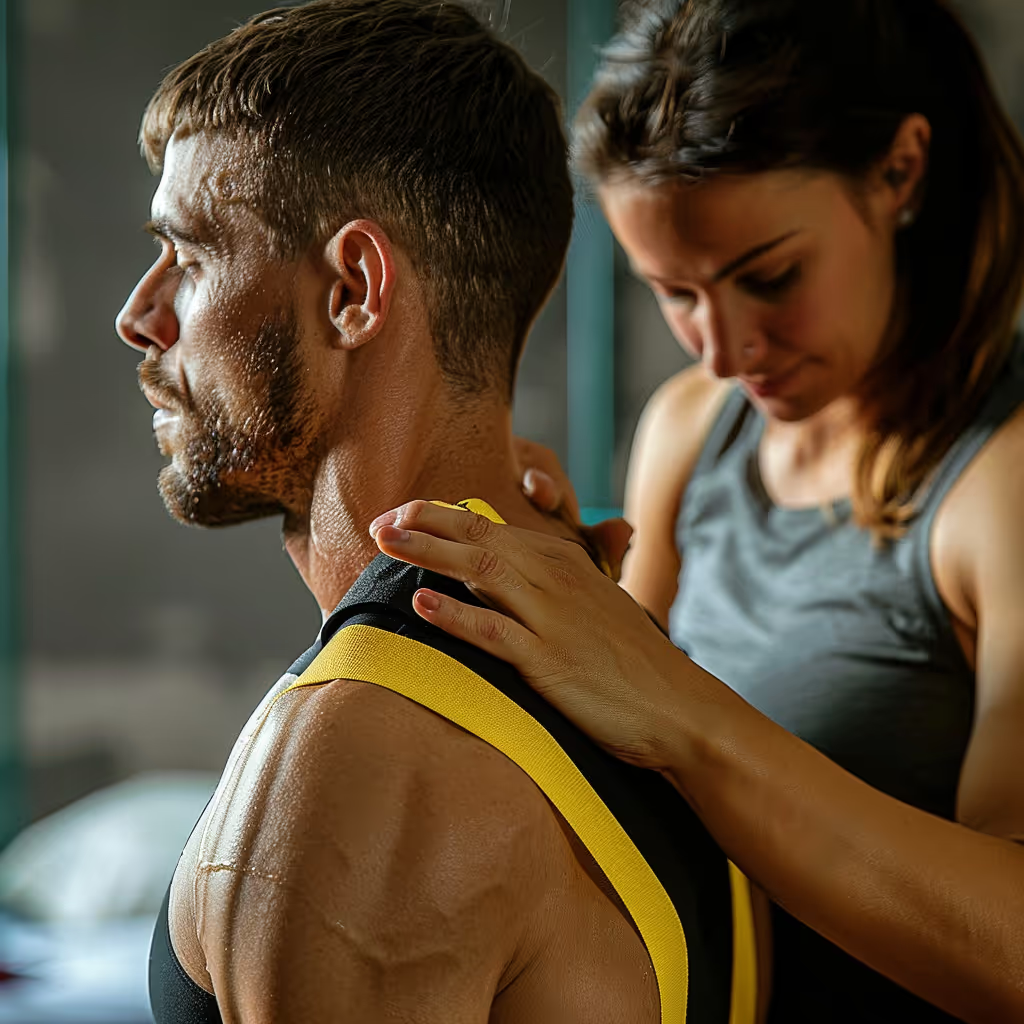


"I woke up Monday morning with a sore neck, but... I didn't do anything special during the night!?"
"I came back from my run, everything was fine, and a few hours later my ankle was stiff and painful, but I didn't fall?"
Do these situations sound familiar? Perhaps you or a family member has experienced something similar. Pain can occur without an accident or any obvious cause. An evaluation can help you understand what’s contributing to your symptoms.
10 Quick Tips to Understand Your Pain
One tip a day for 10 days to help you better understand your pain. About a 2-minute read.
What is the difference between an injury and pain?
An injury is damage to tissue, while pain is an unpleasant experience that is both physical and emotional. Damage can affect the skin, a muscle, a ligament, or other tissue. Pain may accompany an injury, but it can also exist without detectable damage. Its intensity does not directly reflect the extent of the damage.1
A bicycle fall can result in a scrape, a pulled muscle, or a sprain. These injuries can be painful. The inflammation that follows an injury helps repair the tissues but can also increase their sensitivity. However, the pain you feel depends on several factors, not just the injury itself.
Pain following an injury may subside over the course of days or weeks, but it does not always keep pace with the tissue’s healing process. Therefore, in some situations, an injury and pain are related, but they are not the same thing.
Some recent episodes of back pain improve quickly. In a 1994 study of 103 people whose pain had begun less than 72 hours earlier, 90% reported no further pain or limitations after two weeks.2 This finding applies specifically to this group. Persistent pain warrants an evaluation and a tailored treatment plan. Our comprehensive guide to back pain explains the different scenarios.
You may experience real pain even when no injury is found. The absence of a visible injury does not make your pain any less real.
A brief headache caused by eating something very cold is one example. This pain can be severe and disappear quickly once contact with the cold ceases. The classification of headaches describes this phenomenon.
This explanation does not apply to all headaches. A sudden, extremely severe headache—or one accompanied by weakness, confusion, or difficulty speaking—requires urgent evaluation. Warning signs associated with a headache should be taken seriously.
Pain often causes you to protect a certain part of your body, but it does not prove that a tissue is under too much strain. Your health, your emotions, and your life circumstances can influence this experience.1 Persistent pain can linger even after an injury has healed. Our guide to chronic pain explains these interactions.
How does an overuse injury occur?
An overuse injury can develop when the stress placed on tissue exceeds its ability to withstand it and recover. It can occur without a fall or a single impact. The duration, intensity, and repetition of activities, as well as recovery periods, all play a role. However, pain after activity does not necessarily confirm an injury: an evaluation distinguishes between a possible injury and other causes of pain.
If pain occurs during or after an activity, consider what has changed recently:
- A longer or more intense workout, with more jumps, twists, or exertion
- A physically demanding, unusual activity, such as spring cleaning, moving, or shoveling snow
- A position held for a long time, such as standing at a concert or sitting on a couch
- A change in office location, workstation, or task assignment
- Fewer breaks or rest periods between activities
In runners, the way forces increase with each step can also be studied. A review of thirteen studies compared individuals with and without a history of stress fractures. This type of fracture is associated with repeated stress. The studies focused on the tibia, one of the two bones in the lower leg, or on the bones of the foot. The rate at which vertical force increased differed between the groups, whereas the maximum force did not differ significantly.3 This association does not account for the causes of all running injuries. If injuries keep recurring, see “Why Do I Keep Getting Injured While Running?”
What factors predispose you to an overuse injury?
Inadequate recovery and significant fluctuations in training intensity are among the factors to consider regarding overuse injuries. Sleep may also play a role: a review of seven studies links consistently insufficient or poor-quality sleep to a higher incidence of sports injuries among adolescents. The findings are less clear when it comes to a single poor night’s sleep.4 This association does not prove that better sleep will prevent an injury.
Your healthcare provider may also ask you if certain aspects of your health or habits have changed. This information is used to tailor your care; it does not, on its own, indicate the cause of your pain.
- Illness
- Lack of sleep
- Change in diet
- More time spent sitting with very little movement
- A decline in physical fitness, for example, between summer and winter
- Frequent consumption of alcohol or tobacco
Pain in the front of the knee may occur during a period of intense training. In a study of 1,008 military recruits followed for twelve weeks, 8.75% sought medical attention for this problem.5 The study describes the frequency of this issue during training but does not identify a single cause. Our guide on pain in the front of the knee explains possible treatments.
How to control overuse pain?
Adjusting your activities and gradually resuming exercise can help manage pain caused by overuse. You can temporarily reduce the duration or intensity of tasks that worsen your symptoms, while continuing to perform movements that you can tolerate. Your physical therapist will then tailor the exercises and progression to your specific condition. Any new, severe, or worsening pain should be evaluated.
How do you determine the amount of force applied to the fabric?
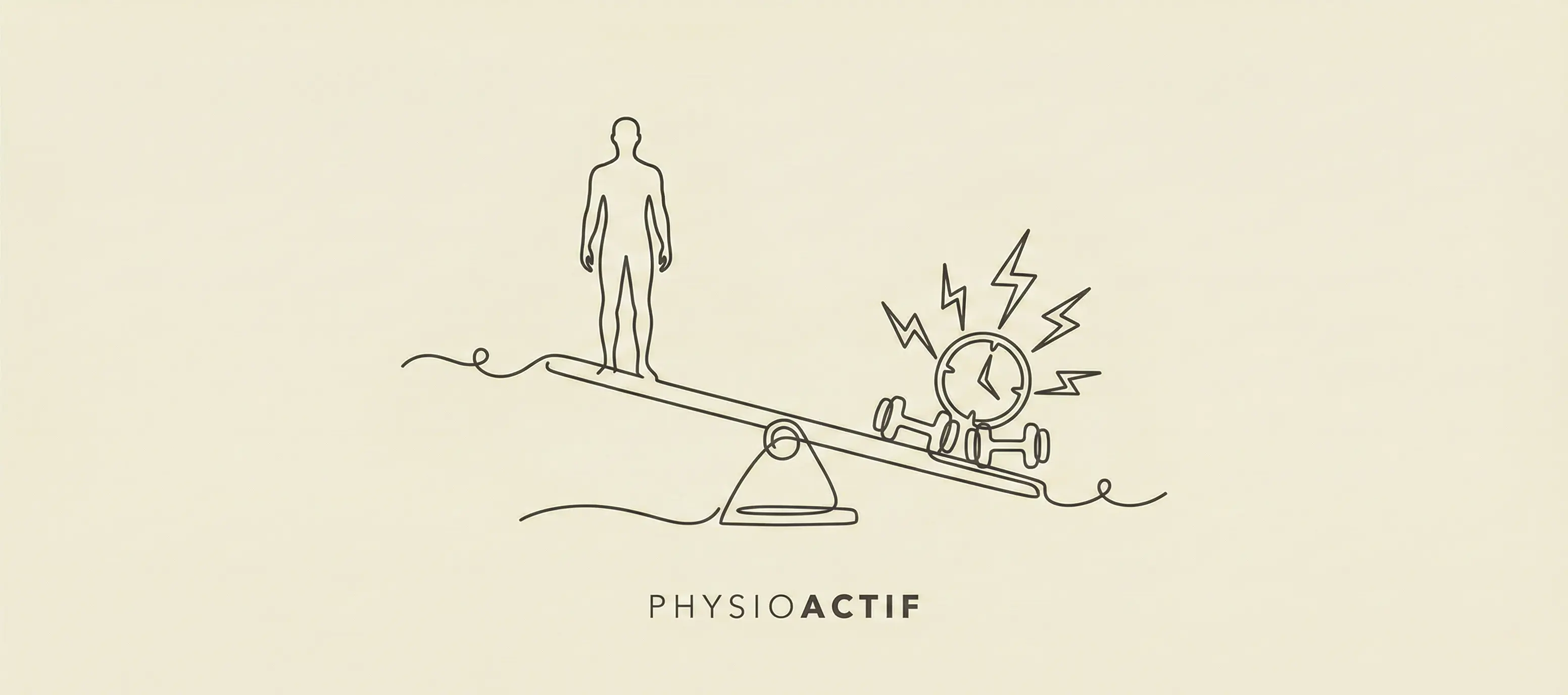
You can think of the day’s activities as expenses in a budget. A long run, work, and housework all add up. This analogy helps you organize your activities and breaks. It doesn’t allow you to measure a tissue’s resilience exactly, nor does it mean that pain indicates you’ve gone over budget. In particular, chronic pain can persist even without overexertion.
For pain around the kneecap—known as patellofemoral pain—exercises tailored to the knee and, in some cases, the hip, along with explanations, constitute the recommended standard of care. A 2024 clinical guideline supports this approach. Pain in the front of the knee, therefore, does not automatically lead to surgery.
The outcomes of a surgical procedure must be evaluated for each specific condition. A review of six trials, involving 277 participants and certain orthopedic procedures, found similar outcomes between actual surgery and simulated surgery, which replicates certain aspects of the procedure without performing the specific surgical maneuver being studied.6 The small number of studies and the diversity of procedures limit the generalizability of these findings. This result does not mean that all surgeries are unnecessary.
When you add a new activity, gradually increase its duration or difficulty based on how your body responds. For example, avoid suddenly turning a short, routine run into a very long run. A study of 5,205 runners found that runs significantly longer than the longest run in the previous 30 days were associated with more injuries. It does not define a guaranteed risk-free progression. Our article “How to Start Running Without Getting Injured” provides an example of a progression plan.
Platelet-rich plasma injections use a preparation derived from your own blood. The blood is processed to concentrate the platelets—small blood cells that help stop bleeding—and the preparation is then injected into the target area. A study published in the New England Journal of Medicine followed 80 athletes with hamstring injuries—the muscles at the back of the thigh. Both groups received the same rehabilitation. The group that received the plasma treatment did not return to sports any faster than the group that received an injection of saline solution without any active ingredient: in each group, half of the participants had returned to sports within 42 days.7 This finding applies to these specific recent muscle injuries and this particular protocol.
La Clinique du Coureur offers a tool to help understand the quantification of mechanical stress—that is, the measurement of the forces applied to tissues during physical activities.
Our guide explains what to do if you get injured while running.
Our tips on returning to sports after an injury will help you prepare to get back into it and reduce the risk of a recurrence.
Need professional advice?
Our physical therapists can assess your condition and provide you with a personalized treatment plan.
Make an appointmentReferences
Links open in a new tab.
- Raja SN, Carr DB, Cohen M, Finnerup NB, Flor H, Gibson S, et al. The revised International Association for the Study of Pain definition of pain: concepts, challenges, and compromises. Pain. 2020;161(9):1976-1982. (Back to sections: 1, 2)
- Coste J, Delecoeuillerie G, Cohen de Lara A, Le Parc JM, Paolaggi JB. Clinical course and prognostic factors in acute low back pain: an inception cohort study in primary care practice. BMJ. 1994;308(6928):577-80. (Back to section: 1)
- Zadpoor AA, Nikooyan AA. The relationship between lower-extremity stress fractures and ground reaction force: a systematic review. Clin Biomech (Bristol). 2011;26(1):23-8. (Back to section: 1)
- Gao B, Dwivedi S, Milewski MD, Cruz AI. Lack of Sleep and Sports Injuries in Adolescents: A Systematic Review and Meta-analysis. J Pediatr Orthop. 2019;39(5):e324-e333. (Back to section: 1)
- Wills AK, Ramasamy A, Ewins DJ, Etherington J. The incidence and occupational outcome of overuse anterior knee pain during army recruit training. J R Army Med Corps. 2004;150(4):264-9. (Back to section: 1)
- Louw A, Diener I, Fernández-de-Las-Peñas C, Puentedura EJ. Sham Surgery in Orthopedics: A Systematic Review of the Literature. Pain Med. 2017;18(4):736-750. (Back to section: 1)
- Reurink G, Goudswaard GJ, Moen MH, Weir A, Verhaar JA, Bierma-Zeinstra SM, et al. Platelet-rich plasma injections for acute muscle injury. N Engl J Med. 2014;370(26):2546-7. (Back to section: 1)
Customer satisfaction is our top priority
At Physioactif, excellence guides everything we do, but our patients are the best ones to tell you about it. Take a look at their verified reviews to get a real sense of their experience.










Discover our physical therapy clinics
We have locations in several areas to better serve you.
Blainville
190 Bas-de-Sainte-Thérèse Road, Suite 110,
Blainville, Quebec
J7B 1A7
Located in Blainville, near Rosemère, the Physioactif clinic is easily accessible to residents of the area and the surrounding communities
Boucherville
690 Rue de Montbrun, Suite S,
Boucherville, Quebec
J4B 8H2
Located in Boucherville, the Physioactif clinic is easily accessible to people in the area
Laval
3224 Jean-Béraud Ave., Suite 220, Laval,
QC H7T 2S4
Located in Chomedey, in the heart of Laval, the Physioactif clinic is easily accessible to people in the area
Montreal
8801 Lajeunesse Street,
Montreal,
QC H2M 1R8
Located in Ahuntsic, near Villeray, the Physioactif clinic is easily accessible to residents of both neighborhoods
Saint-Eustache
180 25th Avenue, Suite
201 Saint-Eustache
QC J7P 2V2
Located in Saint-Eustache, the Physioactif clinic is easily accessible to residents of the area and the surrounding communities
Vaudreuil
21 Cité-des-Jeunes Boulevard, Suite 240,
Vaudreuil-Dorion, Quebec
J7V 0N3
Located in Vaudreuil-Dorion, the Physioactif clinic is easily accessible to people in the area
Make an appointment now