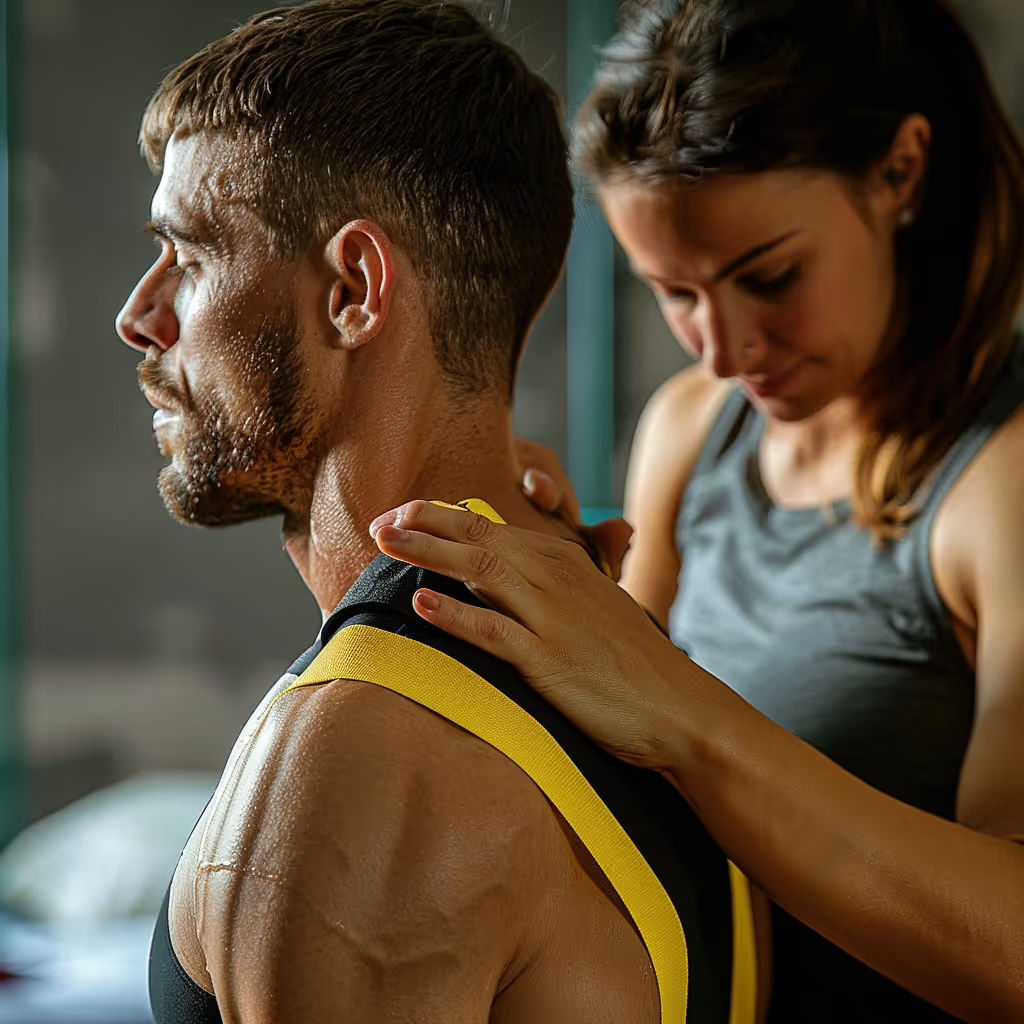


Repeated injuries can interrupt your training and make it difficult to get back on track. Tendon pain, periostitis, or knee pain warrants a proper evaluation. Recurring injuries do not mean that your body is incapable of running.
Several factors may be involved: Your injury history, training, and overall health help provide context for the situation. A review published in 2022 reports conflicting findings regarding the links between injuries and the distance, duration, frequency, or intensity of runs.1. None of these factors alone is sufficient to explain all the injuries. What science tells us about recurring injuries:- A 2025 study links a run that is more than 10% longer than the longest run in the previous 30 days to a higher incidence of overuse injuries. This observation does not prove the cause of the injuries and does not guarantee that a shorter run will prevent any injuries2.
- A change in terrain or season alters running conditions. You can note these changes when you review your training with your physical therapist.
- The frequency of your runs should take into account your schedule and recovery. The 2022 review does not provide a frequency that prevents injuries in all runners1.
- Sleep needs vary among athletes3. Diet has also been studied: a 2025 review links lower energy intake to more injuries among adult female long-distance runners4.
This article helps you identify the circumstances surrounding your recurring injuries. For guidance on managing an active injury, see our guide, “What to Do About a Running Injury.”
10 Quick Tips to Understand Your Pain
One tip a day for 10 days to help you better understand your pain. About a 2-minute read.
Why do I always get injured when I run?
Recurrent running injuries may be influenced by several factors, including previous injuries and changes in training. A previous injury is associated with a higher risk of a new injury among adult runners5. This association does not mean that a new injury is inevitable.
The physical therapist assesses the progression of your symptoms and any lingering issues following an injury. For young runners, recommendations also take into account growth, nutrition, and overall health6. To prepare for your return to running, check out our guidelines for returning to sports after an injury.
What should I do if I keep getting injured while running?
If you frequently get injured while running, a physical therapist can assess your injuries and help you adjust your training. They will evaluate your symptoms, activities, and progress. In this context, “mechanical stress” refers to the forces exerted on the body during movement; the plan aims to tailor these forces to your specific situation.
You can prepare for the assessment by answering the following questions:
- Have I recently increased the duration, distance, speed, or number of my runs?
- Have I changed my running surface or conditions—for example, by switching from a treadmill to the road, the mountains, or snow?
- Do I do most of my outings on the weekend?
These questions help describe your training routine. They cannot, on their own, determine the cause of an injury. The physical therapist interprets them in conjunction with your physical exam and medical history.
A significant increase in the distance of a run can contribute to the risk of overuse injuries2. You can discuss recent changes without assuming that you’ve mismanaged your training.
How do I manage my mechanical stress while running?
You can manage your physical stress by adjusting the duration, distance, speed, and frequency of your workouts based on your abilities and symptoms. Changing one factor at a time makes it easier to observe your body’s response. Your physical therapist will help you choose a progression plan based on your injury and your goals.
La Clinique Du Coureur offers an educational tool for quantifying mechanical stress. You can use it to prepare for a discussion about your activities and your return to training.
The choice of running shoes and adjustments to running technique depend on your comfort and the specific issue being addressed. For certain bone injuries, experts suggest evaluating your stride as part of the treatment options7. This does not mean that all runners need to change the way they run.
A physical therapist who specializes in treating running injuries can help you develop a personalized plan. If a bone injury is suspected, a medical evaluation may be necessary before resumingrunning7, 8.
If you're starting from scratch or getting back into running after a long break, check out our tips on how to start running without getting injured.
Does running damage my knees and bones?
Running is not associated with an increase in knee osteoarthritis in a 2023 review focusing on short-term follow-up, but it can causebone overload injuries⁹, ⁷. These injuries occur when the bone can no longer repair the damage caused by repeated stress. They can range from a stress reaction to a fracture; treatment and recovery depend on their severity and location.
Bone health depends, in particular, on an adequate intake of energy and nutrients, including calcium and vitamin D8. A diet that does not provide enough calories to meet the energy demands of exercise can be detrimental to the health of athletes, both men and women10. A registered dietitian-nutritionist can assess your needs; a supplement is not automatically necessary.
Research on running and osteoarthritis does not promise lifelong protection. The 2017 review reported mixed results11; the 2023 review is reassuring regarding the symptoms and signs of osteoarthritis during the follow-up period9. We discuss this issue in detail in “Does Running Cause Osteoarthritis?”
Where can I find more information on injury prevention?
You can find more information in Episode 1 of the “Parle-moi de santé” podcast, which focuses on running with Blaise Dubois. The YouTube link below takes you to the episode.
Get your questions ready: Make a note of your past injuries, your recent activities, and the activities you'd like to resume. This information will help guide your discussion with your physical therapist.Episode #1: Prevention and treatment of running injuries.
Watch the episode on YouTube.
You can schedule an appointment to discuss your injuries and develop a return-to-play plan tailored to your situation.
Need professional advice?
Our physical therapists can assess your condition and provide you with a personalized treatment plan.
Make an appointmentSources:
Links open in a new tab.
- Fredette A, Roy JS, Perreault K, Dupuis F, Napier C, Esculier JF. The Association Between Running Injuries and Training Parameters: A Systematic Review. J Athl Train. 2022;57(7):650-671. (Back to sections: 1, 2)
- Schuster Brandt Frandsen J, Hulme A, Parner ET, Møller M, Lindman I, Abrahamson J, et al. How much running is too much? Identifying high-risk running sessions in a 5,200-person cohort study. Br J Sports Med. 2025;59(17):1203-1210. (Back to sections: 1, 2)
- Walsh NP, Halson SL, Sargent C, Roach GD, Nédélec M, Gupta L, et al. Sleep and the athlete: narrative review and 2021 expert consensus recommendations. Br J Sports Med. 2020. (Back to section: 1)
- Colebatch EA, Fuller JT, Mantzioris E, Hill AM. Diet, risk of disordered eating, and running-related injury in adult distance runners: A systematic review and meta-analysis of prospective cohort studies. J Sci Med Sport. 2025;28(7):542-552. (Back to section: 1)
- van der Worp MP, ten Haaf DS, van Cingel R, de Wijer A, Nijhuis-van der Sanden MW, Staal JB. Injuries in runners: a systematic review of risk factors and sex differences. PLoS One. 2015;10(2):e0114937. (Back to section: 1)
- Krabak BJ, Roberts WO, Tenforde AS, Ackerman KE, Adami PE, Baggish AL, et al. Youth Running Consensus Statement: Minimizing the Risk of Injury and Illness in Youth Runners. Br J Sports Med. 2021;55(6):305-318. (Back to section: 1)
- Warden SJ, Davis IS, Fredericson M. Management and prevention of bone stress injuries in long-distance runners. J Orthop Sports Phys Ther. 2014;44(10):749-65. (Back to sections: 1, 2, 3)
- Tenforde AS, Kraus E, Fredericson M. Bone Stress Injuries in Runners. Phys Med Rehabil Clin N Am. 2016;27(1):139-49. (Back to sections: 1, 2)
- Dhillon J, Kraeutler MJ, Belk JW, Scillia AJ, McCarty EC, Ansah-Twum JK, et al. Effects of Running on the Development of Knee Osteoarthritis: An Updated Systematic Review at Short-Term Follow-up. Orthop J Sports Med. 2023;11(3):23259671231152900. (Back to sections: 1, 2)
- Mountjoy M, Ackerman KE, Bailey DM, Burke LM, Constantini N, Hackney AC, et al. 2023 International Olympic Committee (IOC) Consensus Statement on Relative Energy Deficiency in Sport (REDs). Br J Sports Med. 2023;57(17):1073-1097. (Back to section: 1)
- Timmins KA, Leech RD, Batt ME, Edwards KL. Running and Knee Osteoarthritis: A Systematic Review and Meta-analysis. Am J Sports Med. 2017;45(6):1447-1457. (Back to section: 1)
- van Gent RN, Siem D, van Middelkoop M, van Os AG, Bierma-Zeinstra SM, Koes BW. Incidence and determinants of lower extremity running injuries in long-distance runners: a systematic review. Br J Sports Med. 2007;41(8):469-80; discussion 480.
Customer satisfaction is our top priority
At Physioactif, excellence guides everything we do, but our patients are the best ones to tell you about it. Take a look at their verified reviews to get a real sense of their experience.






Discover our physical therapy clinics
We have locations in several areas to better serve you.
Blainville
190 Bas-de-Sainte-Thérèse Road, Suite 110,
Blainville, Quebec
J7B 1A7
Located in Blainville, near Rosemère, the Physioactif clinic is easily accessible to residents of the area and the surrounding communities
Boucherville
690 Rue de Montbrun, Suite S,
Boucherville, Quebec
J4B 8H2
Located in Boucherville, the Physioactif clinic is easily accessible to people in the area
Laval
3224 Jean-Béraud Ave., Suite 220, Laval,
QC H7T 2S4
Located in Chomedey, in the heart of Laval, the Physioactif clinic is easily accessible to people in the area
Montreal
8801 Lajeunesse Street,
Montreal,
QC H2M 1R8
Located in Ahuntsic, near Villeray, the Physioactif clinic is easily accessible to residents of both neighborhoods
Saint-Eustache
180 25th Avenue, Suite
201 Saint-Eustache
QC J7P 2V2
Located in Saint-Eustache, the Physioactif clinic is easily accessible to residents of the area and the surrounding communities
Vaudreuil
21 Cité-des-Jeunes Boulevard, Suite 240,
Vaudreuil-Dorion, Quebec
J7V 0N3
Located in Vaudreuil-Dorion, the Physioactif clinic is easily accessible to people in the area
Make an appointment now