

During your physical therapy evaluation, your physical therapist provided you with a plan tailored to your condition and goals. This plan may include two, three, four, or eight sessions, depending on your needs.
Your physical therapist has probably given you advice and exercises to do at home. This article explains what happens during follow-up appointments.
10 Quick Tips to Understand Your Pain
One tip a day for 10 days to help you better understand your pain. About a 2-minute read.
What does a physiotherapy treatment at Physioactif involve?
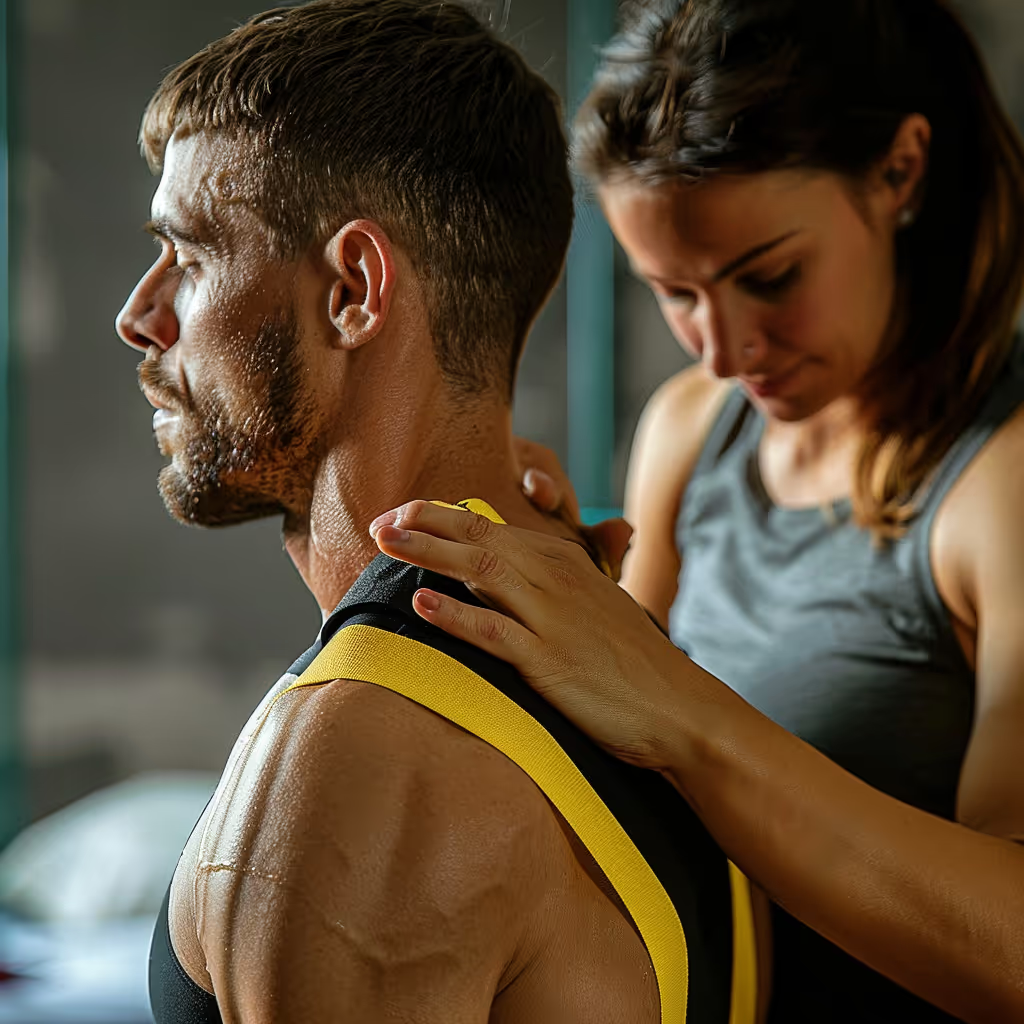
A physical therapy session at Physioactif includes a consultation, a reassessment, tailored exercises, and, if necessary, manual therapy. Your physical therapist will also answer your questions.
Your physical therapist tailors each session to your needs and your progress. An appointment typically includes the following steps.
Discussion of the condition's evolution since the last session
Your physical therapist will ask you what changes you've noticed since your last appointment. The discussion will focus on your activities, pain, sleep, and movement. It also helps track your progress toward your goals.
Review, correction, and progression of exercises to do at home
Your physical therapist checks to see how your at-home exercises are going. If necessary, they’ll correct your movements or gradually increase the difficulty of the exercises. They’ll tailor the progression to your condition.
For recent back pain with no specific cause, continuing your normal activities within the limits of the pain may help. In one study, this approach led to a faster recovery than bed rest.1
Brief re-evaluation of the condition by performing different movements or specific tests
Your physical therapist will repeat certain tests or movements to compare your condition to that in previous sessions. These results allow him or her to adjust your treatment plan.
Pain does not always correspond to changes visible on imaging. People without pain may also have changes in their back, neck, or knee. Your physical therapist therefore interprets the images in light of your symptoms and your physical examination.2, 3, 4, 5
Treatment of joints, muscles, or nerves if necessary
Your physical therapist may use manual therapy to relieve pain and make it easier for you to move. He or she will choose the techniques based on your condition and your response to treatment.
For persistent lower back pain, spinal manipulation may slightly improve the ability to perform daily activities after one month. Its effectiveness in relieving pain is minimal or nonexistent compared to other nonsurgical treatments. The certainty of these results is low.6
For neck pain, combining manual therapy and exercises may provide better short-term relief than exercises alone. This benefit is not clearly sustained in the long term.7
All of our physical therapists have advanced training in manual therapy and nerve treatment.
Answers to all questions or concerns related to the condition
Your physical therapist takes the time to discuss your questions and concerns at each session. You can tell them what reassures you, what worries you, and what you expect from the treatment.
Among workers with persistent back pain, expectations of recovery were associated with a return to work.8 This association does not mean that your expectations alone determine your recovery.
References
Links open in a new tab.
- Malmivaara A, Häkkinen U, Aro T, Heinrichs ML, Koskenniemi L, Kuosma E, et al. The treatment of acute low back pain—bed rest, exercises, or ordinary activity? N Engl J Med. 1995;332(6):351-5. (Back to section: 1)
- Brinjikji W, Luetmer PH, Comstock B, Bresnahan BW, Chen LE, Deyo RA, et al. Systematic literature review of imaging features of spinal degeneration in asymptomatic populations. AJNR Am J Neuroradiol. 2015;36(4):811-6. (Back to section: 1)
- Kim JH, Sharan A, Cho W, Emam M, Hagen M, Kim SY. The Prevalence of Asymptomatic Cervical and Lumbar Facet Arthropathy: A Computed Tomography Study. Asian Spine J. 2019;13(3):417-422. (Back to section 1)
- Culvenor AG, Øiestad BE, Hart HF, Stefanik JJ, Guermazi A, Crossley KM. Prevalence of knee osteoarthritis features on magnetic resonance imaging in asymptomatic, uninjured adults: a systematic review and meta-analysis. Br J Sports Med. 2019;53(20):1268-1278. (Back to section: 1)
- Moseley GL. Teaching people about pain: why do we keep beating around the bush? Pain Manag. 2012;2(1):1-3. (Back to section: 1)
- de Zoete A, Innocenti T, Petrozzi MJ, van Middelkoop M, Assendelft WJ, de Boer MR, et al. Spinal manipulative therapy for adults with chronic low back pain. Cochrane Database Syst Rev. 2026;1(1):CD008112. (Back to section: 1)
- Miller J, Gross A, D'Sylva J, Burnie SJ, Goldsmith CH, Graham N, et al. Manual therapy and exercise for neck pain: a systematic review. Man Ther. 2010;15(4):334-54. (Back to section 1)
- Schultz IZ, Crook J, Meloche GR, Berkowitz J, Milner R, Zuberbier OA, et al. Psychosocial factors predictive of occupational low back disability: toward the development of a return-to-work model. Pain. 2004;107(1-2):77-85. (Back to section: 1)
Customer satisfaction is our top priority
At Physioactif, excellence guides everything we do, but our patients are the best ones to tell you about it. Take a look at their verified reviews to get a real sense of their experience.







Discover our physical therapy clinics
We have locations in several areas to better serve you.
Blainville
190 Bas-de-Sainte-Thérèse Road, Suite 110,
Blainville, Quebec
J7B 1A7
Located in Blainville, near Rosemère, the Physioactif clinic is easily accessible to residents of the area and the surrounding communities
Boucherville
690 Rue de Montbrun, Suite S,
Boucherville, Quebec
J4B 8H2
Located in Boucherville, the Physioactif clinic is easily accessible to people in the area
Laval
3224 Jean-Béraud Ave., Suite 220, Laval,
QC H7T 2S4
Located in Chomedey, in the heart of Laval, the Physioactif clinic is easily accessible to people in the area
Montreal
8801 Lajeunesse Street,
Montreal,
QC H2M 1R8
Located in Ahuntsic, near Villeray, the Physioactif clinic is easily accessible to residents of both neighborhoods
Saint-Eustache
180 25th Avenue, Suite
201 Saint-Eustache
QC J7P 2V2
Located in Saint-Eustache, the Physioactif clinic is easily accessible to residents of the area and the surrounding communities
Vaudreuil
21 Cité-des-Jeunes Boulevard, Suite 240,
Vaudreuil-Dorion, Quebec
J7V 0N3
Located in Vaudreuil-Dorion, the Physioactif clinic is easily accessible to people in the area
Make an appointment now