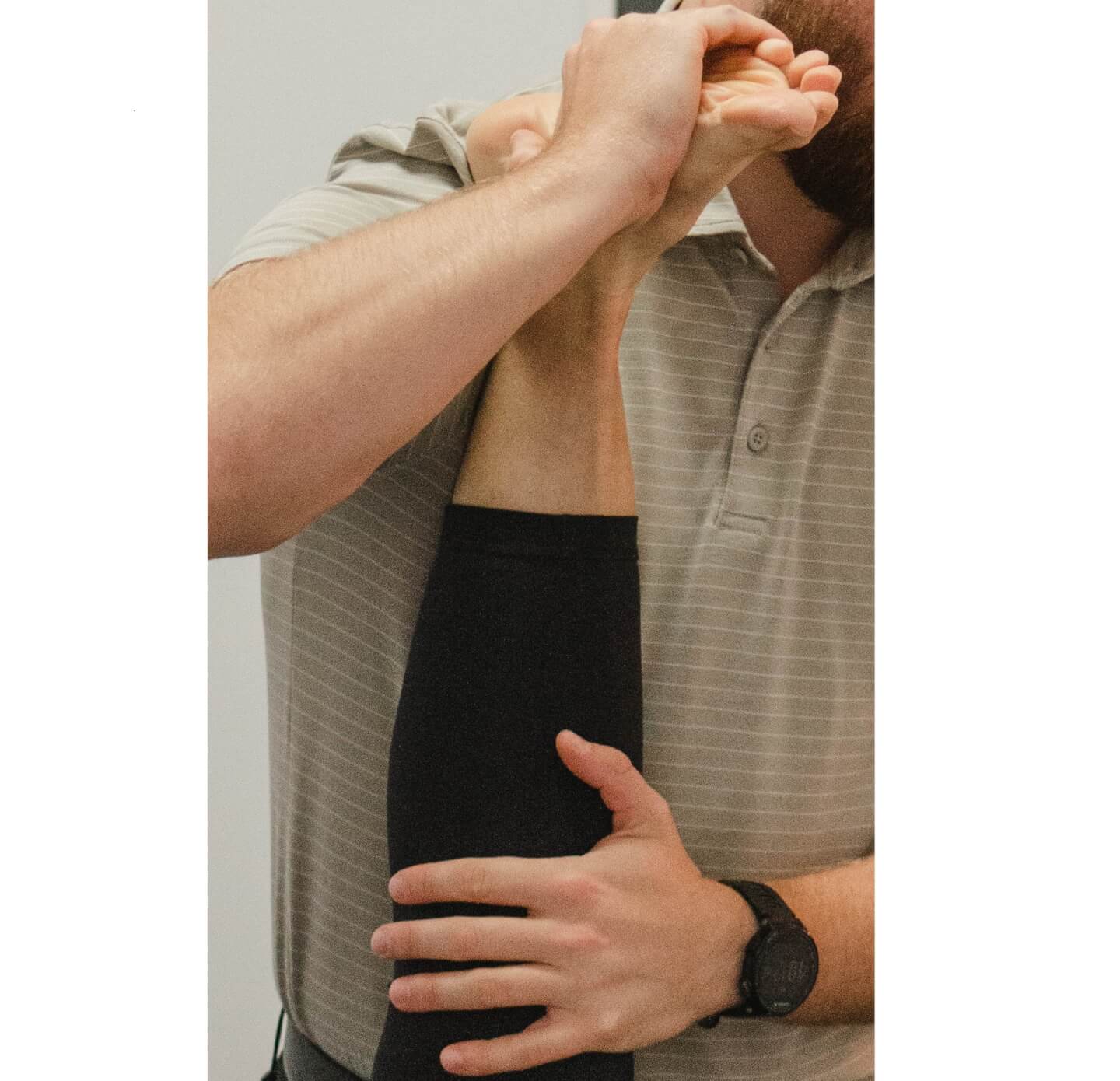


Physical therapy for sciatica targets the structure that is compressing the sciatic nerve, rather than simply masking the pain that radiates down the leg.
Physioactif assesses the back, hips, and nerve tension, then identifies the specific mechanical cause before developing a treatment plan. This is what makes all the difference: once you know which structure is irritating the nerve, you also know which movements will relieve sciatica and which ones will keep it going.
What is sciatica?
Sciatica is not a diagnosis in itself: it is a sign that a structure is irritating or compressing the sciatic nerve somewhere along its path. The clinical term, sciatalgia, describes exactly the same pain. The nerve originates in the nerve roots of the spine at the lumbar level, passes through the buttock, runs down the back of the thigh, and continues all the way to the foot.
Since the same nerve can be pinched in several places, two people with the same diagnosis do not have the same problem: compression of the nerve root in the lower back and irritation of the nerve as it exits the pelvis produce similar symptoms but require different treatment plans. That is why physical therapy for sciatica begins by pinpointing the exact location where the nerve is compressed.
Pain that radiates down the leg, not just in the lower back
Compared to ordinary lower back pain, which remains confined to the lower back and does not extend beyond the buttocks, sciatica follows the path of the nerve and extends below the knee. This pattern is the first clinical clue: the farther the pain travels down the leg, the more likely it is that the sciatic nerve is affected.
Purely mechanical back pain changes mainly with changes in the position and movement of the trunk, whereas pain of nervous origin is also triggered by stretching the back of the leg, prolonged sitting, or sneezing.
Numbness, tingling, and loss of sensation
Compression of the nerve root does not only cause pain. It also distorts the signal carried by the nerve, resulting in numbness, tingling, and a loss of sensation along its path: the buttock, back of the thigh, calf, and top or bottom of the foot.
The affected area provides information about the level of the injury, because each nerve root supplies a different area of skin. When sensation is lost in patches or ankle mobility is reduced, the injury goes beyond simple pain and warrants prompt evaluation.
Signs That Require Immediate Medical Attention
Go to the emergency room—without waiting for a clinic appointment—if you experience any of the following symptoms:
- Progressive loss of strength in the leg or foot, such as a foot that catches on the ground when walking
- Numbness in the perineal area, around the genitals and the anus
- Loss of bladder or bowel control
These symptoms may indicate cauda equina syndrome—compression of the nerve roots at the base of the spine—which requires urgent treatment. These cases are rare, and it’s important to note that the vast majority of sciatica cases are not medical emergencies and can be managed with conservative treatment. The key is to determine what is compressing the nerve, because the cause determines the treatment.
What causes of sciatica does a physical therapy evaluation seek to identify?
The causes of sciatica are mechanical and distinct from one another: a herniated disc, a narrow spinal canal, a gluteal muscle, or a worn-out joint can all put pressure on the same nerve. Since exercises that help in one case may worsen another, physical therapy for sciatica is based first and foremost on a diagnosis that identifies the specific structure responsible, not just on the general cause of the symptom.
| Cause | Structure that compresses the nerve | Typical Index |
|---|---|---|
| Lumbar disc herniation | The disc is pressing on the nerve root | Pain that radiates below the knee, worse when sitting |
| Lumbar Spinal Stenosis | The Narrowed Spinal Canal | Symptoms while walking, relieved by leaning forward |
| Piriformis Syndrome | The piriformis muscle at the exit of the pelvis | Pain centered in the buttock, prolonged sitting |
| Osteoarthritis and Facet Joint Syndrome | The Joint and the Bony Beaks | Referred pain that stops at the thigh |
A lumbar herniated disc is compressing the nerve root
A lumbar disc herniation occurs when the nucleus of the disc protrudes between two vertebrae and presses on a nerve root, most commonly at the L4-L5 or L5-S1 level. It is the most common cause among active adults, and the one that causes the most concern, because the term has acquired a reputation for requiring surgery that it does not deserve.
A lumbar herniated disc responds well to conservative treatment in most cases. According to the CHUM, physical therapy resolves the majority of herniated disc cases by strengthening the stabilizing muscles, stretching tight structures, and correcting postures that maintain compression.
Lumbar spinal stenosis narrows the spinal canal
Unlike a herniated disc, which often occurs suddenly after a sudden, awkward movement, lumbar spinal stenosis develops slowly: osteoarthritis causes the structures around the spinal canal to thicken, and the space available for the nerves decreases over the years. It primarily affects people over the age of 60.
The pattern of symptoms is typical enough to guide the evaluation: the pain worsens with walking and subsides when leaning forward—for example, while pushing a grocery cart—because this position slightly opens the spinal canal.
Piroiformis syndrome irritates the nerve in the buttock
When the piriformis muscle contracts excessively, it compresses the sciatic nerve as it exits the pelvis, without any disc involvement. The pain is then centered in the buttock and becomes noticeable after 20 or 30 minutes of sitting, whether behind the wheel or at a desk.
Muscle imbalances often contribute to this irritation: overworked deep gluteal muscles compensate for a stiff hip or poor pelvic control. Treatment therefore targets the entire movement pattern, not just the painful muscle.
Osteoarthritis and facet syndrome narrow the nerve space
Wear and tear on the facet joints—the joints between the vertebrae—narrows the space through which the nerve exits the spine, and local inflammation eventually narrows this passage even further. The result resembles sciatica but is not actually sciatica: the pain is referred to the buttock and often stops at the thigh, without extending down to the calf or foot.
This distinction has practical implications for treatment: the evaluation is used to distinguish between true radicular sciatica and referred pain before selecting treatment techniques.
How does sciatic physical therapy relieve pain?
Physical therapy for sciatica combines three approaches: manual techniques to restore movement, direct treatment of the nerve, and an exercise program that progresses as recovery occurs. The balance between these three depends on the diagnosis made during the evaluation; it is never based on a one-size-fits-all protocol.
The treatment addresses two goals simultaneously: relieving pain quickly enough for the person to start moving again, and then enabling the muscles and joints to protect the nerve over the long term. The same principle applies in physical therapy for nerve pain and numbness, where relieving the symptom is not enough if the compression remains.
Manual Therapy and Lumbar Mobilizations
Manual therapy encompasses techniques in which the physical therapist manually mobilizes stiff segments: sliding between the lumbar vertebrae, soft-tissue techniques, and hip mobilizations when the hip restricts movement in the lower back.
Restoring mobility to a restricted segment reduces pressure on the nerve root and improves immediate mobility, which opens a window of opportunity for active treatment. These techniques lay the groundwork; they do not resolve the underlying cause on their own.
Neurodynamics causes the sciatic nerve to slip
The sciatic nerve must slide freely along its path with every step and every bend of the leg. When this sliding motion is lost, the nerve becomes sensitive to even the slightest stretch, and sciatica flares up during ordinary activities such as tying one’s shoes.
Neurodynamic techniques restore this ability to glide through controlled, never forced movements: the irritation decreases as the nerve returns to its normal course. Aggressive stretching produces the opposite effect and perpetuates the sensitivity.
Core strengthening and motor control stabilize the spine
Unlike passive stretching, which provides only short-term relief, strengthening the deep muscles of the core, pelvis, and hips changes the way the spine handles everyday stresses.
Muscle training proceeds in three stages: mastering the neutral position, then maintaining that position during a movement, and finally applying it to real-life activities such as lifting a box or running. It is this last stage that prevents relapses, and it is the one that most programs abandon too soon.
Pain Education and Activity Management
Find out what your back can handle before resuming your activities: which positions relieve pain, how many minutes you can walk without your leg going numb, and how to adjust your sitting position at work.
Complete rest hinders recovery because the body loses its tolerance for exercise faster than it can reduce inflammation. Moving a little, often, is more helpful than waiting for the pain to go away on its own, and it shortens the total treatment time. There’s one question everyone asks at the first session: How long will it take?
How long does it take to recover from sciatica?
Physical therapy for sciatica generally yields results within a few weeks— often between 6 and 12 weeks —when the cause is a herniated disc and treatment is ongoing. This timeframe is not a guarantee: the speed of recovery depends on the affected area, how long the symptoms had been present before the first appointment, and what the patient does between sessions.
Sciatica that began 10 days ago and sciatica that has been present for 2 years do not follow the same course. The longer the nerve has been irritated, the longer the recovery time, even when the mechanical cause is easy to correct.
What Changes in the First 6 to 12 Weeks
Recovery follows a fairly predictable pattern: the pain in the leg subsides first, mobility in the back returns next, and exercise tolerance is the last to improve. That’s why we don’t judge the effectiveness of a treatment based on pain intensity alone.
Pain that radiates up toward the lower back is a good sign, even if it remains intense: the painful area is shrinking and moving closer to the center, which indicates that the nerve root is under less strain. Conversely, pain that radiates from the back down to the calf requires an immediate adjustment to the exercise program.
Factors That Slow Down Recovery
If symptoms have persisted for more than 3 months, if nighttime pain is the predominant symptom, or if physical activity has been avoided for many months, the recovery process requires a more gradual approach.Inflammation no longer explains everything at this stage: the nervous system remains on high alert, and overall physical condition has declined.
There are also cases where the problem isn’t the time frame, but the diagnosis. A person who has seen two or three professionals—whose test results come back normal and whose sciatica persists despite treatment—often has never received a clear answer about the underlying cause. Seeking a second opinion from a physical therapist makes sense in this situation: this is the type of complex condition that Physioactif’s senior physical therapists specialize in treating.
That said, even a recent, straightforward case of sciatica is not too minor to warrant an evaluation. Clear-cut cases resolve quickly when addressed early, and that is precisely where home care makes a difference.
What can you do at home to relieve sciatica between treatment sessions?
Treat what you do between appointments as half of your treatment: exercises and positions that relieve pressure help maintain the progress you’ve made in the clinic, though they never replace it. Your physical therapist tailors these instructions to your diagnosis, so the following serves as a general guide to relieve sciatica and help your body recover—it is not a program to be copied.
Positions that relieve pressure on the nerve
A position that relieves pressure reduces the pressure on the nerve root and alleviates the pain enough to allow you to move afterward. Two options work for most people: lying on your back with your knees bent and a pillow under your thighs, or lying on your non-painful side with a pillow between your legs.
Short, frequent walks are better than one long walk: 5 to 10 minutes, several times a day, keep the lower back flexible without putting strain on the nerve.
Heat, Ice, and Pain Management
Ice soothes sharp, recent pain—wheninflammation is the main issue in the first few days—while heat is better suited for persistent pain where muscle tension takes over. Both provide relief without actually healing anything: their role is to make the pain tolerable enough for the muscles to relax and for movement to resume.
15 to 20 minutes at a time is enough, with a layer of fabric on your skin. Try both and stick with what works for you.
Mistakes That Exacerbate Sciatica
Avoid the three habits that most often prolong the problem:
- Prolonged bed rest: After more than 1 or 2 days, inactivity causes the back to stiffen and reduces exercise tolerance
- Aggressive stretching when experiencing sharp pain: pulling on a nerve that is already sensitive increases the irritation instead of relieving it
- Home-use traction devices: The most recent clinical guidelines find no evidence of their effectiveness in treating lower back pain, with or without sciatica
It is important to recognize the true cost of these mistakes: they not only worsen symptoms in the short term, but they also prolong the overall recovery time.
Schedule a consultation for sciatica physical therapy at Physioactif
With Physioactif, you’ll walk out of your first session with a clear diagnosis, a measurable plan, and clear benchmarks to track your progress—whether your sciatica started last week or has been bothering you for years.
Our physical therapists teach at the university level and in continuing education programs, and our five clinics in the Greater Montreal area welcome you directly—no doctor’s referral required—and accept more than 30 insurance plans, including CNESST and SAAQ.
Make an appointment at the nearest clinic and turn this pain into a health issue that’s being addressed, not a problem you just have to put up with.
Frequently Asked Questions About Sciatica Physical Therapy
How many sessions of sciatica physical therapy are needed?
Physical therapy for sciatica generally requires between 6 and 10 sessions spread out over a few weeks, with a reassessment along the way to adjust the treatment. The exact number depends on the identified cause and how long the symptoms have been present: recent cases often require fewer sessions, while sciatica that has been present for months takes longer to treat.
Do you need a doctor's referral to see a physical therapist for sciatica?
No. In Quebec, you can make an appointment directly with a physical therapist without going through your family doctor. Be sure to check the terms of your group insurance plan, though: some private insurers require a prescription to reimburse treatment received at a clinic, even if the law does not require it.
Is walking good or bad for sciatica?
Short, repeated walks are generally beneficial because the movement nourishes the disc and keeps the nerve mobile. Prolonged sitting often worsens symptoms, so it’s better to take four 10-minute walks than to sit for an hour followed by a long walk. If the pain spreads further down your leg while walking, shorten the distance and talk to your physical therapist.
What is the difference between sciatica and sciatic pain?
There is no substantive difference: both terms refer to the same pain that follows the course of the sciatic nerve. “Sciatica” is the clinical term used in medical records, while “sciatic pain” is the everyday term. Neither term specifies the cause of the problem, and that is precisely what the evaluation is designed to determine.
Can sciatica return after successful treatment?
Yes, a recurrence is still possible if the mechanical cause has not been corrected. Prevention involves maintaining the progress made: keeping the core and hip muscles strong, maintaining physical fitness, and adjusting work habits. The strengthening program described above remains valuable long after the sessions have ended.
Customer satisfaction is our top priority
At Physioactif, excellence guides everything we do, but our patients are the best ones to tell you about it. Take a look at their verified reviews to get a real sense of their experience.










Discover our physical therapy clinics
We have locations in several areas to better serve you.
Blainville
190 Bas-de-Sainte-Thérèse Road, Suite 110,
Blainville, Quebec
J7B 1A7
Located in Blainville, near Rosemère, the Physioactif clinic is easily accessible to residents of the area and the surrounding communities
Boucherville
690 Rue de Montbrun, Suite S,
Boucherville, Quebec
J4B 8H2
Located in Boucherville, the Physioactif clinic is easily accessible to people in the area
Laval
3224 Jean-Béraud Ave., Suite 220, Laval,
QC H7T 2S4
Located in Chomedey, in the heart of Laval, the Physioactif clinic is easily accessible to people in the area
Montreal
8801 Lajeunesse Street,
Montreal,
QC H2M 1R8
Located in Ahuntsic, near Villeray, the Physioactif clinic is easily accessible to residents of both neighborhoods
Saint-Eustache
180 25th Avenue, Suite
201 Saint-Eustache
QC J7P 2V2
Located in Saint-Eustache, the Physioactif clinic is easily accessible to residents of the area and the surrounding communities
Vaudreuil
21 Cité-des-Jeunes Boulevard, Suite 240,
Vaudreuil-Dorion, Quebec
J7V 0N3
Located in Vaudreuil-Dorion, the Physioactif clinic is easily accessible to people in the area
Make an appointment now