

Geneviève Bernatchez-Lavallée
in a nutshell
"We shouldn't wait to enjoy life."
This is how I like to approach life. It's why I took the time to travel between finishing my studies and starting my career. It's also why I take advantage of my free time to move and spend time with the people I love.
As a physiotherapist, it is important for me to help my patients resume the activities that are important to them. That's what motivates me to help people suffering from an injury, pain, or a perineal and/or pelvic issue.
You'll get along well with me if:
- You want to take charge of your physical condition and enjoy life as you see fit.
- You enjoy physical activity, travel, and food
I have a particular interest in:
- All injuries related to sports activities, such as climbing, cycling, and skiing, or simply related to everyday mishaps or work.
- Perineal and pelvic issues in women.
After obtaining a Minor in Biology from the University of Montreal, I wanted to change direction. I was drawn to physiotherapy because it's a profession that would allow me to use advanced knowledge in health sciences, but it's also very human, active, and allows me to establish good connections with people.
During my studies, I was a student therapist for the soccer and flag football teams at Collège Montmorency. This gave me a good overview of what the physiotherapy profession could be.
- Basic Principles of Taping (2020)
- Sports First Responder (2021)
- Motor Control of the Cervical Region and TMJ, Sean Gibbons (2023)
- Graduate Microprogram in Perineal and Pelvic Rehabilitation, Université de Montréal (2023—in progress)
- The Neuromeningeal System in Musculoskeletal Problems 1.0 (2024)
What I'm most passionate about in physiotherapy is being in contact with people and promoting an active lifestyle. I love seeing or hearing patients tell me that they have started gardening, playing golf, holding their granddaughter, dancing, etc. again. It's a very stimulating job that involves significant analytical work to arrive at a physiotherapy diagnosis.
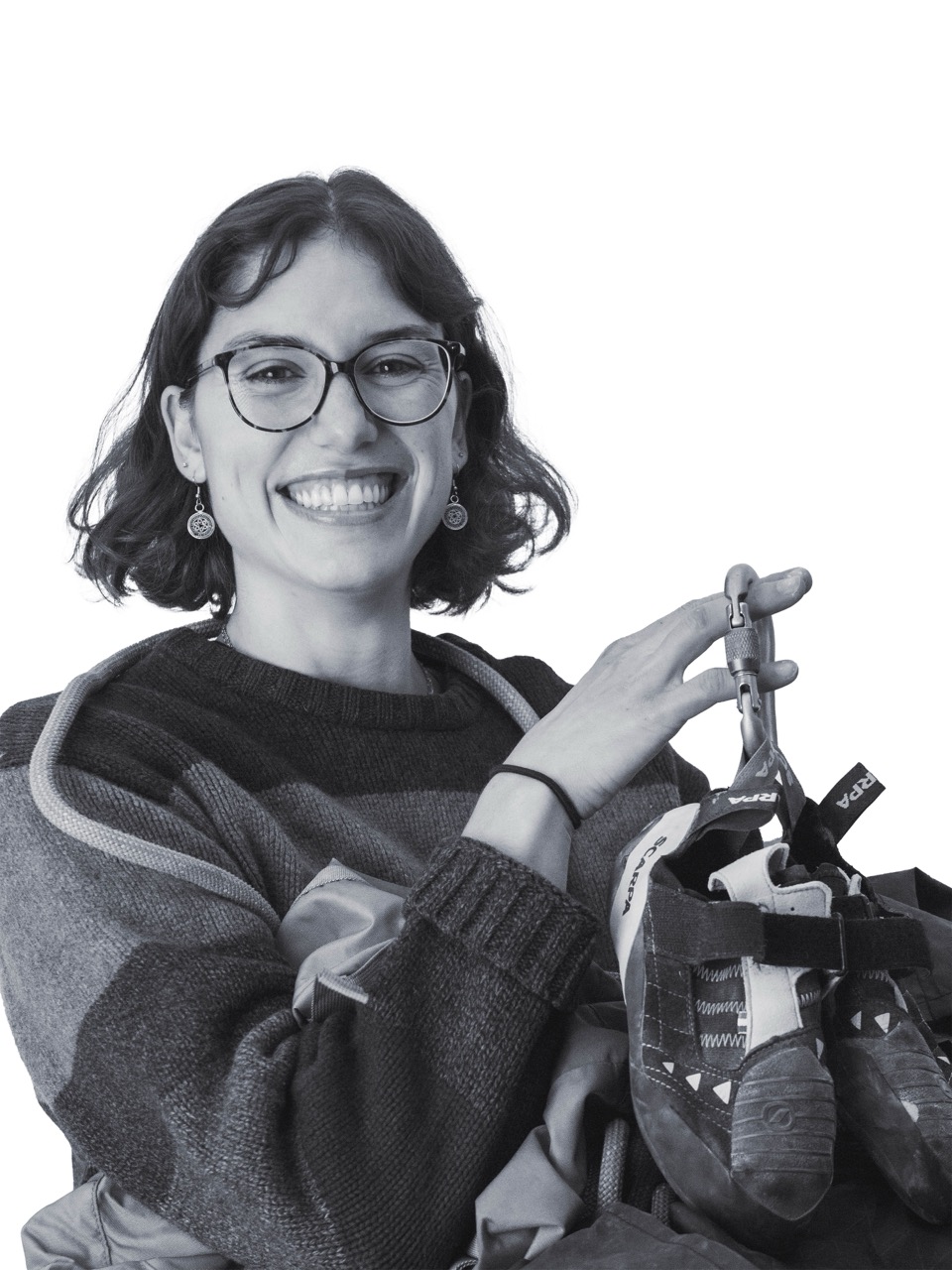
I love rock climbing. I use a bicycle as a means of transportation, summer and winter, as well as for short bike-camping trips. In the winter, I love downhill skiing, ski touring, and cross-country skiing. I have played soccer and volleyball at a high level. I have also practiced gymnastics and figure skating. So, I have an easy time understanding various movement patterns as well as the injuries related to them.
Fortunately, I have never suffered a serious injury. However, when I was 11 years old, I was diagnosed with Osgood Schlatter's disease, which is an inflammation of the patellar tendon (knee). At the time, like any stubborn child who likes to move, I didn't want to listen to the physiotherapist's recommendations, and now I have a nice bump on my knee... If I could do it again, I would follow the recommendations of my physiotherapist at the time more closely.
- After finishing my studies, I decided to take a cycle-tourism trip to Vermont from Montreal, a climbing trip to Kentucky, as well as a trip to Southeast Asia and Mexico.
- I speak French and English. In addition, I have an intermediate level of Spanish and love to practice when I have the chance.
- I love getting recommendations for restaurants, books, and movies.
Services offered by Guillaume
We offer a full range of healthcare services tailored to your individual needs. Whether you’re seeking treatment for a specific condition or looking to maintain your overall well-being, we’re here to help.

In most cases, a blockage or stiffness doesn't originate solely from the area where you feel the limitation. It could be due to joint irritation, a protective muscle spasm, or a mechanical restriction that prevents normal movement.
Simply treating the pain or “forcing” movement does not solve the problem. At Physioactif, our approach involves precisely identifying the underlying issue through advanced manual physical therapy and restoring effective movement starting with the very first sessions.
Numbness or neuralgia does not always originate solely from the area where the symptoms appear. The problem may be related to irritation or compression of the nerve in the spine or elsewhere along its peripheral course, as in the case of jaw neuralgia, where the pain radiates to the face.
When the median nerve is compressed at the wrist, numbness is often caused by compression of the median nerve at the wrist. An evaluation helps pinpoint the exact cause of the symptom and allows for the use of appropriate techniques, such as neurodynamic mobilization, to improve the nerve’s tolerance to movement and reduce radiating pain.
When symptoms affect the inner ear, treatment for vertigo involves targeted exercises for the vestibular system. Our guide to physical therapy for nerve-related pain explains these techniques in detail.
It’s common to have received several different explanations or to have not received a satisfactory answer to a persistent problem. When faced with conflicting explanations or a persistent problem, getting a second opinion from a physical therapist can help clarify your condition. A thorough evaluation allows for a structured review of your case and an analysis of factors that are often overlooked during initial consultations.
At Physioactif, the evaluation aims to establish precise clinical reasoning, validate or invalidate certain hypotheses, and propose a clear direction based on your actual situation.
Chronic pain is rarely caused by a single factor. It can involve mechanical and neurological components, as well as increased sensitivity of the body’s pain system. This is also true in oncology physical therapy, where pain requires specialized management. It is often for this reason that passive or overly general treatments yield few lasting results. Balance disorders and dizziness also respond well to active, targeted management.
At Physioactif, the approach involves analyzing all the factors that maintain pain and gradually reintroducing adapted movements and loads to desensitize the system and improve function.
Rehabilitation doesn't start after surgery, but well before. Good preparation helps improve mobility, strength, and understanding of exercises, which greatly facilitates post-operative recovery.
After surgery, the goal is to gradually restore movement, protect the healing tissues, and regain the abilities needed for your daily activities without compromising the results of the surgery—a process supervised by physical therapists certified by the FCAMPT.
During pregnancy and after childbirth, the body undergoes significant adaptations that affect muscles, joints, and the pelvic floor. These changes can lead to lower back pain, urinary leakage, or reduced muscle control.
, symptoms treated by pelvic floor rehabilitation
Physical therapy during pregnancy helps monitor changes in the body, prevent certain complications, and gradually regain strength, stability, and control through exercises tailored to each stage. After birth, we also support the infant’s development through pediatric physical therapy.
Pelvic floor disorders are not just about weakness. In many cases, they involve a lack of coordination, excessive tension, or poor muscle control. These imbalances can lead to urinary leakage, pain, or a feeling of pressure.
, especially during pregnancy—which physical therapy for pregnant womenhelps prevent
The evaluation allows for a precise analysis of how the pelvic muscles function and uses targeted exercises to restore effective control, improve support, and reduce symptoms.
Sports-related pain isn't just caused by trauma; it often results from repeated stress that the body can't handle, as in the case of anterior knee pain in runners. Continuing to train without addressing the cause increases the risk of a relapse.
The evaluation helps identify the limitations involved, whether related to mobility, strength, or control. Treatment then aims to reduce pain, correct functional deficits, and prepare for a gradual return to sports. To resume physical activity during or after pregnancy, prenatal physical therapy provides guidance to ensure a safe return.
Accident-related injuries can affect the neck, back, or nervous system, even if symptoms initially seem mild.
An assessment helps identify the affected structures and establish a tailored treatment plan recognized by the SAAQ to promote full recovery.
Work-related injuries can be mechanical, muscular, or caused by repetitive movements.
The assessment helps us understand the specific demands of your job and tailor treatment to ensure a safe and lasting return to work under the CNESST program.
The physical consequences of a criminal act can include muscle pain, stiffness, or more complex injuries.
The goal is to precisely assess your condition and implement a progressive treatment that respects your recovery pace and the requirements of the IVAC program.
Injuries in veterans are often complex and can affect multiple systems, such as joints, muscles, or the nervous system.
Our approach aims to precisely understand your condition and provide structured treatment that meets program requirements while supporting a gradual return to your activities.
Techniques mastered by Guillaume
The McKenzie Approach is a globally recognized assessment and treatment method that is particularly effective for back problems. It is often combined with manual therapy provided by an FCAMPT-certified physical therapist to create a comprehensive treatment plan. This approach gives you the tools to manage and prevent your pain on your own. The same principle of guided self-treatment applies to jaw joint pain, where targeted exercises help restore a comfortable range of motion.
The Mulligan approach, recognized worldwide, combines active movement and mobilization to produce immediate results. This unique technique restores joint function without pain, even in cases where other approaches have failed. It is part of our arsenal of orthopedic manual therapy techniques.
Knowledge is the key to a successful recovery. Our educational approach helps you better understand your pain-related issues and provides you with the tools you need to actively participate in your recovery and prevent relapses. For example, it helps you understand the mechanisms behind urinary incontinence.
An ill-suited workstation can cause strain and pain that affect your productivity. Our professional ergonomic assessment identifies the adjustments needed to create a comfortable and efficient workspace.
A personalized exercise program is the key to achieving your strength and endurance goals, as well as to strengthening your thigh muscles and relieving patellofemoral pain. Our expertise in designing tailored programs allows you to progress safely while taking your abilities and lifestyle into account. To understand how these therapeutic rehabilitation exercises fit into a recovery plan, check out our comprehensive guide.
Weak stabilizing muscles can cause pain during prolonged postures or everyday movements. Core exercises are often taught incorrectly and can hinder your progress—a common challenge in postpartum physical therapy when it’s necessary to reactivate the abdominal core. Our specialized approach activates these essential deep muscles, creating a solid foundation for all your movements and daily activities. The pelvic floor is one of these deep muscles, and its rehabilitation follows the same principles of control and coordination.
Joint pain and stiffness can significantly limit your daily activities. Our physical therapists, trained inthe FCAMPT approach, use specialized joint mobilization and manipulation techniques to restore the natural movement of your joints and reduce your pain, including for temporomandibular joint disorders that limit your ability to open your mouth. This expertise is based on FCAMPT certification.
Poor posture can be the source of many everyday aches and discomforts, including jaw tension related to the position of the head and neck. Our approach combines precise postural analysis with practical solutions to improve your natural alignment and prevent chronic muscle tension. For toddlers, posture assessment is part of pediatric physical therapy for children ages 0 to 7.
Always moving the same way can lead to injuries because repetitive movements eventually overburden the same structures in your body, which often explains persistent pain in the front of the knee. Our approach precisely analyzes and corrects your movement patterns to restore biomechanics that won’t cause microtrauma. This focus on quality of movement also applies to children’s motor development, where we support the acquisition of proper movement patterns from an early age.
Therapeutic taping uses adhesive strips to support a joint and guide movement in the short term. Among our approaches, we use the McConnell method in particular, which focuses on biomechanical correction rather than a neuromuscular effect—a technique sometimes used as a complementary treatment for patellar pain. Taping aimed at altering biomechanics can provide short-term relief; however, according to available data, so-called neuromuscular taping approaches do not show a clear advantage over placebo taping. We do not deny that some people still experience a benefit from it, but it is not an approach we recommend as a first resort: taping always complements an active treatment plan tailored to your evaluation—it is never a substitute for it.
Tele-physical therapy offers the flexibility of professional care from the comfort of your own home. No matter where you are in the world, you can benefit from our unique expertise. This modern solution provides effective, personalized care tailored to your schedule, while maintaining the highest quality of care.
Primitive reflexes that persist into adulthood can disrupt your balance, coordination, and posture, causing chronic tension and pain. The symmetrical tonic neck reflex during lateral flexion can also be assessed. The integration of these reflexes is a cornerstone of pediatric physical therapy for children ages 0 to 7. The Galant spinal reflex test is one such assessment. When balance disorders are predominant, vestibular rehabilitation complements this approach. Our specialized approach targets these primitive motor patterns to restore more mature and efficient movements, specifically by assessing the Galant spinal reflex. These treatments are indicated for persistent pain.
We are pioneers in Quebec in the treatment of nerves. We know that symptoms of nerve compression—such as tingling, numbness, or burning pain—can disrupt your sleep and your quality of life. These nerve irritations can also contribute to jaw pain, which we evaluate in the same way. Our specialized nerve treatment techniques precisely target these sensitive structures to reduce irritation and restore their proper function.
Contact Guillaume Lamothe
If you have any questions or would like more information, please don't hesitate to contact us.


Phone

Office
8801 Lajeunesse Street,
Montreal,
QC H2M 1R8
Located in Ahuntsic, near Villeray, the Physioactif clinic is easily accessible to residents of both neighborhoods
Make an appointment now