

Myofascial release: What is it, and does it really work?
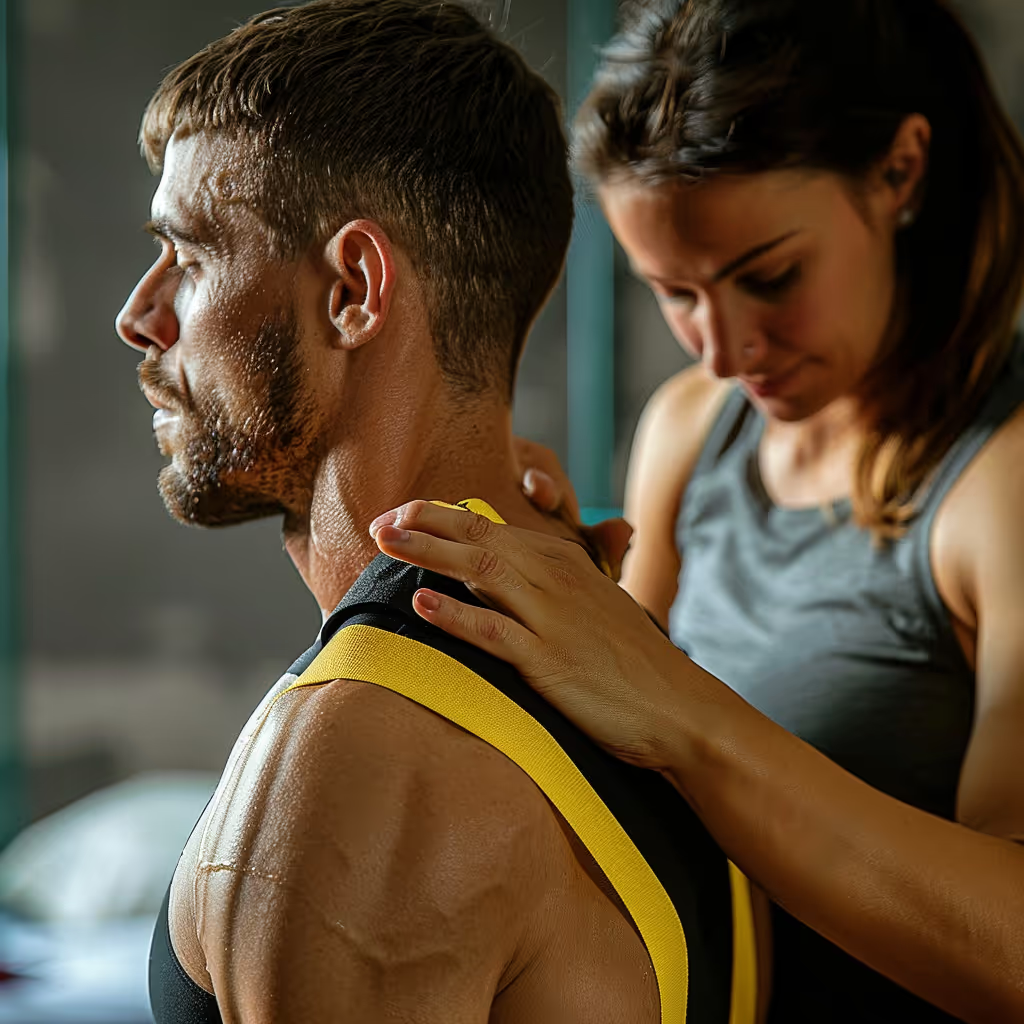
Myofascial release refers to techniques that apply pressure to the tissues surrounding the muscles; its mechanisms remain unclear, and the studies presented here do not allow for a reliable prediction of individual responses.1 At Physioactif, movement and exercise guide our care. Myofascial release is not among the treatments we recommend. This article explains this approach, the research questions it addresses, and how it differs from general massage or other manual techniques.
What is myofascial release?
Myofascial release involves techniques that use slow, sustained pressure to target the fascia. The fascia are supportive tissues that surround muscles, bones, nerves, and blood vessels, among other structures.2 Practitioners of this approach seek to address areas they perceive as tense or restricted in movement. This intention does not prove that the tissue “releases” under their hands.
Fascia: A Continuous Network Throughout the Body
Fascia form a network of supportive tissue throughout the body. Research has described changes in stiffness, cells, and nerves in certain fascia associated with pain-related issues.2 However, a tender spot alone does not provide precise information about the condition of this tissue. The question remains: what changes occur when pressure is applied, and how significant are they for the individual?
10 Quick Tips to Understand Your Pain
One tip a day for 10 days to help you better understand your pain. About a 2-minute read.
Different Approaches and Their Objectives
Several approaches involve applying pressure to the tissues, using different techniques and explanations.
- John Barnes’ Myofascial Release approach uses gentle, slow, and sustained pressure. Its proponent describes it as a way to address fascial restrictions.
- The Active Release Techniques (ART) method combines pressure applied by the practitioner with movements performed by the patient. This name refers to a specific method of working with soft tissues.
- Myofascial self-release refers to the use of a foam roller or ball to apply pressure to oneself.
The phrase “releasing fascial tension” describes the stated goal of some of these approaches. It does not identify a proven mechanism. Research on manual therapy examines several possible bodily responses, without determining precisely which ones account for the clinical results.1
How does myofascial release really work?
The mechanism of myofascial release has not been established with sufficient precision to assert that it releases the fascia or calms the nervous system. Research is exploring the responses of tissues and the nervous system. A possible explanation must be distinguished from an effect observed in patients.1
What a force model shows
A study modeled the deformation of three fascias during a 20-second compression. In this model, deforming the fascia lata—on the side of the thigh—or the fascia under the foot by 1% required very high forces. The more flexible tissue studied near the nose could be deformed with much weaker forces.3 This result depends on the tissue and the model’s assumptions. It does not prove that all fascias resist manual manipulation or that no lasting changes are possible under any circumstances.
Researchers also distinguish between several measures: pain experienced in daily life, the pressure at which pain begins during a test, and the range of motion. A review of sensitivity tests following manual therapy reports conflicting results and evidence that is often of low quality.4 Studies on foam rolling tend to measure joint range of motion in healthy adults.5 These measures alone do not prove a lasting transformation of the fascia.
Theories about the Nervous System
One model of manual therapy suggests that forces applied to tissues trigger reactions in the nerves, spinal cord, and brain.6 The spinal cord is a cord of nervous tissue that transmits messages between the brain and the body. Sensors in the skin and muscles respond to pressure.7 Research is also examining the responses of the fascia in both humans and animals.8 These observations alone are not sufficient to explain the results of each technique for each individual.1
The “gate” theory, proposed by Melzack and Wall in 1965, explains how certain nerve signals can be inhibited or amplified in the spinal cord. Signals from the brain also play a role. The details of the original model have since been revised.9 A signal indicating danger to the tissues is not pain itself. This general theory does not prove the mechanism behind a myofascial release session.
The Benefits of General Massage and Exercise
General massage is the subject of separate research. For back pain that has lasted several weeks or longer, a Cochrane review reports less pain and fewer functional limitations in the short term compared to no treatment, a wait-and-see approach, or a sham treatment. A sham treatment involves performing certain movements without actually applying the treatment being studied. Compared with other active treatments, massage reduced pain more significantly in both the short and long term, without a clear benefit regarding functional limitations. The certainty of these results is low to very low.10 These comparisons do not measure the effect of a single session of myofascial release.
The addition of exercise has also been studied in people with trigger points—muscle areas that are highly sensitive to pressure. A review of fourteen trials reports less pain, greater mobility, and fewer difficulties performing activities in programs that included exercise. The comparison treatments, exercises, and study populations varied widely.11 This research supports a role for exercise in care but does not demonstrate that a single manual technique is necessary for all types of chronic pain.
For what conditions is myofascial release studied?
Myofascial release has been studied for chronic back or neck pain, fibromyalgia, and certain types of heel pain. A 2018 review included eight trials on back pain, fibromyalgia, elbow pain, and heel pain.12Low back pain refers to pain in the lower back, and neck pain refers to pain in the neck. Fibromyalgia is characterized by pain in multiple areas of the body and, often, fatigue. Not all studies use the same techniques, comparison groups, or measures.
Research questions vary depending on the condition.
- Studies on chronic low back pain measure pain, daily difficulties, and back movement. Two 2021 systematic reviews did not include exactly the same participants and did not reach the same conclusions for all of these measures.13, 14 Their results do not allow for an accurate prediction of an individual’s prognosis.
- An Overview of neck pain includes thirteen studies and 601 participants. It distinguishes between pain in daily life, neck mobility, daily difficulties, and the pain threshold to pressure. This threshold corresponds to the force applied at the moment when pressure begins to cause pain.15 A result from this test alone does not, therefore, describe a person’s activities.
- A review on fibromyalgia compares several types of massage. Its analysis specifically regarding myofascial release is based on 145 participants.16 Myofascial syndrome refers here to muscle pain associated with very tender points. It does not refer to the same condition as fibromyalgia. The results from one of these populations do not automatically apply to the other.
Separate studies on manual therapy
For plantar fasciitis—pain under the heel associated with the plantar fascia—a review of seven trials examines various manual techniques applied to joints and tissues. It reports improved outcomes regarding functional activity and pressure tolerance in several comparisons conducted over periods ranging from four weeks to six months. The benefits regarding pain relief are less consistent. The authors recommend combining manual therapy with stretching and strengthening exercises.17 These pooled results should not be attributed to any single method.
In another study, 22 runners received pressure applied to trigger points in the calf, combined with stretching. Their ankle range of motion was greater immediately after this combination than after the comparison condition. Each participant tried both conditions, and the effect of the first condition might persist during the second. The study therefore does not distinguish between the roles of pressure and stretching and does not measure recovery from a sports injury.18
How does our approach differ from myofascial release?
Physioactif bases its care on movement and exercise tailored to the individual and may incorporate manual therapy. Myofascial release and fascial therapy are not among the treatments we recommend. The goal of the manual therapy we provide is to support the activities outlined in your care plan, based on the assessment and your response.
The term “myofascial release” refers to an approach focused on the fascia and on applying pressure intended to address restrictions within it. It describes a specific treatment framework. Not all pressure applied to a muscle automatically falls under this approach.
Soft-tissue mobilization refers to techniques applied primarily to muscles and the surrounding tissues. It may be performed in conjunction with a patient’s movement or followed by exercises. The observed response—such as easier movement—helps determine whether to continue or adjust the treatment. It does not prove that a fascia has been released.
The plan may combine an assessment, relevant manual therapy, and progressive exercises. For example, the physical therapist may compare a movement before and after an intervention, and then recommend an appropriate exercise. The progression gradually increases the duration, resistance, or difficulty based on your abilities.
Our article on manual soft-tissue therapy explains the techniques used and their role in a treatment plan.
What happens during a soft tissue manual therapy session?
A soft-tissue manual therapy session includes an assessment, tailored techniques, and a check of your response. The physical therapist explains the goal, confirms your consent, and may combine these techniques with exercises. This description applies to general manual therapy. It does not present myofascial release as a service offered by Physioactif.
Initial Assessment
The physical therapist will discuss your symptoms with you, including their location and how they vary. He or she will observe your movements and touch certain areas to check for tenderness. He or she will also determine whether any issues require medical evaluation before applying pressure.
Applying the Techniques
- The physical therapist adjusts the slow or rhythmic pressure based on the treatment goal and your tolerance. Some movements are performed while you are moving.
- Targeted or more general stretches focus on the limited movements that are relevant to your activities. They may involve an area adjacent to the painful area.
- Examining adjacent areas helps in understanding mobility issues. For example, a physical therapist may examine the calf and ankle when a patient complains of foot pain. Tissue continuity alone does not prove that applying pressure at a distance addresses the underlying cause.
10 Quick Tips to Understand Your Pain
One tip a day for 10 days to help you better understand your pain. About a 2-minute read.
What you'll feel
You may feel pressure, a stretching sensation, or discomfort. Please let us know how you’re feeling during the procedure. Pressure should not be applied against your will or become difficult to tolerate. You can ask us to reduce the intensity or stop.
Foam Roller and Exercise Ball at Home
The foam roller and ball are used to apply pressure to oneself. Some programs refer to this practice as “self-myofascial release.” Studies on foam rolling have primarily evaluated joint range of motion in healthy individuals: one review focused on immediate measurements, while another examined training over several weeks.5, 19 These protocols do not demonstrate that the tool prolongs the effects of a session in an injured person. A pressure tool is not a substitute for exercises recommended for your specific condition.
What are some frequently asked questions about myofascial release?
Frequently asked questions about myofascial release include pain during the procedure, how it differs from massage, duration and frequency, tools for home use, and side effects. The answers below distinguish this approach from general manual therapy and exercises.
Does myofascial release hurt?
The pressure may feel uncomfortable. If it hurts or becomes too intense, say so and ask for it to be adjusted or stopped. Significant pain during a procedure does not mean that the fascia is releasing. New symptoms, such as numbness or weakness, require an evaluation rather than continuing the pressure.
What is the difference between massage and myofascial release?
A general massage involves various techniques, such as sliding the hands, kneading a muscle, or applying pressure. It may be aimed at relaxation. Myofascial release, on the other hand, focuses on sustained pressure applied to the fascia. The speed and techniques can overlap: a massage isn’t always fast.20 Hypotheses regarding blood circulation, nerves, and tissues remain distinct from clinical findings.1 The force model presented above does not compare the long-term outcomes of massage and myofascial release.3
The Cochrane review on massage for back pain includes 25 trials and 3,096 participants. It finds some benefits regarding pain and functional limitations, with low to very low certainty in the results. The effects depend on the condition, the comparator, and the follow-up period.10 General massage may have a role among other treatment options, including adapted exercises.
How long do the effects last?
Studies do not establish a reliable timeframe for the response to myofascial release in any given individual. Immediate measurements, follow-ups over several weeks, and longer-term comparisons address different questions. For general back massage, some benefits extend beyond the short term, depending on the comparison treatment.10 Progression in activities remains a goal to be discussed in your plan.
How often should this type of treatment be performed?
The frequency of visits depends on your goals, your progress, and the type of treatment. If a strain keeps recurring, ask to review the diagnosis, the exercises, and other possible factors. This doesn’t mean you’re not trying hard enough. Follow-up visits can be spaced out as your needs allow, with guidelines on when to schedule another appointment.
Can I do this myself with a foam roller?
A foam roller or ball allows you to apply pressure on your own; first, ask if this practice is appropriate for your situation. Some people use a foam roller on their calf or thigh, or a ball on a more specific muscle area. The choice of area and intensity should be appropriate.21 If this pressure causes severe or persistent pain, stop and consult a healthcare professional. The active exercises included in your plan should still be performed as scheduled.
Are there any side effects?
Muscle tenderness or pain may occur after pressure is applied. Severe or persistent pain should be reported so that the technique can be reevaluated. Pressure can also cause bruising; be especially careful if you are taking medication that reduces blood clotting. Seek medical advice before applying pressure to a fracture, burn, wound, or area where a blood clot is suspected. A blood clot is a mass of blood that can block a blood vessel.21 New weakness or loss of sensation after the procedure requires medical evaluation.
Does myofascial release work for everyone?
No study can guarantee that myofascial release will work for everyone. A small study on targeted pressure involved 28 participants, each with two tender points in the upper back. Pressure was applied to one point using a tool, while the other served as a control. The researchers measured the pressure pain threshold after one week.22 This method cannot predict a person’s long-term response.22
Persistent pain may require multiple treatment approaches. For chronic low back pain, a review of 41 trials shows that multidisciplinary rehabilitation reduces pain and daily difficulties more effectively than standard care. These programs combine physical therapy with psychological, social, or work-related support. The benefit in terms of pain relief compared to physical therapy alone is less clear.23 This approach can help you resume the activities that are important to you.
A Care Plan to Help You Resume Your Activities
Our physical therapists will support you with exercises, advice, and—depending on your needs—manual therapy. The plan focuses on the activities that matter most to you.
Make an appointmentReferences
Links open in a new tab.
- Keter DL, Bialosky JE, Brochetti K, Courtney CA, Funabashi M, Karas S, et al. The mechanisms of manual therapy: A living review of systematic, narrative, and scoping reviews. PLoS One. 2025;20(3):e0319586. (Back to sections: 1, 2, 3, 4, 5)
- Kondrup F, Gaudreault N, Venne G. The deep fascia and its role in chronic pain and pathological conditions: A review. Clin Anat. 2022;35(5):649-659. (Back to sections: 1, 2)
- Chaudhry H, Schleip R, Ji Z, Bukiet B, Maney M, Findley T. A three-dimensional mathematical model for the deformation of human fascia in manual therapy. J Am Osteopath Assoc. 2008;108(8):379-90. (Back to sections: 1, 2)
- Rodgers LJ, Bialosky JE, Minick SA, Coronado RA. An overview of systematic reviews examining the hypoalgesic effects of manual therapy for musculoskeletal pain, as measured by quantitative sensory testing. J Man Manip Ther. 2024;32(1):67-84. (Back to section: 1)
- Wilke J, Müller AL, Giesche F, Power G, Ahmedi H, Behm DG. Acute Effects of Foam Rolling on Range of Motion in Healthy Adults: A Systematic Review with Multilevel Meta-analysis. Sports Med. 2020;50(2):387-402. (Back to sections: 1, 2)
- Bialosky JE, Bishop MD, Price DD, Robinson ME, George SZ. The mechanisms of manual therapy in the treatment of musculoskeletal pain: a comprehensive model. Man Ther. 2009;14(5):531-8. (Back to section 1)
- Hok P, Hlustik P. Modulation of the human sensorimotor system by afferent somatosensory input: evidence from experimental pressure stimulation and physical therapy. Biomed Pap Med Fac Univ Palacky Olomouc Czech Repub. 2020;164(4):371-379. (Back to section: 1)
- Isaji Y, Sasaki D, Okuyama K, Kurasawa Y, Suzuki K, Kon Y, et al. Therapeutic mechanisms of fascia manipulation: A scoping review. J Back Musculoskelet Rehabil. 2025;38(6):1267-1276. (Back to section: 1)
- Mendell LM. Constructing and deconstructing the gate theory of pain. Pain. 2014;155(2):210-216. (Back to section 1)
- Furlan AD, Giraldo M, Baskwill A, Irvin E, Imamura M. Massage for low-back pain. Cochrane Database Syst Rev. 2015;2015(9):CD001929. (Back to sections: 1, 2, 3)
- Zhou Y, Lu J, Liu L, Wang HW. Is Exercise Rehabilitation an Effective Adjuvant to Clinical Treatment for Myofascial Trigger Points? A Systematic Review and Meta-Analysis. J Pain Res. 2023;16:245-256. (Back to section: 1)
- Laimi K, Mäkilä A, Bärlund E, Katajapuu N, Oksanen A, Seikkula V, et al. Effectiveness of myofascial release in the treatment of chronic musculoskeletal pain: a systematic review. Clin Rehabil. 2018;32(4):440-450. (Back to section: 1)
- Chen Z, Wu J, Wang X, Wu J, Ren Z. The effects of myofascial release techniques on patients with low back pain: A systematic review and meta-analysis. Complement Ther Med. 2021;59:102737. (Back to section: 1)
- Wu Z, Wang Y, Ye X, Chen Z, Zhou R, Ye Z, et al. Myofascial Release for Chronic Low Back Pain: A Systematic Review and Meta-Analysis. Front Med (Lausanne). 2021;8:697986. (Back to section: 1)
- Guo Y, Lv X, Zhou Y, Li Z, She H, Bai L, et al. Myofascial release for the treatment of pain and dysfunction in patients with chronic mechanical neck pain: Systematic review and meta-analysis of randomized controlled trials. Clin Rehabil. 2023;37(4):478-493. (Back to section: 1)
- Yuan SL, Matsutani LA, Marques AP. Effectiveness of different styles of massage therapy in fibromyalgia: a systematic review and meta-analysis. Man Ther. 2015;20(2):257-64. (Back to section: 1)
- Fraser JJ, Corbett R, Donner C, Hertel J. Does manual therapy improve pain and function in patients with plantar fasciitis? A systematic review. J Man Manip Ther. 2018;26(2):55-65. (Back to section: 1)
- Grieve R, Cranston A, Henderson A, John R, Malone G, Mayall C. The immediate effect of triceps surae myofascial trigger point therapy on restricted active ankle dorsiflexion in recreational runners: a crossover randomized controlled trial. J Bodyw Mov Ther. 2013;17(4):453-61. (Back to section: 1)
- Konrad A, Nakamura M, Tilp M, Donti O, Behm DG. Effects of Foam Rolling Training on Range of Motion: A Systematic Review and Meta-Analysis. Sports Med. 2022;52(10):2523-2535. (Back to section: 1)
- Weerapong P, Hume PA, Kolt GS. The mechanisms of massage and its effects on performance, muscle recovery, and injury prevention. Sports Med. 2005;35(3):235-56. (Back to section: 1)
- Cleveland Clinic. Myofascial Release Therapy. (Back to sections: 1, 2)
- Gulick DT, Palombaro K, Lattanzi JB. Effect of ischemic pressure using a Backnobber II device on discomfort associated with myofascial trigger points. J Bodyw Mov Ther. 2011;15(3):319-25. (Back to sections: 1, 2)
- Kamper SJ, Apeldoorn AT, Chiarotto A, Smeets RJ, Ostelo RW, Guzman J, et al. Multidisciplinary biopsychosocial rehabilitation for chronic low back pain: Cochrane systematic review and meta-analysis. BMJ. 2015;350:h444. (Back to section: 1)
Customer satisfaction is our top priority
At Physioactif, excellence guides everything we do, but our patients are the best ones to tell you about it. Take a look at their verified reviews to get a real sense of their experience.









Discover our physical therapy clinics
We have locations in several areas to better serve you.
Blainville
190 Bas-de-Sainte-Thérèse Road, Suite 110,
Blainville, Quebec
J7B 1A7
Located in Blainville, near Rosemère, the Physioactif clinic is easily accessible to residents of the area and the surrounding communities
Boucherville
690 Rue de Montbrun, Suite S,
Boucherville, Quebec
J4B 8H2
Located in Boucherville, the Physioactif clinic is easily accessible to people in the area
Laval
3224 Jean-Béraud Ave., Suite 220, Laval,
QC H7T 2S4
Located in Chomedey, in the heart of Laval, the Physioactif clinic is easily accessible to people in the area
Montreal
8801 Lajeunesse Street,
Montreal,
QC H2M 1R8
Located in Ahuntsic, near Villeray, the Physioactif clinic is easily accessible to residents of both neighborhoods
Saint-Eustache
180 25th Avenue, Suite
201 Saint-Eustache
QC J7P 2V2
Located in Saint-Eustache, the Physioactif clinic is easily accessible to residents of the area and the surrounding communities
Vaudreuil
21 Cité-des-Jeunes Boulevard, Suite 240,
Vaudreuil-Dorion, Quebec
J7V 0N3
Located in Vaudreuil-Dorion, the Physioactif clinic is easily accessible to people in the area
Make an appointment now