Neck pain
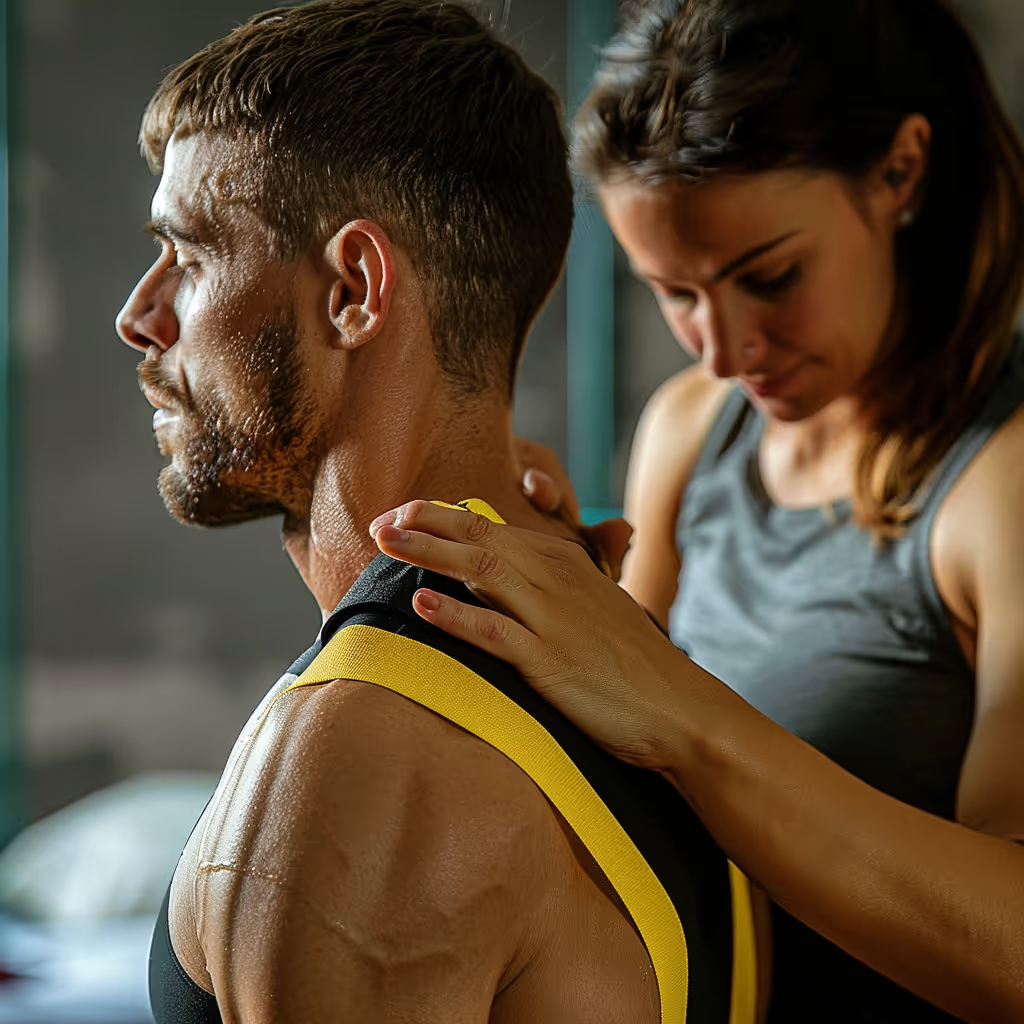
Neck pain is a general term used to describe pain in the neck that has no specific cause, such as an accident or a sudden awkward movement. Neck pain is therefore synonymous with “my neck hurts, and nothing in particular happened.”
.png)
.png)
.png)



Synonyms for neck pain
- Mechanical neck pain: pain that varies depending on position or movement
- Nonspecific neck pain: pain without a specific lesion identified to explain it
What is neck pain?
Neck pain is a general term used to describe pain in the neck. The pain may occur after an accident or a sudden, awkward movement. Often, the healthcare professional cannot identify a specific injury to a bone, disc, or other tissue that explains the pain. The healthcare professional examines range of motion, strength, and tenderness to distinguish between pain that varies with movement and a problem affecting a nerve. They also look for signs that warrant further testing or treatment.1
What are the symptoms of neck pain?
The general symptoms are:
- Pain only in the neck that appears gradually
- Stiffness or increased pain with neck movements
Certain movements can affect the symptoms:
- Neck pain with symptoms when bending forward (head tilted forward)
- Neck pain with symptoms when extending (head tilted backward)
What actions can trigger pain?
For neck pain that worsens when bending forward, the pain may increase during certain movements:
- Bending your head down
- Reading a book
- Looking at a cell phone or tablet for a long time
- Standing and cooking with your head bent, like when cutting vegetables
- Washing dishes
- Do a puzzle
10 Quick Tips to Understand Your Pain
One tip a day for 10 days to help you better understand your pain. About a 2-minute read.
For neck pain with symptoms that worsen when the neck is extended, the pain may increase during certain movements:
- Driving for a long time
- Being at the computer for a long time
- Watching television for a long time
- Looking up
- Doing a task in the air (painting, putting away dishes high up)
The same person may experience pain when tilting their head forward and backward. These reactions help in adjusting activities; they do not indicate two distinct diagnoses.
Head position alone is not enough to explain neck pain. In a study of 1,108 17-year-olds, there were no differences in neck pain or headaches among the different sitting posture groups. Another study that followed participants until age 22 did not show that good posture protected against pain.2, 3

What are the serious symptoms of neck pain?
Significant weakness, loss of sensation, or new difficulties with coordination require urgent medical evaluation. Do not wait for a physical therapy appointment if you experience the following symptoms:
- Severe weakness or paralysis in one or both arms
- Significant or even complete loss of sensation in one or both arms
- Recent loss of balance when walking
- New incoordination of the arms or hands
- New difficulties with bladder or bowel control
- Loss of sensation in the genital area or when wiping after a bowel movement
Neck pain is rarely a sign of a serious health problem.1
What are the causes of neck pain?
Neck pain can have several causes. The evaluation examines changes in activity, symptoms, and other health issues. The following situations may precede the onset of pain but do not, on their own, explain its cause:
- An activity that is longer or more demanding than usual. For example:
- Doing spring or fall cleaning
- Gardening with your head tilted for an entire weekend
- Drive 10 hours in a single day
- Painting for an entire weekend
- A recent decrease in your physical activity or a change in your habits
- A new job, sport, or activity that works your neck in a new way. For example:
- Changing workstations
- Starting a new job that requires more time at the computer than before
How is neck pain diagnosed?
The healthcare professional will ask you about your symptoms and then examine the range of motion, strength, and sensitivity in your neck and arms.
A reversal or loss of the normal curvature of the neck, as seen on an X-ray, is often coincidental: it does not necessarily indicate the cause of the pain.4, 5
"It is important to know that imaging often reveals age-related changes that can also be present without pain. In the lumbar spine, for example, among 20-year-olds without pain, about 37% already show changes in their discs; by age 80, that figure is nearly 96%.6 In the neck as well, the discs and joints can change over the years without causing pain.”6, 7
This means that many of the changes visible on spinal imaging may be part of the aging process without causing any symptoms. An abnormal result is therefore not sufficient to explain the pain.6, 1
When should you consult a physiotherapist for neck pain?
A physical therapy appointment is recommended if neck pain persists, limits daily activities, or disrupts sleep—provided there are no urgent symptoms as described above. These symptoms require an immediate medical evaluation.
In Quebec, you can see a physical therapist directly without first seeing a doctor. If your medical condition requires a doctor’s opinion, the physical therapist will refer you to the appropriate service. Urgent symptoms are still a reason to seek immediate medical attention.
What physiotherapy treatments are available for neck pain?
Physical therapy treatments may combine exercises, manual techniques, and advice on adapting daily activities. Your physical therapist will perform an assessment to determine the appropriate interventions. The professional will examine the following factors, among others:
- Your joint mobility
- How your symptoms respond to movements that put pressure on the nerves
- Your postural habits
- The quality of your movements
- Your strength and stability
Based on the assessment results, your physiotherapist will:
- May use guided joint or nerve movements to improve mobility and tolerance for movement
- Will provide you with targeted exercises to do at home, selected based on the results of your assessment, to work on the movements and skills you're having trouble with
- Will teach you how to balance your daily activities and leisure time so you can gradually resume the activities that are important to you
- Give you advice for your postural habits and movements
Strength and endurance exercises for the neck may reduce chronic neck pain. In a follow-up study of 118 women who completed a 12-month program, improvements in pain and function were sustained at three years.8, 9
What to do at home for neck pain?
At home, temporarily limit movements that cause severe pain, then gradually resume them based on how much pain you can tolerate. Vary your positions and stick to activities that remain comfortable. Exercises can help manage neck pain, but the choice of exercises and the intensity should be tailored to your specific situation.1
Exercising muscles can temporarily reduce pain sensitivity. A laboratory study involving 48 people observed this effect after a sustained arm contraction while keeping the elbow still. Sensitivity decreased near the muscles being worked and in certain areas of the hands.10
Another study compared 21 people with persistent pain following a whiplash injury and 19 people without symptoms. The injured participants experienced mild to moderate pain and difficulty. After holding a squatting position with their backs against a wall, both groups showed reduced sensitivity to pressure on the neck and leg. A cycling session did not produce this reduction, nor did it increase sensitivity.11 These results after a single session do not guarantee lasting relief and do not mean the same exercise is appropriate for everyone.
What adjustments should you try based on the sensitive movements?
For neck pain with symptoms when bending the neck forward:
- Limit the time spent with your head bent down.
- When reading or using your phone or tablet, place cushions on your lap and position the device at eye level.
- Rest your elbows on armrests or cushions when you're sitting if doing so makes you more comfortable
- When the pain becomes too severe, lie on your back with your neck well supported until the pain subsides. Stay in this position only if it provides relief.
- Rest your head against a cushion on the wall when you are sitting.
- Avoid cracking your neck.
- Make sure your neck is well supported while you sleep at night by using a pillow that fills the curve of your neck. Make sure your neck isn't completely bent toward your stomach while you sleep (for example, don't sleep on your back with a stack of thick pillows).
For neck pain with symptoms when extending the neck:
- Limit the time spent on the computer and driving if it increases the pain.
- Rest your elbows on armrests or cushions when you're sitting if doing so makes you more comfortable
- When the pain becomes too severe, lie on your back with your neck well supported until the pain subsides. Stay in this position only if it provides relief.
- If looking up triggers pain, try looking down slightly. Keep doing this only if it helps. You don't have to move your chin backward; avoid doing so for the time being if it makes your symptoms worse.
- Rest your head against a cushion on the wall when you are sitting.
- Avoid cracking your neck.
- Make sure your neck is well supported while you sleep at night by using a pillow that fills the curve of your neck. Make sure your neck isn't tilted all the way back while you sleep (for example, don't sleep on your stomach or on your back without a pillow).
If you don't see any improvement despite these strategies, you should see a physical therapist.
Need professional advice?
Our physical therapists can assess your condition and provide you with a personalized treatment plan.
Make an appointmentReferences
Links open in a new tab.
- Cohen SP. Epidemiology, diagnosis, and treatment of neck pain. Mayo Clin Proc. 2015;90(2):284-99. (Back to sections: 1, 2, 3, 4)
- Richards KV, Beales DJ, Smith AJ, O'Sullivan PB, Straker LM. Neck Posture Clusters and Their Association With Biopsychosocial Factors and Neck Pain in Australian Adolescents. Phys Ther. 2016;96(10):1576-1587. (Back to section: 1)
- Richards KV, Beales DJ, Smith AL, O'Sullivan PB, Straker LM. Is Neck Posture in Late Adolescence a Risk Factor for Persistent Neck Pain in Young Adults? A Prospective Study. Phys Ther. 2021;101(3). (Back to section: 1)
- Grob D, Frauenfelder H, Mannion AF. The association between cervical spine curvature and neck pain. Eur Spine J. 2007;16(5):669-78. (Back to section: 1)
- Helliwell PS, Evans PF, Wright V. The straight cervical spine: does it indicate muscle spasm? J Bone Joint Surg Br. 1994;76(1):103-6. (Back to section: 1)
- Brinjikji W, Luetmer PH, Comstock B, Bresnahan BW, Chen LE, Deyo RA, et al. Systematic literature review of imaging features of spinal degeneration in asymptomatic populations. AJNR Am J Neuroradiol. 2015;36(4):811-6. (Back to sections: 1, 2, 3)
- Nakashima H, Yukawa Y, Suda K, Yamagata M, Ueta T, Kato F. Abnormal findings on magnetic resonance images of the cervical spine in 1,211 asymptomatic subjects. Spine (Phila, Pa, 1976). 2015;40(6):392-8. (Back to section: 1)
- Ylinen J, Häkkinen A, Nykänen M, Kautiainen H, Takala EP. Neck muscle training in the treatment of chronic neck pain: a three-year follow-up study. Eura Medicophys. 2007;43(2):161-9. (Back to section: 1)
- Ylinen J, Takala EP, Nykänen M, Häkkinen A, Mälkiä E, Pohjolainen T, et al. Active neck muscle training in the treatment of chronic neck pain in women: a randomized controlled trial. JAMA. 2003;289(19):2509-16. (Back to section: 1)
- Wu B, Zhou L, Chen C, Wang J, Hu LI, Wang X. Effects of Exercise-Induced Hypoalgesia and Its Neural Mechanisms. Med Sci Sports Exerc. 2022;54(2):220-231. (Back to section: 1)
- Smith A, Ritchie C, Pedler A, McCamley K, Roberts K, Sterling M. Exercise-induced hypoalgesia is elicited by isometric, but not aerobic, exercise in individuals with chronic whiplash-associated disorders. Scand J Pain. 2017;15:14-21. (Back to section: 1)
Other conditions

Hip osteoarthritis is the normal wear and tear of the hip joint. It is often said that osteoarthritis is the wear and tear of the cartilage between our bones. That is true, but it involves more than just the cartilage. Cartilage is a tissue that acts as a cushion between the surfaces of our bones and allows our joints to glide smoothly and move fluidly.
This is normal wear and tear of the knee joint. It’s often said that osteoarthritis is the wearing down of the cartilage between our bones. That’s true, but it’s more than just the cartilage. Cartilage is a tissue that acts as a cushion between the surfaces of our bones and allows our joints to glide smoothly and move fluidly.
It is an inflammation of the subacromial bursa in the shoulder joint.
A bursa is a small, thin sac filled with fluid that is found in many of the body's joints. This small sac acts as a cushion within the joint and lubricates the structures that are subject to increased friction.
It is a tissue that surrounds the shoulder and helps keep the shoulder bone in place within the joint. The capsule helps keep the joint stable.
In both types of injury, pain is felt in the neck and then radiates into the arm, or vice versa.
It is a severe strain or tear of the muscle fibers in the groin or inner thigh.
Make an appointment now
We offer a three-pronged quality assurance approach: optimized treatment time, a second opinion from a physical therapist, and ongoing expertise to ensure effective care tailored to your needs.

Customer satisfaction is our top priority
At Physioactif, excellence guides everything we do, but our patients are the best ones to tell you about it. Take a look at their verified reviews to get a real sense of their experience.










Discover our physical therapy clinics
We have locations in several areas to better serve you.
Blainville
190 Bas-de-Sainte-Thérèse Road, Suite 110,
Blainville, Quebec
J7B 1A7
Located in Blainville, near Rosemère, the Physioactif clinic is easily accessible to residents of the area and the surrounding communities
Boucherville
690 Rue de Montbrun, Suite S,
Boucherville, Quebec
J4B 8H2
Located in Boucherville, the Physioactif clinic is easily accessible to people in the area
Laval
3224 Jean-Béraud Ave., Suite 220, Laval,
QC H7T 2S4
Located in Chomedey, in the heart of Laval, the Physioactif clinic is easily accessible to people in the area
Montreal
8801 Lajeunesse Street,
Montreal,
QC H2M 1R8
Located in Ahuntsic, near Villeray, the Physioactif clinic is easily accessible to residents of both neighborhoods
Saint-Eustache
180 25th Avenue, Suite
201 Saint-Eustache
QC J7P 2V2
Located in Saint-Eustache, the Physioactif clinic is easily accessible to residents of the area and the surrounding communities
Vaudreuil
21 Cité-des-Jeunes Boulevard, Suite 240,
Vaudreuil-Dorion, Quebec
J7V 0N3
Located in Vaudreuil-Dorion, the Physioactif clinic is easily accessible to people in the area
Make an appointment now