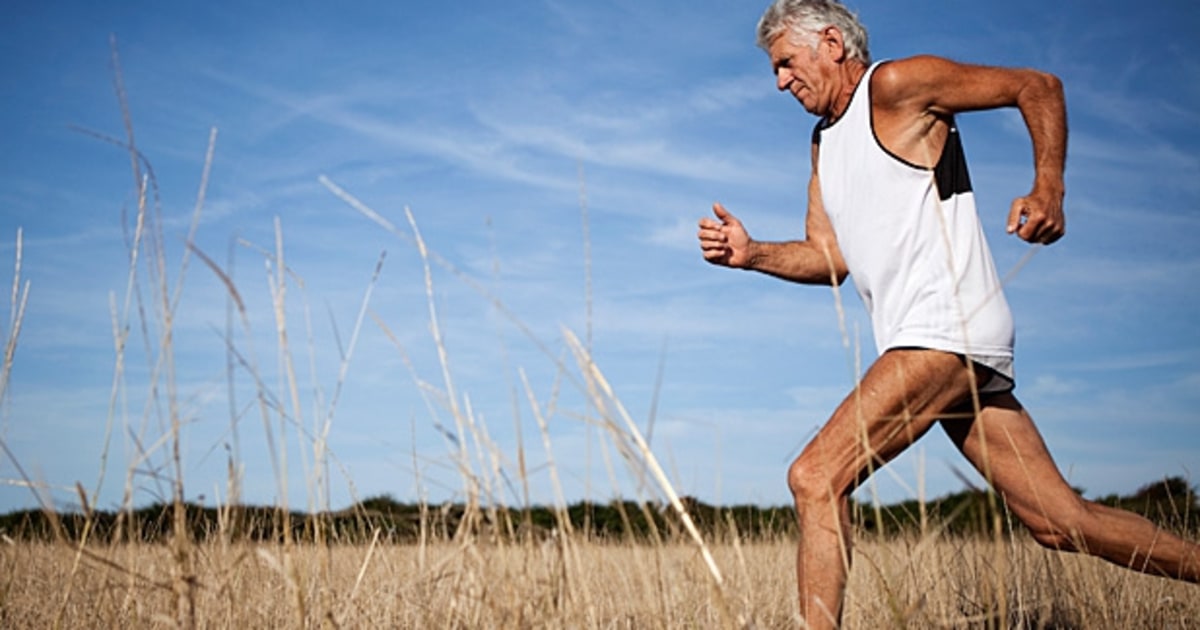


Maybe you've been told that your knees won't hold up or that it's "a sport for young people." These concerns are understandable, especially when you hear so many myths about running.
Good news: Your age alone isn't enough to determine whether running is right for you. A meta-analysis, which combines several studies, found fewer cases of hip or knee osteoarthritis among recreational runners than in sedentary control groups. This association does not prove that running prevents osteoarthritis, and the study did not assess the age at which participants began running.1. A common concern as people age is that running might damage the knees. The available data do not support the conclusion that recreational running causes knee osteoarthritis. Nor do they allow us to determine with certainty the role of running in this condition2. One systematic review even found a possible protective effect against surgery for knee osteoarthritis.2 We address this concern in detail in our article Does running cause osteoarthritis?.10 Quick Tips to Understand Your Pain
One tip a day for 10 days to help you better understand your pain. About a 2-minute read.
- Even at age 70, endurance training can improve the ability to sustain prolonged exertion. The extent of this adaptation varies depending on one’s health status, which does not mean that all tissues adapt in the same way or that a gradual progression is always sufficient to start running3.
- Both prior experience and age can influence a runner’s early performance. A systematic review links older age and a lack of running experience to an increased risk of injury among short-distance runners4.
- Running goals and training progress should be tailored to each person's abilities.
- In the pooled studies, people who ran for recreation had less hip or knee osteoarthritis than sedentary comparison groups. However, this association does not prove that a sedentary lifestyle directly damages the joints more than running in moderation1.
- Running injuries have several causes. A previous injury stands out as a significant risk factor amonglong-distance runners⁴, ⁵. Data on weekly mileage, frequency, intensity, and rapid changes in training load remain conflicting: they do not allow us to identify mileage as the primary factor, but you can adjust your mileage and your pace of progression6. This follows the same principle as in our article on overuse injuries.
This article explains the factors to consider before starting. To avoid injuries, also consult our guide on how to start running without getting injured.
Is there an age limit to start running?
Age alone does not determine whether you can start running. Your overall health, past injuries, and running experience also matter. Older age is one of the factors associated with injuries among short-distance runners. The risk depends on several factors, and there is no guarantee that a particular training progression will preventinjuries4, 7.
In a six-week supervised program involving 1,696 beginners aged 18 to 65, 10.9% sustained injuries. The risk was associated with older age and a higher body mass index, a measure of weight relative to height. Previous muscle, joint, or bone problems unrelated to sports, and a lack of running experience were also associated with the risk7. Certain factors will also influence how easily you can get started and the risk of injury you face.7
What factors should you consider before you start running?
Before you begin, be sure to consider your current level of physical activity, your overall health, the amount of time you spend sitting, and your footwear habits.
Does your lifelong level of physical activity affect how you start a race?
Your current physical condition helps determine how to start running. People who spend more time sitting tend to have lower levels of endurance, strength, and balance on average. These correlations are weak and do not allow us to directly determine the pace at which a sedentary person should start running8. No matter where you start, running form can be improved: check out our article on the best running technique.
- If you have been active all your life, your body already possesses several qualities necessary for running. Since it is a new sport, however, it will be important to properly manage your running and adopt appropriate running behaviors.
- If you haven't been very active, start by assessing your tolerance for walking and short runs. Alternating between walking and running may be appropriate, depending on your ability.
Does your overall health affect how well you adapt to running?
Your health can influence gains in endurance through exercise. Among adults aged 70 and older, a review of trials found greater gains in healthy individuals than in those with health problems. This finding pertains to endurance; it does not describe the adaptation of all tissues or the effect of each disease separately3.
- A chronic illness does not impose the same limitations on everyone. Your healthcare provider can help you determine the precautions that apply to your specific situation.
- Diabetes, high blood pressure, high cholesterol, and obesity are among the factors to discuss during this evaluation. Their presence alone is not enough to determine your running progress.
These individuals can start by walking if running is too strenuous for them at this time. The program is then adjusted based on how they respond to the exercise.
- They can also focus on getting enough sleep, eating well, and managing stress as they return to work.
Does your level of physical inactivity affect how you get started?
Spending a lot of time sitting is associated with lower endurance, lower muscle strength, and poorer balance. These associations are weak8. These associations do not allow you to determine your progress. Your current fitness level guides the choice between walking, running, or alternating between the two.
- Sedentary behavior refers to the time spent awake while sitting or lying down and expending very little energy—for example, in front of a screen or in a car. Sleeping or actively pedaling on a stationary bike does not count as sedentary behavior. The consensus on sedentary behavior clarifies this definition.
- An office job or long periods spent driving increase the amount of time you spend sitting. Your ability to walk, your balance, and your exercise tolerance provide more concrete information to help you prepare for your first race.
- A job that involves walking and regular physical activity already keeps your body moving. However, these habits are no substitute for a proper progression when you start running.
Do your shoe-wearing habits affect how you start a race?
Shoes alter the foot's movements and the way its muscles work while running9. However, the available data do not support the claim that prolonged use of thick, cushioned shoes reduces the feet’ ability to absorb impact from the ground10. This habit alone is therefore not enough to determine the pace of your early runs.
- Strengthening the muscles of the foot and ankle can be part of a prevention program. In a randomized trial involving 118 recreational runners, the comparison group—which did not receive the strengthening program—was 2.42 times more likely to sustain a running-related injury over a 12-month period than the group that completed the program. Increased foot strength was associated with a longer time to injury, but the trial does not demonstrate that improved foot muscle strength alone explains the observed reduction11.
- Simply because you’ve worn thick, cushioned shoes for a long time—without spending much time barefoot—doesn’t mean your feet have lost strength or the ability to handle physical exertion. Base your training progression on your current tolerance rather than on this habit alone.
- A study of children and adolescents in Kenya linked the habit of walking barefoot to greater strength in certain foot muscles. It compared the participants’ habits; it did not prove a causal relationship12. Another review, combining 28 trials, reports that minimalist shoes—which are very flexible and have little cushioning—may increase the strength of the little toes. Foot exercises may also improve certain measures of strength. The certainty of the results ranges from low to very low, and the findings regarding muscle size are inconsistent13.
For tips on choosing running shoes, check out our article on what shoes to wear for running, and the one on how to handle flat feet when running.
If injuries keep coming back despite a gradual increase in intensity, our article "Why Do I Keep Getting Injured While Running?" explains what to check. And if an injury occurs while you're out running, find out what to do about a running injury.
Where can I learn more about running?
To learn more about running, check out Episode 1 of the “Parle-moi de santé” podcast, hosted by one of our physical therapists, Alexis Gougeon.
Episode #1: Preventing and treating running injuries.
Listen to the episode on running with Blaise Dubois on Apple Podcasts.
Need professional advice?
Our physical therapists can assess your condition and provide you with a personalized treatment plan.
Make an appointmentSources:
Links open in a new tab.
- Alentorn-Geli E, Samuelsson K, Musahl V, Green CL, Bhandari M, Karlsson J. The Association of Recreational and Competitive Running With Hip and Knee Osteoarthritis: A Systematic Review and Meta-analysis. J Orthop Sports Phys Ther. 2017;47(6):373-390. (Back to sections: 1, 2)
- Timmins KA, Leech RD, Batt ME, Edwards KL. Running and Knee Osteoarthritis: A Systematic Review and Meta-analysis. Am J Sports Med. 2017;45(6):1447-1457. (Back to sections: 1, 2)
- Cheour S, Cheour C, Bragazzi NL, Zou L, Paravlic AH, Slimani M, et al. Dose-Response Relationship between Endurance Training Prescription Variables and Increases in Aerobic Performance of Healthy and Unhealthy Middle-Aged and Very Old Individuals Aged 70 Years and Older: A Systematic Review and Meta-Analysis of Randomized Controlled Trials. Life (Basel). 2021;11(2). (Back to sections: 1, 2)
- van Poppel D, van der Worp M, Slabbekoorn A, van den Heuvel SSP, van Middelkoop M, Koes BW, et al. Risk factors for overuse injuries in short- and long-distance running: A systematic review. J Sport Health Sci. 2021;10(1):14-28. (Back to sections: 1, 2, 3)
- van Gent RN, Siem D, van Middelkoop M, van Os AG, Bierma-Zeinstra SM, Koes BW. Incidence and determinants of lower extremity running injuries in long-distance runners: a systematic review. Br J Sports Med. 2007;41(8):469-80; discussion 480. (Back to section: 1)
- Fredette A, Roy JS, Perreault K, Dupuis F, Napier C, Esculier JF. The Association Between Running Injuries and Training Parameters: A Systematic Review. J Athl Train. 2022;57(7):650-671. (Back to section: 1)
- Kluitenberg B, van Middelkoop M, Smits DW, Verhagen E, Hartgens F, Diercks R, et al. The NLstart2run study: Incidence and risk factors of running-related injuries in novice runners. Scand J Med Sci Sports. 2015;25(5):e515-23. (Back to sections: 1, 2, 3)
- Silva FM, Duarte-Mendes P, Rusenhack MC, Furmann M, Nobre PR, Fachada MÂ, et al. Objectively Measured Sedentary Behavior and Physical Fitness in Adults: A Systematic Review and Meta-Analysis. Int J Environ Res Public Health. 2020;17(22). (Back to sections: 1, 2)
- Kelly LA, Lichtwark GA, Farris DJ, Cresswell A. Shoes alter the spring-like function of the human foot during running. J R Soc Interface. 2016;13(119). (Back to section: 1)
- Perkins KP, Hanney WJ, Rothschild CE. The risks and benefits of running barefoot or in minimalist shoes: a systematic review. Sports Health. 2014;6(6):475-80. (Back to section: 1)
- Taddei UT, Matias AB, Duarte M, Sacco ICN. Foot Core Training to Prevent Running-Related Injuries: A Survival Analysis of a Single-Blind, Randomized Controlled Trial. Am J Sports Med. 2020;48(14):3610-3619. (Back to section: 1)
- Aibast H, Okutoyi P, Sigei T, Adero W, Chemjor D, Ongaro N, et al. Foot Structure and Function in Adolescents Who Usually Go Barefoot or Wear Shoes in Kenya. Curr Sports Med Rep. 2017;16(6):448-458. (Back to section: 1)
- Peters-Dickie JL, Detrembleur C, Guallar-Bouloc M, Rastelli M, Lobet S, Hidalgo B, et al. The effects of foot core exercises and minimalist footwear on foot muscle size, foot strength, and biomechanics: A systematic review and meta-analysis. Clin Biomech (Bristol). 2025;122:106417. (Back to section: 1)
Customer satisfaction is our top priority
At Physioactif, excellence guides everything we do, but our patients are the best ones to tell you about it. Take a look at their verified reviews to get a real sense of their experience.










Discover our physical therapy clinics
We have locations in several areas to better serve you.
Blainville
190 Bas-de-Sainte-Thérèse Road, Suite 110,
Blainville, Quebec
J7B 1A7
Located in Blainville, near Rosemère, the Physioactif clinic is easily accessible to residents of the area and the surrounding communities
Boucherville
690 Rue de Montbrun, Suite S,
Boucherville, Quebec
J4B 8H2
Located in Boucherville, the Physioactif clinic is easily accessible to people in the area
Laval
3224 Jean-Béraud Ave., Suite 220, Laval,
QC H7T 2S4
Located in Chomedey, in the heart of Laval, the Physioactif clinic is easily accessible to people in the area
Montreal
8801 Lajeunesse Street,
Montreal,
QC H2M 1R8
Located in Ahuntsic, near Villeray, the Physioactif clinic is easily accessible to residents of both neighborhoods
Saint-Eustache
180 25th Avenue, Suite
201 Saint-Eustache
QC J7P 2V2
Located in Saint-Eustache, the Physioactif clinic is easily accessible to residents of the area and the surrounding communities
Vaudreuil
21 Cité-des-Jeunes Boulevard, Suite 240,
Vaudreuil-Dorion, Quebec
J7V 0N3
Located in Vaudreuil-Dorion, the Physioactif clinic is easily accessible to people in the area
Make an appointment now