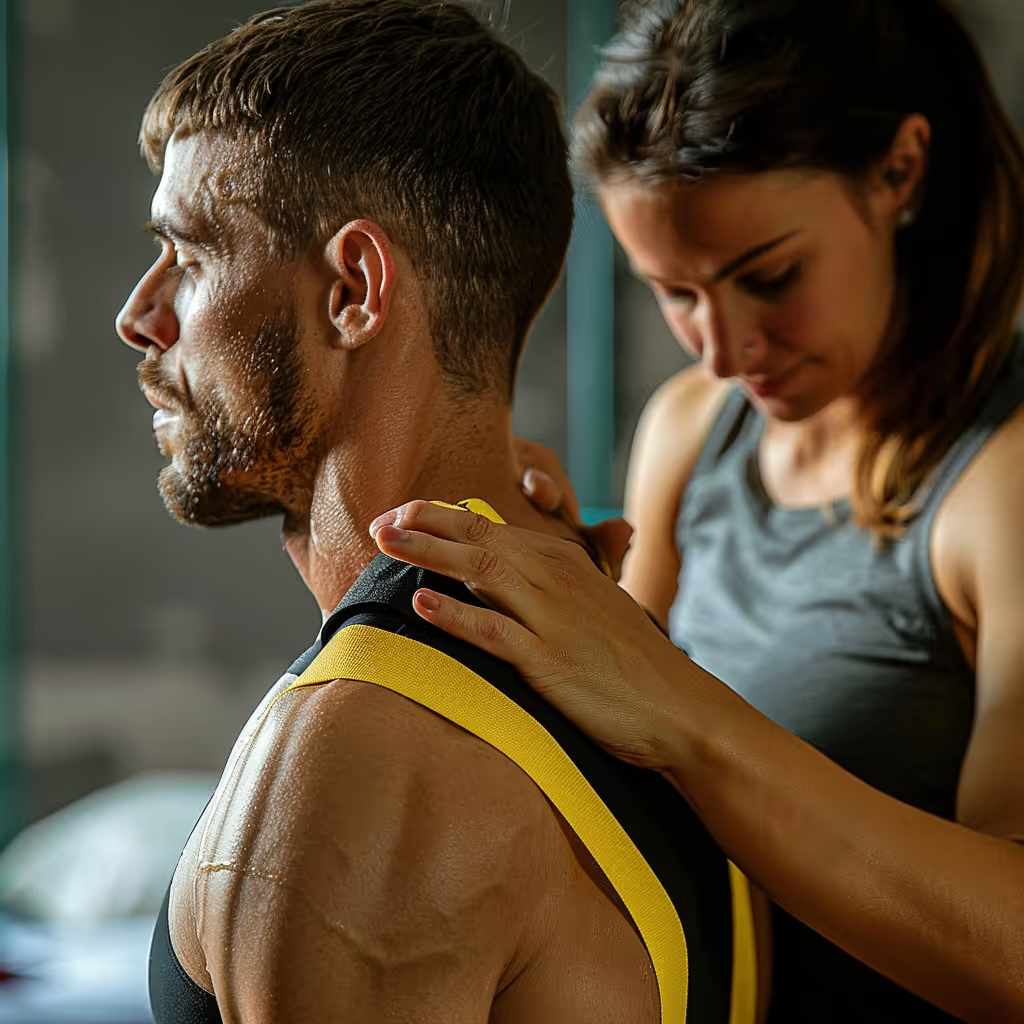


So, you've decided to take charge of your pain. You're eager to get advice tailored to your specific pain. In the meantime, here are our top physical therapy tips for pain management:
A review of 15 recent studies on back pain found an average 58% reduction in pain and difficulty performing daily activities during the first month. This result reflects an average outcome, not a guarantee for every individual.1 The same review reports that episodes of pain often recur within the following year1, which is why it’s important not to stop once you experience initial relief.
What are the best physical therapy tips for managing pain at home?
Pain management at home relies on appropriate activities, getting as much restful sleep as possible, and relief methods tailored to your situation. You can try applying cold or heat for comfort and ask your pharmacist for advice before taking any medication. These steps can make the waiting period more bearable. An assessment helps tailor these measures to your situation: our article on self-care and when to seek medical attention explains where to draw the line.
10 Quick Tips to Understand Your Pain
One tip a day for 10 days to help you better understand your pain. About a 2-minute read.
What should you do if you have sudden, severe pain?
Any recent, severe pain warrants professional medical advice, especially if it appears suddenly or worsens rapidly. For a recent soft-tissue injury, such as a sprain or muscle strain, PEACE and LOVE offers guidelines for management: protect the area initially, then gradually resume activities. This framework does not apply to all causes of pain2. The cause, duration, and progression of the pain guide the advice given. To understand the role of duration, see the difference between acute pain and chronic pain.
See the article on PEACE and LOVE for details.
If back pain is accompanied by a new difficulty urinating, loss of bladder or bowel control, numbness between the legs, or weakness in both legs, go to the emergency room immediately. Back pain following a serious accident also requires urgent evaluation. These symptoms require immediate medical attention.
1. Should you keep moving when you're in pain?
Exercise is generally beneficial, with activities tailored to your symptoms. For recent back pain with no signs of a serious problem, the recommendation to stay active offers a slight advantage in terms of daily activities and returning to work compared to bed rest. For sciatica—pain that radiates down the leg—this review finds little or no difference between these two recommendations.3
A short walk, gentle movements, or a few everyday activities can help you stay active. Adjust their duration and intensity based on your symptoms. In a program for patellar tendinopathy—a painful condition affecting the tendon beneath the kneecap—the authors use the same movement test every day. If pain returns to its usual level during this test within 24 hours, this serves as a guide for adjusting the intensity of your activities.4 A recommended program for Achilles tendinopathy—a painful condition affecting the tendon behind the ankle—also monitors pain, stiffness, and swelling after activity, particularly the following day. It includes recovery days between strenuous sessions.5 These benchmarks are part of specific tendon rehabilitation programs. Pain that subsides the next day does not, on its own, guarantee that an activity is appropriate for your condition.
Pain does not mean you have to avoid all movement. Taking breaks can be helpful, while prolonged bed rest is rarely necessary for simple back pain. For some conditions, prolonged immobility does more harm than good: in cases of recent back pain, people advised to stay in bed experience slightly more pain and recover slightly less well than those advised to stay active6. Monitor your pain and how easily you can move during and after activity. If your symptoms worsen significantly or if your activities become more difficult, reduce your effort and seek advice.
You can temporarily modify a movement or position that increases your pain. Try the following adjustments only if they improve your comfort:
- Leaning forward increases the pain: try bending your knees more, bringing the object closer to you, or reducing the range of motion.
- Sitting on the couch for a long time makes the pain worse: change your position, try sitting in a chair, or add a cushion.
- Turning your head to the right increases the pain: temporarily limit your neck movement or turn your torso as well.
- Sleeping on one shoulder makes the pain worse: try sleeping on the other side and prop up your sore arm with a pillow.
2. How can I sleep better despite the pain?
A comfortable sleeping position is one that reduces your pain and allows you to rest. However, be sure to follow any specific instructions you received after an injury or surgery. If your back or neck feels tight, try sleeping on your back or on your side, and use pillows or a rolled-up blanket to fill in any gaps and make the position more comfortable.
- Gently try out several positions and stick with the ones that provide relief.
- If you sleep on your side: a pillow large enough to fill the space between the bed and your head often makes this position more comfortable, and body pillows or a rolled-up comforter can support your torso (place your legs and arms on either side as if you were hugging it).
- If you sleep on your back: place a rolled-up blanket under your knees and choose a pillow that isn't too high.
3. Cold or hot: which one should you choose?
Choose between cold and heat based on which provides relief. For back pain that’s new or has been present for a few weeks, heat may offer some short-term pain relief. The data on cold therapy is too limited, and direct comparisons are contradictory, so we can’t conclude that one is better than the other: try both and stick with whatever works for you.7
Wrap the cold or heat source in a cloth to protect the skin. Use a comfortable temperature. See this article on cold and heat for more information.
4. Can I take medication while I'm waiting for my appointment?
Your pharmacist can check whether a medication is appropriate for your pain and your health condition. Some medications for pain, inflammation, or muscle spasms—involuntary muscle contractions—are available without a prescription. Their benefits and risks depend on the specific product and your individual situation.
Your pharmacist is a valuable ally in choosing the right product, dosage, and duration of use. Be sure to mention any other medications you’re taking and any health conditions you have. Some products require special precautions or may not be right for you. The goal is to relieve pain enough to make it easier for you to go about your daily activities, without viewing the medication as a sign of recovery. Health Canada explains how to use medications in consultation with your healthcare provider.
5. How can you take care of yourself while you wait?
Taking care of yourself while you wait means getting enough sleep, drinking enough water, eating a balanced diet, cutting back on alcohol and cigarettes, and finding ways to reduce stress.
Pain can make these habits more difficult. Choose actions you can manage and ask for help when needed:
- Maintain as regular a sleep schedule as possible
- Drinking enough water
- Eating a balanced diet
- Cut back on alcohol and cigarettes to support your overall health
- Try to manage stress (meditation, walking, breathing, asking for help when possible).
One reassuring point while you wait: As seen in images of the spine, changes in the discs—the cushions between the vertebrae—are common even in people without pain, and they become more frequent with age. These changes are often part of the normal aging process and are not always the cause of pain.8
If words like “degeneration” worry you, our article on what medical imaging can really tell you about your aches and pains explains why an image doesn’t tell the whole story about your pain.
When your appointment arrives, the physical therapy evaluation is designed to tailor this advice to your specific situation. If you’ve been experiencing pain for a long time, our guide on chronic pain goes into more detail.
Need professional advice?
Our physical therapists can assess your condition and provide you with a personalized treatment plan.
Make an appointmentReferences
Links open in a new tab.
- Pengel LH, Herbert RD, Maher CG, Refshauge KM. Acute low back pain: a systematic review of its prognosis. BMJ. 2003;327(7410):323. (Back to sections: 1, 2)
- Dubois B, Esculier JF. Soft-tissue injuries simply need PEACE and LOVE. Br J Sports Med. 2020;54(2):72-73. (Back to section: 1)
- Hilde G, Hagen KB, Jamtvedt G, Winnem M. Advice to stay active as a single treatment for low back pain and sciatica. Cochrane Database Syst Rev. 2002(2):CD003632. (Back to section: 1)
- Malliaras P, Cook J, Purdam C, Rio E. Patellar Tendinopathy: Clinical Diagnosis, Load Management, and Advice for Challenging Case Presentations. J Orthop Sports Phys Ther. 2015;45(11):887-98. (Back to section: 1)
- Silbernagel KG, Crossley KM. A Proposed Return-to-Sport Program for Patients With Midportion Achilles Tendinopathy: Rationale and Implementation. J Orthop Sports Phys Ther. 2015;45(11):876-86. (Back to section: 1)
- Hagen KB, Jamtvedt G, Hilde G, Winnem MF. The updated Cochrane review of bed rest for low back pain and sciatica. Spine (Phila, Pa, 1976). 2005;30(5):542-6. (Back to section: 1)
- French SD, Cameron M, Walker BF, Reggars JW, Esterman AJ. Superficial heat or cold for low back pain. Cochrane Database Syst Rev. 2006;2006(1):CD004750. (Back to section: 1)
- Brinjikji W, Luetmer PH, Comstock B, Bresnahan BW, Chen LE, Deyo RA, et al. Systematic literature review of imaging features of spinal degeneration in asymptomatic populations. AJNR Am J Neuroradiol. 2015;36(4):811-6. (Back to section: 1)
Customer satisfaction is our top priority
At Physioactif, excellence guides everything we do, but our patients are the best ones to tell you about it. Take a look at their verified reviews to get a real sense of their experience.









Discover our physical therapy clinics
We have locations in several areas to better serve you.
Blainville
190 Bas-de-Sainte-Thérèse Road, Suite 110,
Blainville, Quebec
J7B 1A7
Located in Blainville, near Rosemère, the Physioactif clinic is easily accessible to residents of the area and the surrounding communities
Boucherville
690 Rue de Montbrun, Suite S,
Boucherville, Quebec
J4B 8H2
Located in Boucherville, the Physioactif clinic is easily accessible to people in the area
Laval
3224 Jean-Béraud Ave., Suite 220, Laval,
QC H7T 2S4
Located in Chomedey, in the heart of Laval, the Physioactif clinic is easily accessible to people in the area
Montreal
8801 Lajeunesse Street,
Montreal,
QC H2M 1R8
Located in Ahuntsic, near Villeray, the Physioactif clinic is easily accessible to residents of both neighborhoods
Saint-Eustache
180 25th Avenue, Suite
201 Saint-Eustache
QC J7P 2V2
Located in Saint-Eustache, the Physioactif clinic is easily accessible to residents of the area and the surrounding communities
Vaudreuil
21 Cité-des-Jeunes Boulevard, Suite 240,
Vaudreuil-Dorion, Quebec
J7V 0N3
Located in Vaudreuil-Dorion, the Physioactif clinic is easily accessible to people in the area
Make an appointment now