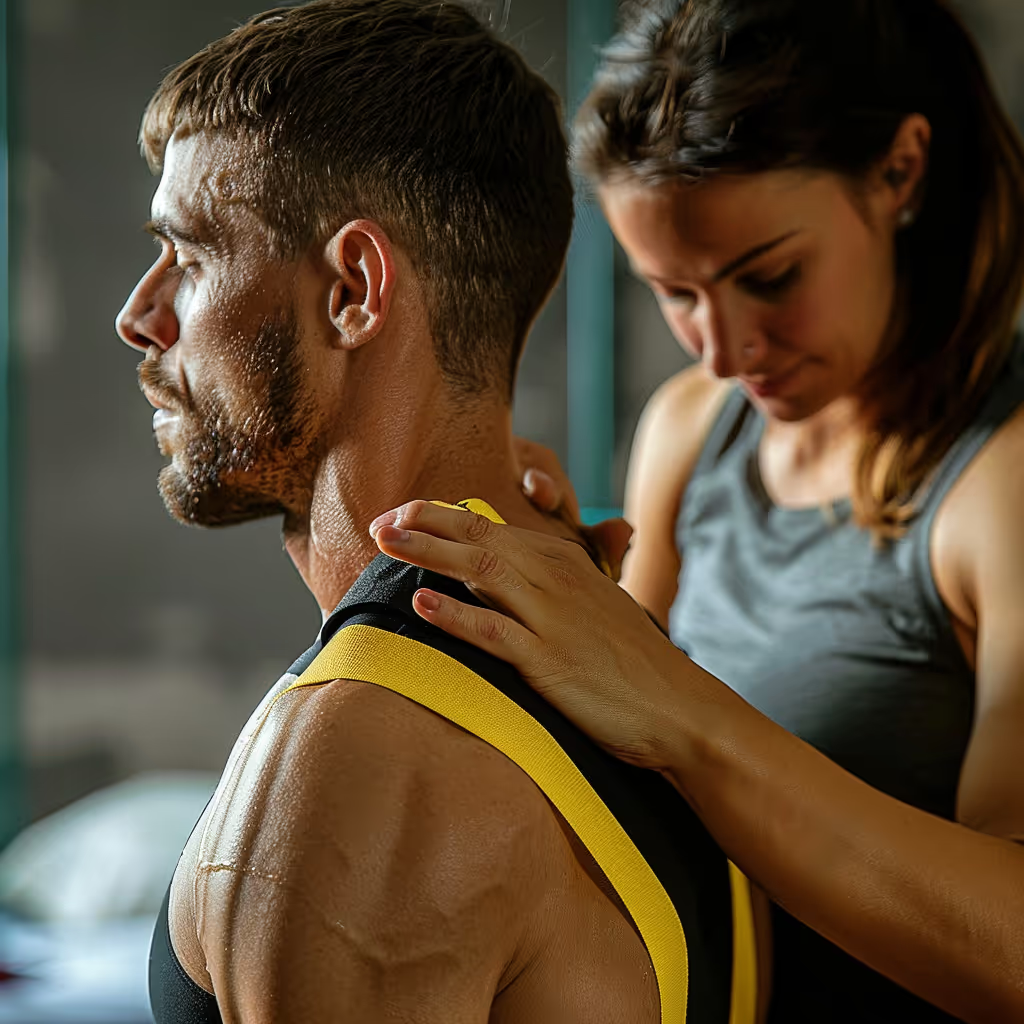


You've been diagnosed with osteoarthritis and now you're worried. Will it get worse? Will you lose your mobility? Perhaps you're afraid to move, fearing it might make things worse. These concerns are understandable, but the reality is often more encouraging than you might imagine.
Appropriate exercise is one of the first-line treatments for hip and knee osteoarthritis. The 2020 physical therapy guide combines exercises with recommendations in its four care profiles.1 A regular program, tailored to your needs, can reduce pain and make it easier to perform daily activities. Discomfort may increase at first; your physical therapist will work with you to adjust the exercises (exercises adapted for osteoarthritis).
Osteoarthritis visible on an X-ray does not always cause pain. Conversely, knee pain can occur without visible osteoarthritis. Therefore, the X-ray and your symptoms must be interpreted together.2 However, changes in the joint can contribute to pain, and more advanced signs are more often associated with symptoms.3
10 Quick Tips to Understand Your Pain
One tip a day for 10 days to help you better understand your pain. About a 2-minute read.
What Science Tells Us About Osteoarthritis and Pain:
- Signs of osteoarthritis on medical images, such as X-rays, may be present even in the absence of pain2
- Osteoarthritis usually progresses slowly. However, one review describes rapid progression in at least one in seven people who develop knee osteoarthritis in the studies examined. The affected knees progress from no or minimal signs to an advanced stage on X-rays in less than four years, often in less than twelve months.4 This figure does not apply to all people who already have osteoarthritis.
- Appropriate exercise can improve symptoms. A meta-analysis found no evidence that therapeutic exercises damage the structure or quality of knee cartilage—the tissue that covers the ends of the bones.5 The program remains tailored to your condition. Our article also addresses the question: Does running cause osteoarthritis?
- Exercises, advice, and other treatments can help manage pain and resume activities. You can choose a plan based on your needs.
The example of the hip illustrates this difference. One study looked at 978 adults aged 50 and older living in Framingham, in the United States. After adjusting the estimates for age, 19.6% showed signs of hip osteoarthritis on X-rays. The proportion was 4.2% for those who had both these signs and pain in the same hip on most days.6
This guide helps you understand the true relationship between osteoarthritis and pain. To learn more about different forms of osteoarthritis, consult our guide on knee osteoarthritis.
Can osteoarthritis develop overnight?
Osteoarthritis generally develops over several years and does not usually develop overnight. However, some forms of knee osteoarthritis progress more rapidly, as noted in the review described above.4 Sudden pain alone is therefore not a reliable indicator of the rate of change in your joint.
A flare-up of osteoarthritis is a temporary worsening of symptoms, such as pain, stiffness, or swelling (osteoarthritis flare-ups). New pain may also have another cause, such as an injury. Your medical history and a physical exam help assess the cause (causes of joint pain). The pain may be related to osteoarthritis without exactly matching the changes visible on an X-ray.3
Certain changes in the knee become more common with age and are also seen in adults who have no pain or history of injury. A review of magnetic resonance imaging (MRI) scans—a test that shows the tissues—confirms this.7 This does not mean that all osteoarthritis is simply a normal change or that the tissues never contribute to pain.
Osteoarthritis may be accompanied by pain or may be painless. It does not necessarily worsen continuously. Treatment can reduce symptoms and improve daily functioning, even though no treatment can cure osteoarthritis (progression and treatments).
The X-ray alone isn't enough to explain all your pain.
To improve your comfort, the treatment plan takes into account the joint and other factors that influence pain. Pain intensity does not directly reflect the condition of the tissues.8 Nerves and the brain play a role in the experience of pain. Sleep, stress, fatigue, and expectations can also influence it; pain, in turn, can disrupt sleep and mood.3, 8 These connections do not mean that the pain is imaginary or that you are to blame for it. The same severity of an injury seen on an X-ray does not necessarily result in the same symptoms in two different people.2
How Can Physical Therapy Help With Painful Osteoarthritis?
Physical therapy helps manage osteoarthritis pain and resume daily activities through tailored exercises and guidance.1 The physical therapist assesses your symptoms, your range of motion, and the activities you find difficult. The treatment plan may include:
- A schedule that balances strenuous tasks, leisure activities, and sports, with breaks or adjusted exertion levels.
- Exercises to strengthen muscles and maintain the ability to walk or engage in other activities.
- Adjustments to your posture or movements to make tasks that are difficult for you easier.
- Depending on your needs, manual therapy—such as hand-guided joint movements—may be used in conjunction with exercises (the role of manual therapy).
The 2020 guidelines place education and exercise at the center of care for hip or knee osteoarthritis.1 A review of twelve studies on manual therapy for the knee reports improvements in functional ability as assessed by questionnaires, compared to no treatment or when these techniques are added to another treatment. Some pain-related results are also favorable. The quality of the studies varied, and the data do not allow for conclusions regarding functional ability as measured by physical tests.9
What symptoms can osteoarthritis cause?
Osteoarthritis can cause joint pain, stiffness, difficulty moving, and sometimes swelling (symptoms of osteoarthritis). Cracking sounds may also occur. To diagnose knee osteoarthritis, the healthcare professional considers several factors from the patient’s history and physical examination; no single sound or symptom is sufficient on its own.10, 11
- The absence of stiffness upon waking, or stiffness lasting less than thirty minutes, is consistent with osteoarthritis. Stiffness lasting longer warrants evaluation (diagnostic criteria). This criterion complements the other symptoms.10
- Cracking or creaking sounds in the joint when you move—known as crepitus—are common, even in people who aren't experiencing pain12. These sounds alone are not sufficient to conclude that tissue is tearing. They may be associated with signs of osteoarthritis on medical imaging, but the certainty of the evidence is low to very low. They must be interpreted in conjunction with other symptoms.
- Swelling may be a symptom of osteoarthritis, but it can also have other causes. If it gets worse, recurs frequently, or persists, have it evaluated (persistent pain or swelling).
Treatment is tailored to your symptoms and the activities you wish to resume. Improvement is still possible even if changes are visible on the images; the response to treatment varies from person to person.
Education includes information about osteoarthritis, advice on adjusting activities, and support for managing symptoms on a daily basis.1
Your age or X-ray results do not fully reflect your capabilities. For hip or knee osteoarthritis, pain that still significantly limits your daily life despite appropriate treatment warrants a new evaluation. You can then discuss other options, including surgery in some cases (when to reconsider treatment options).
When should you seek immediate medical attention?
A painful joint accompanied by swollen, warm skin requires urgent medical attention. Joint pain accompanied by general malaise, high fever, feelings of heat or cold, or chills also requires urgent medical attention (signs requiring urgent care).
Go to the emergency room if you can no longer walk or put weight on your leg, or if the joint appears to be out of place, even without an injury. After a fall or injury, severe joint pain, tingling, or loss of sensation also require immediate medical attention. Call 911 if you need an ambulance (signs requiring immediate medical attention). These situations should not automatically be attributed to osteoarthritis.
Depending on the affected joint, our detailed guides go into greater depth: hip osteoarthritis, lumbar osteoarthritis, and cervical osteoarthritis.
To learn more
The podcast “Parle-moi de santé,” hosted by physical therapist Alexis Gougeon, dedicates its 15th episode to osteoarthritis with Anthony Teoli.
Episode 15 of Parle-moi de santé (osteoarthritis)
The link above takes you to the video episode.
Need professional advice?
Our physical therapists can assess your condition and provide you with a personalized treatment plan.
Make an appointmentSources
Links open in a new tab.
- van Doormaal MCM, Meerhoff GA, Vliet Vlieland TPM, Peter WF. A clinical practice guideline for physical therapy in patients with hip or knee osteoarthritis. Musculoskeletal Care. 2020;18(4):575-595. (Back to sections: 1, 2, 3, 4)
- Bedson J, Croft PR. The discordance between clinical and radiographic knee osteoarthritis: a systematic review and summary of the literature. BMC Musculoskeletal Disorders. 2008;9:116. (Back to sections: 1, 2, 3)
- Neogi T. The epidemiology and impact of pain in osteoarthritis. Osteoarthritis Cartilage. 2013;21(9):1145-53. (Back to sections: 1, 2, 3)
- Driban JB, Harkey MS, Barbe MF, Ward RJ, MacKay JW, Davis JE, et al. Risk factors and the natural history of accelerated knee osteoarthritis: a narrative review. BMC Musculoskeletal Disorders. 2020;21(1):332. (Back to sections: 1, 2)
- Bricca A, Juhl CB, Roos EM. Does Exercise Therapy "Wear Down" My Knee Joint: Myth or Reality? J Orthop Sports Phys Ther. 2025;55(7):1-5. (Back to section: 1)
- Kim C, Linsenmeyer KD, Vlad SC, Guermazi A, Clancy MM, Niu J, et al. Prevalence of radiographic and symptomatic hip osteoarthritis in an urban U.S. community: the Framingham Osteoarthritis Study. Arthritis Rheumatol. 2014;66(11):3013-7. (Back to section: 1)
- Culvenor AG, Øiestad BE, Hart HF, Stefanik JJ, Guermazi A, Crossley KM. Prevalence of knee osteoarthritis features on magnetic resonance imaging in asymptomatic, uninjured adults: a systematic review and meta-analysis. Br J Sports Med. 2019;53(20):1268-1278. (Back to section: 1)
- Cohen SP, Vase L, Hooten WM. Chronic pain: an update on burden, best practices, and new advances. Lancet. 2021;397(10289):2082-2097. (Back to sections: 1, 2)
- Salamh P, Cook C, Reiman MP, Sheets C. Treatment effectiveness and fidelity of manual therapy for the knee: A systematic review and meta-analysis. Musculoskeletal Care. 2017;15(3):238-248. (Back to section: 1)
- Zhang W, Doherty M, Peat G, Bierma-Zeinstra MA, Arden NK, Bresnihan B, et al. EULAR evidence-based recommendations for the diagnosis of knee osteoarthritis. Ann Rheum Dis. 2010;69(3):483-9. (Back to sections: 1, 2)
- Décary S, Feldman D, Frémont P, Pelletier JP, Martel-Pelletier J, Fallaha M, et al. Initial derivation of diagnostic clusters combining history elements and physical examination tests for symptomatic knee osteoarthritis. Musculoskeletal Care. 2018;16(3):370-379. (Back to section: 1)
- Couch JL, King MG, De Oliveira Silva D, Whittaker JL, Bruder AM, Serighelli F, et al. Noisy knees—prevalence of knee crepitus and its association with structural pathology: a systematic review and meta-analysis. Br J Sports Med. 2025;59(2):126-132. (Back to section: 1)
Customer satisfaction is our top priority
At Physioactif, excellence guides everything we do, but our patients are the best ones to tell you about it. Take a look at their verified reviews to get a real sense of their experience.










Discover our physical therapy clinics
We have locations in several areas to better serve you.
Blainville
190 Bas-de-Sainte-Thérèse Road, Suite 110,
Blainville, Quebec
J7B 1A7
Located in Blainville, near Rosemère, the Physioactif clinic is easily accessible to residents of the area and the surrounding communities
Boucherville
690 Rue de Montbrun, Suite S,
Boucherville, Quebec
J4B 8H2
Located in Boucherville, the Physioactif clinic is easily accessible to people in the area
Laval
3224 Jean-Béraud Ave., Suite 220, Laval,
QC H7T 2S4
Located in Chomedey, in the heart of Laval, the Physioactif clinic is easily accessible to people in the area
Montreal
8801 Lajeunesse Street,
Montreal,
QC H2M 1R8
Located in Ahuntsic, near Villeray, the Physioactif clinic is easily accessible to residents of both neighborhoods
Saint-Eustache
180 25th Avenue, Suite
201 Saint-Eustache
QC J7P 2V2
Located in Saint-Eustache, the Physioactif clinic is easily accessible to residents of the area and the surrounding communities
Vaudreuil
21 Cité-des-Jeunes Boulevard, Suite 240,
Vaudreuil-Dorion, Quebec
J7V 0N3
Located in Vaudreuil-Dorion, the Physioactif clinic is easily accessible to people in the area
Make an appointment now