Guyon's Canal Syndrome
It's a tunnel through which several tendons and the ulnar nerve pass. The tunnel is formed by wrist bones and ligaments. If the space in Guyon's canal is too small for the ulnar nerve to move freely, irritation of this nerve can develop, which is known as Guyon's canal syndrome.
.png)
.png)
.png)


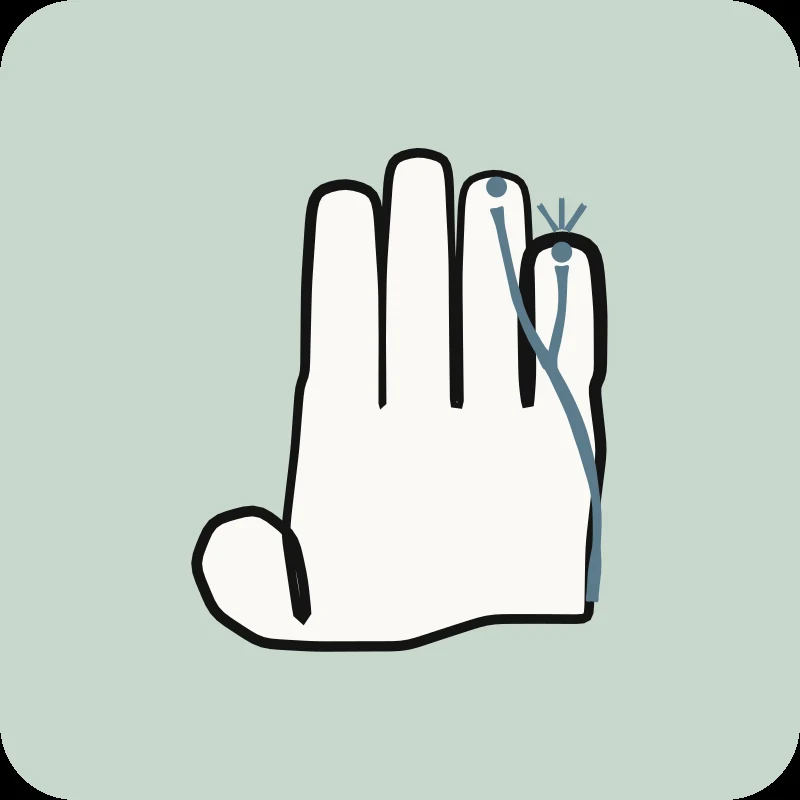


What is Guyon's canal syndrome?
Guyon's canal syndrome is a compression of the ulnar nerve within a tunnel located on the little-finger side of the wrist.1 Symptoms affect sensation, strength, or both, depending on which part of the nerve is compressed.
Specifically, what is Guyon's canal?
The Guyon’s canal is a passageway in the wrist that contains the ulnar nerve and the ulnar artery, a blood vessel that carries blood. It does not contain any tendons, which are bands of tissue that connect a muscle to a bone. Its walls consist of bones and ligaments, which are strong bands that connect bones. It is divided into three zones. Compression in the first zone can reduce strength and sensation. In the second zone, it primarily affects strength. In the third zone, it primarily affects sensation.2
Pressure or damage within the tunnel can interfere with the function of the ulnar nerve. Compressed nerves may exhibit changes in circulation and signal transmission, but the exact combination of mechanisms varies depending on the cause and duration of the problem.3
10 Quick Tips to Understand Your Pain
One tip a day for 10 days to help you better understand your pain. About a 2-minute read.
What is a nerve?
A nerve carries signals between the brain, the spinal cord, and the rest of the body. The spinal cord is a nerve cord protected by the spine. Some signals allow us to sense touch, pressure, or temperature. Others instruct the muscles to contract to produce movement.
What is the ulnar nerve?
The ulnar nerve originates in the neck, runs down the arm and forearm, and then passes through Guyon’s canal at the wrist. The entire nerve controls certain muscles of the forearm and several small muscles of the hand. Because compression of Guyon’s canal occurs at the wrist, it primarily affects the muscles of the hand. The nerve also contributes to sensation in the little finger and part of the ring finger.4
What are the causes of Guyon's canal syndrome?
The syndrome may be related to repeated pressure on the palm, an injury, a fracture, a cyst (a fluid-filled sac), or a problem with the ulnar artery. Compression and stretching are among the mechanisms studied in nerve disorders, though they do not explain every case in the same way.3
The specific cause may vary from person to person. The following situations can compress or irritate the nerve in the wrist:
- Repetitive pressure or movements of the hand and wrist5
- Repeated pressure on the palm or heavy loads on the wrist
- For example: gymnasts who do a lot of handstand pirouettes
- A direct blow or a wrist fracture, such as after falling on one's hand
- Prolonged pressure on the inside of the wrist
- For example, during a long bike ride4, doing a lot of floor exercises using your hands for support (push-ups, hand planks)
What are the symptoms of Guyon's canal syndrome?
The main symptoms include tingling or numbness in the little finger and part of the ring finger, pain on the side of the little finger, or weakness in the hand.
- Pain, burning, numbness, or tingling on the side of the little finger
- Often in the 4th and 5th fingers
- Feeling of weakness in the hand6
- Change in sensation in the hand or fingers
Weakness may be noticeable when spreading or bringing the fingers together, pinching an object between the thumb and index finger, or shaking hands. Long-term damage can also cause certain muscles in the hand to atrophy.7
Compression in the Guyon's canal primarily causes symptoms in the hand. Symptoms that radiate up the forearm, reach the elbow, or originate in the neck may indicate that the nerve is irritated elsewhere.1“Arm neuralgia” describes pain related to a nerve in the arm, but this term alone does not specify the exact location of the problem. See our guide on arm neuralgia.
How is Guyon's canal syndrome diagnosed?
The diagnosis is based on the history of symptoms, an examination of sensation and strength, and then identifying the location where the nerve is affected.5
Electromyography measures the electrical activity of muscles. Nerve conduction studies measure the speed and strength of signals in the nerves. These tests can support the diagnosis and help pinpoint the location of the problem in the wrist, elbow, or neck.1 An X-ray, ultrasound, or MRI may be ordered if a fracture, cyst, abnormal muscle, or arterial problem is suspected.
When should you consult a physiotherapist for Guyon's canal syndrome?
You can see a physical therapist if mild to moderate symptoms are limiting your activities and if there is no progressive weakness. The physical therapist can assess which movements and pressures affect your symptoms and then refer you for further evaluation if another cause needs to be investigated.
At a private clinic, you can see a physical therapist directly for a non-urgent condition. However, new or worsening weakness, visible muscle loss, a lump on the wrist, or symptoms following an injury require prompt medical evaluation. Seek emergency care if the pain is severe, if it makes you feel very unwell, dizzy, or nauseous, or if you experience sensations of heat or cold or chills. Urgent care is also warranted if you cannot move your wrist or hold an object, if you lose some or all sensation, or if your wrist changes shape. After an injury, a cracking or snapping sound also requires urgent evaluation. A cold, pale, or bluish hand, as well as a very painful, warm, or red lump, also requires urgent care.
What physiotherapy treatments are available for Guyon's canal syndrome?
Physical therapy can help reduce pressure on the nerve, maintain functional movement, and gradually resume activities. Data specific to physical therapy for this rare syndrome remain limited. The evaluation focuses on the following aspects, among others:
- Hand and Finger Muscle Strength
- Sensitivity in the little finger, ring finger, and back of the hand
- Movements of the wrist, elbow, shoulder, and neck
- Support, tools, and activities that worsen symptoms
- Signs indicating a lesion located outside the Guyon canal
Based on the results of the assessment, the plan may include the following measures:
- Reduce or distribute direct pressure on the palm
- Temporarily adjust your bike, equipment, floor exercises, or other activities that trigger symptoms
- Use a splint—a removable support that keeps the wrist straight rather than bent—especially at night, if recommended
- Perform gentle wrist movements and exercises appropriate for your hand strength
- Try nerve glide exercises if the evaluation determines that they are tolerable
- Reassess the symptoms and seek medical advice if the weakness worsens or if non-surgical treatment is not helping
Nerve gliding exercises move the nerve through the surrounding tissues, but the cited study does not demonstrate that they reduce symptoms of Guyon’s canal syndrome. In this study using donated cadavers, a gliding motion moved the median and ulnar nerves further than a motion that increased their tension. Measurements were taken at the wrist for the median nerve and near the elbow for the ulnar nerve.8
What can you do at home for Guyon's canal syndrome?
At home, reduce direct pressure on the little finger side of your wrist and temporarily adjust any activities that trigger your symptoms. Resume these activities gradually once your sensitivity and strength allow it.
Other measures can help reduce pressure on the nerve:
- A splint—a removable brace worn temporarily at night—can help keep the wrist straight rather than bent, provided it is comfortable and fits properly
- Place a pillow under your forearm if necessary, without resting the little-finger side of your wrist on a hard surface
- When riding a bike, change your hand position often, adjust your grip, and stop your ride if numbness or weakness increases
Seek medical attention if symptoms persist despite these measures. Increasing weakness or muscle loss requires prompt medical attention.
Need professional advice?
Our physical therapists can assess your condition and recommend a personalized treatment plan.
Make an appointmentSources
Links open in a new tab.
- Scarborough A, MacFarlane RJ, Mehta N, Smith GD. Ulnar tunnel syndrome: pathoanatomy, clinical features, and management. Br J Hosp Med (Lond). 2020;81(9):1-9. (Back to sections: 1, 2, 3)
- Saran S, Reddy PS, Shirodkar K, Shah AB, Agarwal A, Shah A, et al. Unveiling Guyon's Canal: Insights into Clinical Anatomy, Pathology, and Imaging. Diagnostics (Basel). 2025;15(5). (Back to section 1)
- Schmid AB, Fundaun J, Tampin B. Entrapment neuropathies: a contemporary approach to pathophysiology, clinical assessment, and management. Pain Rep. 2020;5(4):e829. (Back to sections: 1, 2)
- Vij N, Traube B, Bisht R, Singleton I, Cornett EM, Kaye AD, et al. An Update on Treatment Modalities for Ulnar Nerve Entrapment: A Literature Review. Anesth Pain Med. 2020;10(6):e112070. (Back to sections: 1, 2)
- Earp BE, Floyd WE, Louie D, Koris M, Protomastro P. Ulnar nerve entrapment at the wrist. J Am Acad Orthop Surg. 2014;22(11):699-706. (Back to sections: 1, 2)
- Tottas S, Kougioumtzis I, Titsi Z, Ververidis A, Tilkeridis K, Drosos GI. Ulnar nerve entrapment in Guyon's canal caused by a ganglion cyst: two case reports and a review of the literature. Eur J Orthop Surg Traumatol. 2019;29(7):1565-1574. (Back to section: 1)
- Okwumabua E, Sinkler MA, Bordoni B. Anatomy: Shoulder and Upper Limb, Hand Muscles. StatPearls. 2023. (Back to section: 1)
- Coppieters MW, Butler DS. Do “sliders” slide and “tensioners” tension? An analysis of neurodynamic techniques and considerations regarding their application. Man Ther. 2008;13(3):213-21. (Back to section: 1)
- Dua A, Gillespie E. Guyon Canal Syndrome. [Updated September 13, 2026]. In: StatPearls [Internet]. Treasure Island (FL): StatPearls Publishing; 2026.
- Dy CJ, Mackinnon SE. Ulnar neuropathy: evaluation and management. Curr Rev Musculoskelet Med. 2016;9(2):178-84.
Videos in this category
Other conditions

Hip osteoarthritis is the normal wear and tear of the hip joint. It is often said that osteoarthritis is the wear and tear of the cartilage between our bones. That is true, but it involves more than just the cartilage. Cartilage is a tissue that acts as a cushion between the surfaces of our bones and allows our joints to glide smoothly and move fluidly.
This is normal wear and tear of the knee joint. It’s often said that osteoarthritis is the wearing down of the cartilage between our bones. That’s true, but it’s more than just the cartilage. Cartilage is a tissue that acts as a cushion between the surfaces of our bones and allows our joints to glide smoothly and move fluidly.
It is an inflammation of the subacromial bursa in the shoulder joint.
A bursa is a small, thin sac filled with fluid that is found in many of the body's joints. This small sac acts as a cushion within the joint and lubricates the structures that are subject to increased friction.
It is a tissue that surrounds the shoulder and helps keep the shoulder bone in place within the joint. The capsule helps keep the joint stable.
Neck pain is a general term used to describe pain in the neck that has no specific cause, such as an accident or a sudden awkward movement. Neck pain is therefore synonymous with “my neck hurts, and nothing in particular happened.”
In both types of injury, pain is felt in the neck and then radiates into the arm, or vice versa.
Make an appointment now
We offer a three-pronged quality assurance approach: optimized treatment time, a second opinion from a physical therapist, and ongoing expertise to ensure effective care tailored to your needs.
Customer satisfaction is our top priority
At Physioactif, excellence guides everything we do, but our patients are the best ones to tell you about it. Take a look at their verified reviews to get a real sense of their experience.









Discover our physical therapy clinics
We have locations in several areas to better serve you.
Blainville
190 Bas-de-Sainte-Thérèse Road, Suite 110,
Blainville, Quebec
J7B 1A7
Located in Blainville, near Rosemère, the Physioactif clinic is easily accessible to residents of the area and the surrounding communities
Boucherville
690 Rue de Montbrun, Suite S,
Boucherville, Quebec
J4B 8H2
Located in Boucherville, the Physioactif clinic is easily accessible to people in the area
Laval
3224 Jean-Béraud Ave., Suite 220, Laval,
QC H7T 2S4
Located in Chomedey, in the heart of Laval, the Physioactif clinic is easily accessible to people in the area
Montreal
8801 Lajeunesse Street,
Montreal,
QC H2M 1R8
Located in Ahuntsic, near Villeray, the Physioactif clinic is easily accessible to residents of both neighborhoods
Saint-Eustache
180 25th Avenue, Suite
201 Saint-Eustache
QC J7P 2V2
Located in Saint-Eustache, the Physioactif clinic is easily accessible to residents of the area and the surrounding communities
Vaudreuil
21 Cité-des-Jeunes Boulevard, Suite 240,
Vaudreuil-Dorion, Quebec
J7V 0N3
Located in Vaudreuil-Dorion, the Physioactif clinic is easily accessible to people in the area
Make an appointment now