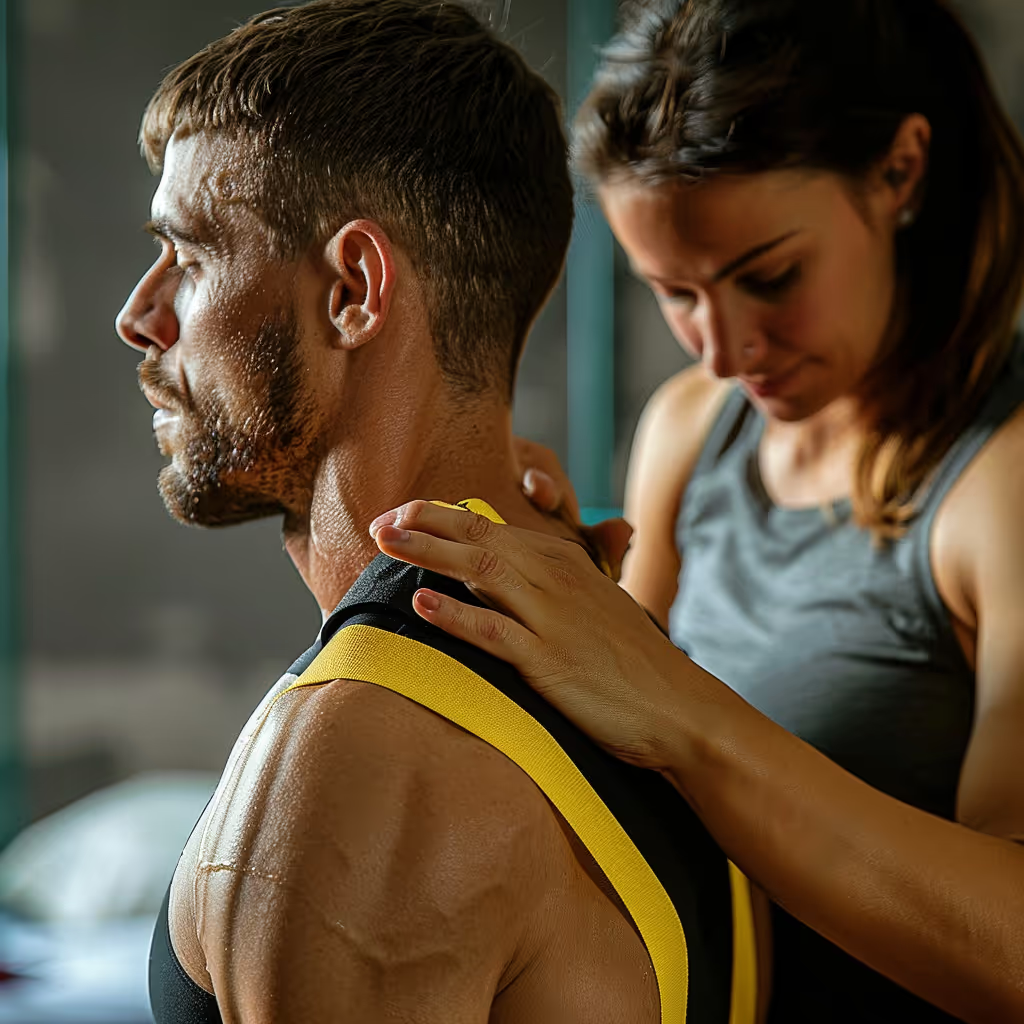
Pain related to scoliosis
It is a deformation of the spine in the shape of an 'S' or 'C' that causes a curvature and rotation of the vertebrae and ribs.
.png)
.png)
.png)


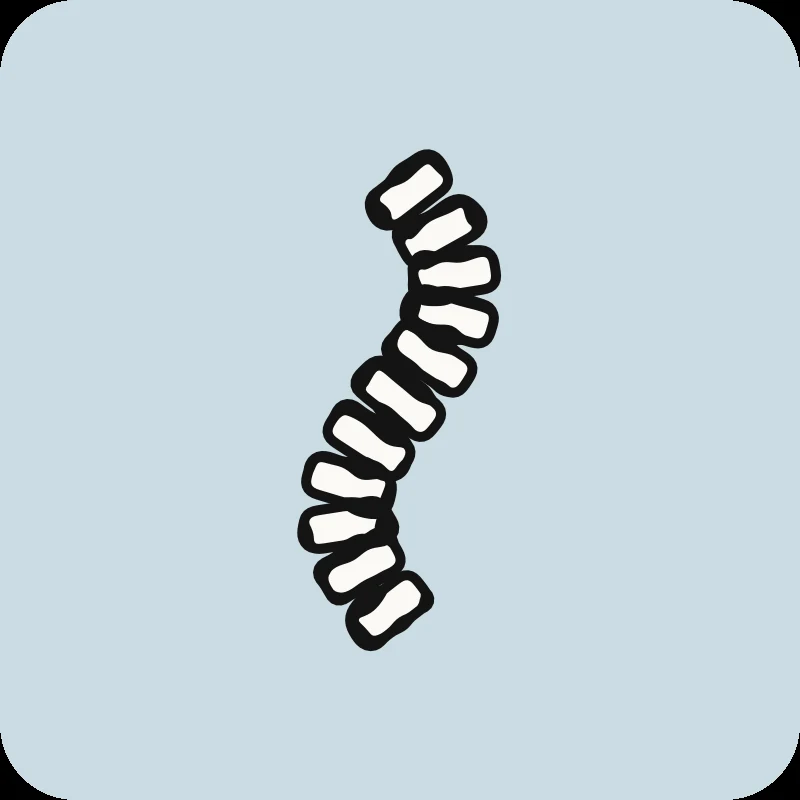


What is scoliosis?
Scoliosis is an “S”- or “C”-shaped deformity of the spine that causes the vertebrae and ribs to curve and rotate.
What are the causes of scoliosis?
The majority of scoliosis cases do not have a specific cause. Scoliosis can have different causes. Here are some possible causes:
- A neuromuscular disease (e.g., Duchenne muscular dystrophy)
- Any syndrome (e.g., Marfan syndrome)
- A neurological condition (e.g., cerebral palsy)
“Many people have mild scoliosis in their spine, which is completely normal—much like having one foot larger than the other: asymmetry is normal and isn’t a problem in and of itself.”
Spines naturally vary from person to person, including in their curvature.
What are the symptoms of scoliosis?
It is important to know that many people have small scoliosis without any pain. Having a small scoliosis does not automatically lead to pain. Some scoliosis cases will be more severe and cause more problems.
In general, when scoliosis is the cause of pain, back pain appears during childhood.
Here are some signs and symptoms that may be present:
- Visible deformation of the spine when viewed from the back
- Back pain (often in the lower back or thoracic region)
- One shoulder being noticeably higher than the other
- One hip being noticeably higher than the other
What are the serious symptoms of scoliosis to watch out for?
The presence of certain signs and symptoms should prompt you to seek immediate medical attention at the emergency room or from a doctor. These include:
- Severe weakness or paralysis of one or both legs
- Significant or even complete loss of sensation in one or both legs
- Recent loss of balance when walking
- Significant and new incoordination
- New difficulties with bladder or bowel control
- Loss of sensation in the genital area or when wiping after a bowel movement
Serious symptoms are only present in less than 1% of cases of lower back pain. Most of the time, although the pain can be very unpleasant, the condition improves.
How is scoliosis diagnosed?
Diagnosis is made based on a review of your symptoms and a clinical examination.
In some cases, radiological examinations (X-rays, MRI, EMG) are necessary to determine the severity of the scoliosis, especially in young children.
It's important to know that what we see on an X-ray or other types of imaging isn't always relevant. A small scoliosis in the back will have very little impact on our well-being.
When should you see a physiotherapist for scoliosis?
You should consult a physiotherapist if you have back pain or if your doctor has already ruled out any other cause that could explain your pain.
In a child, the earlier scoliosis is diagnosed, the better it will be to limit its impact.
You do not need to see a doctor before consulting a physiotherapist. If your condition requires you to see a doctor, your physiotherapist will be able to tell you.
What are the physiotherapy treatments for scoliosis?
Your physical therapist will conduct an evaluation to determine the cause of the pain and the severity of the scoliosis. To do so, they will assess the following:
- Your joint mobility
- The gliding of your nerves
- The quality of your movements
- Your strength and stability
Based on the assessment results, your physiotherapist will:
- Mobilize your spine to reduce pain and improve your movement
- Give you specific exercises to re-educate the control of your back movements
- Give you exercises to regain mobility, reduce pain and regain your muscle strength.
- Teach you how to properly manage your daily activities and hobbies to optimize healing
- Give you advice for your posture and movements.
It is important to know that in cases of severe scoliosis, especially in children, you should consult a physiotherapist who specializes in the treatment of severe scoliosis.
It is important to note that scoliosis cannot be cured as such, because that is how your spine is made. However, the symptoms associated with scoliosis can be completely eliminated with treatment, even if the scoliosis is still present.
What to do at home for scoliosis?
Temporarily stop doing the movements that cause too much pain, and then gradually start doing them again. Don't remain completely still for long periods, as you will become stiffer and experience more pain afterward.
Need professional advice?
Our physical therapists can assess your condition and provide you with a personalized treatment plan.
Make an appointmentIf you don't see any improvement despite these strategies, see a physical therapist.
Sources
- Janicki JA, Alman B. Scoliosis: Review of diagnosis and treatment. Paediatrics & child health. 2007 Nov 1;12(9):771-6.
10 Quick Tips for Understanding Your Pain
The ones that have made the biggest difference in my patients' lives. 1 a day, 2 minutes.
Videos in this category
Other conditions

Hip osteoarthritis is the normal wear and tear of the hip joint. It is often said that osteoarthritis is the wear and tear of the cartilage between our bones. That is true, but it involves more than just the cartilage. Cartilage is a tissue that acts as a cushion between the surfaces of our bones and allows our joints to glide smoothly and move fluidly.
This is normal wear and tear of the knee joint. It’s often said that osteoarthritis is the wearing down of the cartilage between our bones. That’s true, but it’s more than just the cartilage. Cartilage is a tissue that acts as a cushion between the surfaces of our bones and allows our joints to glide smoothly and move fluidly.
It is an inflammation of the subacromial bursa in the shoulder joint.
A bursa is a small, thin sac filled with fluid that is found in many of the body's joints. This small sac acts as a cushion within the joint and lubricates the structures that are subject to increased friction.
It is a tissue that surrounds the shoulder and helps keep the shoulder bone in place within the joint. The capsule helps keep the joint stable.
Neck pain is a general term used to describe pain in the neck that has no specific cause, such as an accident or a sudden awkward movement. Neck pain is therefore synonymous with “my neck hurts, and nothing in particular happened.”
In both types of injury, pain is felt in the neck and then radiates into the arm, or vice versa.
Make an appointment now
We offer a three-pronged quality assurance approach: optimized treatment time, a second opinion from a physical therapist, and ongoing expertise to ensure effective care tailored to your needs.
Customer satisfaction is our top priority
At Physioactif, excellence guides everything we do, but our patients are the best ones to tell you about it. Take a look at their verified reviews to get a real sense of their experience.












Discover our physical therapy clinics
We have locations in several areas to better serve you.
Blainville
190 Bas-de-Sainte-Thérèse Road, Suite 110,
Blainville, Quebec
J7B 1A7
Located in Blainville, near Rosemère, the Physioactif clinic is easily accessible to residents of the area and the surrounding communities
Boucherville
690 Rue de Montbrun, Suite S,
Boucherville, Quebec
J4B 8H2
Located in Boucherville, the Physioactif clinic is easily accessible to people in the area
Laval
3224 Jean-Béraud Ave., Suite 220, Laval,
QC H7T 2S4
Located in Chomedey, in the heart of Laval, the Physioactif clinic is easily accessible to people in the area
Montreal
8801 Lajeunesse Street,
Montreal,
QC H2M 1R8
Located in Ahuntsic, near Villeray, the Physioactif clinic is easily accessible to residents of both neighborhoods
Saint-Eustache
180 25th Avenue, Suite
201 Saint-Eustache
QC J7P 2V2
Located in Saint-Eustache, the Physioactif clinic is easily accessible to residents of the area and the surrounding communities
Vaudreuil
21 Cité-des-Jeunes Boulevard, Suite 240,
Vaudreuil-Dorion, Quebec
J7V 0N3
Located in Vaudreuil-Dorion, the Physioactif clinic is easily accessible to people in the area
Make an appointment now