Neuro-Developmental Therapy: A Complete Guide
.png)
.png)
.png)


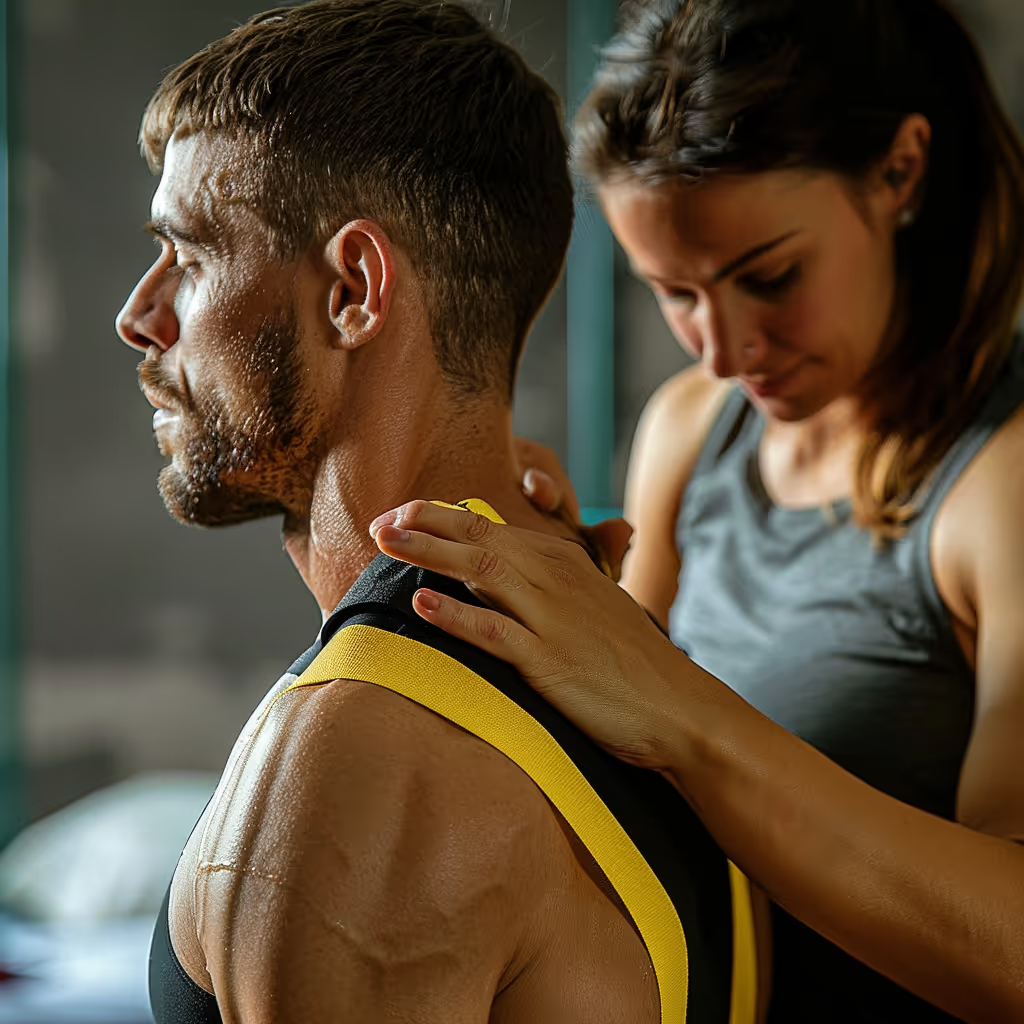
Neurodevelopmental therapy (NDT), also known as the Bobath method, is an approach to rehabilitation for movement disorders of neurological origin. The therapist observes the person’s movements and guides them through activities selected in consultation with them. The exercises and goals should take into account the research findings presented in this article.
What is Neuro-Developmental Therapy?
Neurodevelopmental therapy uses movement analysis and manual guidance to improve posture, coordination, and everyday movements1. The nervous system’s ability to change with practice—known as neuroplasticity—is one of the foundations of neurological rehabilitation2. This principle does not prove that NDT is superior to other approaches.
The physical therapist works with you to choose exercises based on your goals and scientific evidence. Repetitive activities, such as standing up or picking up an object, play a central role in rehabilitation.
Berta and Karel Bobath, a physical therapist and a physician based in Great Britain, developed this approach. Their book on motor development is one of the seminal works on the concept3. The contemporary Bobath description emphasizes movement analysis and task-specific strategies1. A compensatory strategy, such as using a support to stand up, can also help a person become more independent. It is not necessarily detrimental to recovery4.
10 Quick Tips to Understand Your Pain
Tips to help you better understand your pain, in short messages.
NDT is based on the following principles, many of which are shared with neurological rehabilitation:
- Neural Plasticity: The Brain Retains Its Ability to Learn Throughout Life5. After a stroke, progress varies depending on the individual, the extent of the damage, and the stage of recovery4.
- Active motor learning: The individual performs the movements themselves. The therapist adapts the tasks and provides movement cues to supportlearning.⁶, ⁷
- Movement Analysis: The therapist observes movements to understand what facilitates or limits an activity.
- Guidance through touch: The therapist uses their hands to guide a movement as the person performs it.
How Does Neuro-Developmental Therapy Work?
Neurodevelopmental therapy combines movement observation, manual guidance, and active task practice. The therapist may place their hands on specific areas of the body, known as key control points. This method of guiding movement is part of the theoretical framework of NDT; it does not guarantee a change in muscle tone8.
Key Control Points
Key control points refer to the areas where the therapist places their hands to guide the movement. In NDT terminology, these points are grouped as follows:
- Proximal points: The therapist guides the movement near the center of the body, such as at the shoulders or the pelvis.
- Distal points: The therapist guides the movement using the hands or feet, which are farther from the center of the body.
- Key points: The therapist uses the patient's torso for support to assist with movement or rotation.
The therapist adapts their manual assistance based on the task and the person's level of participation1. For children under two years of age with cerebral palsy or at risk of developing it, a review found little robust evidence regarding interventions targeting muscle tone, including NDT9. Given this uncertainty, it is not possible to guarantee a reduction in spasticity.
Muscle Tone Regulation
Muscle tone refers to the resistance felt when another person moves a limb that is at rest. A neurological disorder can alter this tone in several ways:
- Hypertonia: The limb offers greater resistance to forced movement. Spasticity is a form of hypertonia in which the resistance depends, in particular, on the speed of movement. Rigidity is another form of hypertonia10.
- Hypotonia: The limb offers less resistance to forced movement. The therapist also assesses strength and the ability to maintain a position, which are not synonymous with muscle tone.
- Variable tone: Resistance and contractions may vary depending on position, exertion, or emotion.
The therapist can adjust the patient’s position and the use of manual assistance to enable the performance of a task. A movement that is performed more easily during a session does not prove a lasting change in muscle tone. Reviews on stretching, which do not evaluate NDT as a whole, also do not support this conclusion. One review reports little or no effect on spasticity and activity limitations11. The other notes certain immediate effects, but their duration and long-term benefit remain uncertain12.
Integration of Primitive Reflexes
Primitive reflexes are automatic responses present in newborns, such as the Moro reflex or the grasp reflex. Many of them fade during the first few months as the nervous system matures. The timeline varies depending on the reflex13. During the first year, the baby gradually learns to hold up his or her head, roll over, and sit up14.
The persistence or recurrence of certain reflexes may be part of a neurological examination13. A review of children aged 3 to 11 without neurodevelopmental disorders reports links between persistent reflexes and motor or cognitive difficulties, but the data are limited and variable15. It does not demonstrate that NDT improves movement by integrating these reflexes. The physical therapist assesses the child’s activities and sets specific goals in collaboration with the family.
What Conditions Are Treated with Neuro-Developmental Therapy?
Neurodevelopmental therapy has been used, in particular, with people who have cerebral palsy, who have had a stroke, or who have suffered a traumatic brain injury. Its use for a particular condition does not prove that it is the best choice. The rehabilitation program must be tailored to the individual’s needs and the available evidence.
Pediatric Conditions
- Cerebral Palsy: The Evidence Supports Active Interventions, Such as Task Training and Strengthening, for Specific Goals16. A meta-analysis of 34 trials involving a total of 1,332 participants found no advantage of NDT over control groups in terms of motor function. Activity-based approaches yielded better results. The authors recommend discontinuing NDT in this population17.
- Delayed motor development: The physical therapist assesses difficulties with holding up the head, rolling over, sitting up, or walking. He or she suggests activities tailored to the child's abilities.
- Autism: Difficulties with coordination or movement may warrant an evaluation. A diagnosis of autism alone is not sufficient to justify the choice of NDT.
- Genetic syndromes: Trisomy 21, Rett syndrome, and other diagnoses can affect movement. The goals depend on each child’s needs; these diagnoses alone do not indicate the need for NDT.
Adult Conditions
- Stroke: Physical rehabilitation can improve function and mobility after a stroke. The 2025 Cochrane review recommends task-based practice and finds no benefit to neurophysiological approaches such as Bobath18. Another review highlights the difficulty of distinguishing between recovery of movement and compensatory strategies in the measures used19. Functional neurological disorders constitute a distinct diagnosis; this term does not refer to the aftereffects of a stroke.
- Traumatic Brain Injury: A study followed 51 individuals receiving early Bobath-style rehabilitation after traumatic brain injury of varying severity. Their mobility improved, but the absence of a control group prevents these improvements from being attributed to NDT20. Our guide on concussions focuses on a mild form of head injury.
- Multiple Sclerosis: A controlled study involving 40 participants reported improvements in balance and certain cognitive outcomes after eight weeks of Bobath rehabilitation. These improvements were no longer observed eight weeks after the program21. This single study does not allow for generalizing the results.
- Parkinson's Disease: A physical therapist can assess posture, balance, and slowness of movement. The program addresses the observed difficulties; these objectives do not demonstrate an effect specific to NDT.
Movement-Specific Conditions
- Balance and Coordination Disorders: The physical therapist assesses balance issues to select the appropriate exercises and assistive devices.
- Spasticity: The physical therapist assesses resistance to movement and its impact on daily activities. NDT does not guarantee a reduction in spasticity.
- Ataxia: The physical therapist assesses coordination difficulties and their impact on movement. The diagnosis alone does not justify promising that DTT will be effective in treating tremors.
What happens during a neuro-developmental therapy session?
During a neurodevelopmental therapy session, the physical therapist assesses your movements and then guides you through useful movements. The therapist tailors the support, exercises, and breaks to your abilities. The duration and content of the session are discussed based on your needs.
Initial Assessment
During the first visit, the physical therapist will discuss your challenges and goals:
- Observation of Spontaneous Movement: The physical therapist observes how you move in different positions.
- Muscle Tone Assessment: The physical therapist evaluates resistance to movement and how it relates to your difficulties.
- Reflex Assessment: The physical therapist examines reflexes and balance responses when clinically indicated, such as whenassessing the abdominal reflex.
- Functional tests: The physical therapist assesses your ability to perform activities such as standing up, walking, picking up an object, or getting dressed.
- Discussing Goals: You and your physical therapist will work together to choose the activities that matter most to you.
Course of a typical session
PreparationThe therapist will help you find a comfortable position and prepare the exercises with you. He or she may suggest gradual movements and adjust your support. This preparation is designed to encourage your participation; it does not guarantee a change in muscle tone.
Active workActive practice is the focus of the session. The therapist may use their hands to guide you through the following activities:
- You practice the selected movements with the therapist's help, based on your needs.
- You practice changing positions, such as going from lying down to sitting or from sitting to standing.
- You repeat tasks that align with your goals.
- You incorporate these actions into an activity that matters to you.
You participate in the movement to the best of your ability. The therapist adjusts the level of assistance and lets you do what you can on your own.
Functional PracticeThe session may include walking, climbing stairs, picking up objects, or using utensils. The choice of activities depends on your goals and your safety.
Home program
A physical therapist can teach you exercises to do at home. A review of home-based programs for the arms and hands of children with cerebral palsy found them to be feasible but did not conclude that they are effective overall due to differences among the studies22. This review does not prove a lasting effect specific to NDT. The program may include:
- The physical therapist suggests comfortable positions for performing activities.
- You do strength-training exercises tailored to your abilities.
- You apply the strategies you've learned to change your position or seat.
- You make adjustments to certain parts of your home to make daily activities easier.
You'll discuss with the physical therapist what you can do at home. The program takes into account your fatigue, your schedule, and the support available to you.
How effective is neurodevelopmental therapy?
Neurodevelopmental therapy has not been shown to be superior to other approaches to stroke rehabilitation, and the evidence regarding cerebral palsy supportsactivity-based interventions.²³, ¹⁷ These findings guide treatment decisions; they do not mean that physical therapy is ineffective.
What studies show
The review by Zanon and colleagues published in 2019 identified three trials involving a total of 66 children with cerebral palsy, including one ongoing trial. Only one trial provided data useful for comparing motor function. The review found no difference between NDT and conventional physical therapy, with low certainty. This does not demonstrate their equivalence. The authors did not support the routine use of NDT24. The following objectives may guide rehabilitation, though they do not constitute proven benefits specific to NDT:
10 Quick Tips to Understand Your Pain
Tips to help you better understand your pain, in short messages.
- The person is practicing a posture or balance that is useful for an activity.
- The person is looking for a more comfortable way to perform a movement despite the spasticity.
- The person practices changing positions, such as moving from the bed to a chair.
- The client and the therapist define what will count as progress, and then measure it.
Following a stroke, the review by Díaz-Arribas and colleagues, published in 2020, finds no evidence that the Bobath method is superior in terms of mobility, walking, balance, or activities of daily living. Other approaches yield better results for certain arm and hand movements, with moderate certainty23. Another review favors task-based training over the Bobath method for lower-body activities, such as standing up and walking, while noting limitations in the studies25.
Limitations of the approach
When choosing an approach, the following limitations must be taken into account:
- Adding NDT to other treatments is not enough to demonstrate an additional benefit.
- Progress varies depending on the diagnosis, initial abilities, and the activities performed.
The physical therapist tracks your progress and adjusts the program in consultation with you. He or she focuses on activities that are tailored to your goals and supported by the available data.
NDT does not address the cause of the neurological impairment. Its theoretical framework focuses on movement strategies tailored to the individual’s activities and goals1.
FAQ about Neurodevelopmental Therapy
The answers regarding neurodevelopmental therapy explain the comfort level of the sessions, the range of treatment options, and the limitations of expected results.
Is neurodevelopmental therapy painful?
A session should be tailored to your comfort level and tolerance. Let your physical therapist know if you experience pain or significant fatigue so they can adjust the activity. Persistent pain, worsening symptoms, or new symptoms warrant an evaluation; do not automatically attribute them to normal exertion.
How many sessions are needed to see results?
The number of sessions depends on your goals, your abilities, and your measured progress. There is no universal number that guarantees results with NDT. The physical therapist will schedule follow-up evaluations with you to decide whether to continue or adjust the program.
Is NDT suitable for very young children?
A young child with motor difficulties can benefit from early assessment and support. Reviews of children with cerebral palsy or at risk of developing it primarily support active task practice and certain adapted play programs, although the evidence for these approachesis stilllimited.²⁶, ²⁷ This does not justify automatically choosing NDT in the first few months of life.
What is the difference between NDT and traditional physiotherapy?
NDT is an approach used in rehabilitation, not a separate discipline. It emphasizes movement analysis and manual guidance1. Neurological physical therapy also includes task practice, strengthening, and other exercises. These elements may overlap; training in one method does not prove its superiority.
Are the effects of NDT permanent?
Studies do not provide evidence of permanent effects specific to NDT. The Cochrane Review reports certain lasting benefits of physical rehabilitation after a stroke, without attributing them to Bobath18. The review of home-based programs for children with cerebral palsy also does not support the conclusion that NDT specifically leads to sustained benefits22. Follow-up care is tailored to your needs and the progression of your condition.
Can NDT help my child walk?
Rehabilitation can focus on improving your child's walking when this goal is appropriate for his or her abilities. For children with cerebral palsy, evidence regarding motor function supports active approaches over NDT17. A review reports improvements with task-based training, while highlighting the limitations of the studies28. The physical therapist assesses mobility options with the family, including mobility aids. No single method guarantees that every child will walk.
Is the therapy covered by insurance?
Coverage depends on your insurance plan and the rules of the specific program. Ask your insurer whether physical therapy sessions are covered and under what conditions. For a traffic accident or work-related injury, check the requirements of the Société de l'assurance automobile du Québec (SAAQ) or the Commission des normes, de l'équité, de la santé et de la sécurité du travail (CNESST) before beginning your sessions.
Can NDT be combined with other treatments?
Depending on the patient’s needs, several professionals may be involved in rehabilitation: a physical therapist for movement, an occupational therapist for activities, and a speech-language pathologist for communication or swallowing. Stabilization exercises and movement rehabilitation may be part of the program. The choice of a specific combination must be based on a specific goal; adding NDT does not guarantee its effectiveness.
How does neurodevelopmental therapy work at Physioactif?
At Physioactif, the process of requesting neurodevelopmental therapy begins with verifying the availability of the service and whether it meets your needs. When scheduling an appointment, please specify the diagnosis, age, and the specific challenges to be assessed. You can visit our pages on neurological physical therapy and pediatric physical therapy.
The physical therapist selects interventions based on the evaluation and your goals. The program may include task practice, strengthening, or balance exercises. Joint mobilization may be considered if the evaluation warrants it; it does not demonstrate a specific benefit unique to NDT.
To request neurological rehabilitation, please contact our team to confirm the services offered at your chosen clinic. The evaluation will help determine the appropriate course of treatment for you or your child.
Need professional advice?
Our physical therapists can assess your condition and provide you with a personalized treatment plan.
Make an appointmentSources
The following sources describe neurodevelopmental therapy and the research findings cited in this article.
Links open in a new tab.
- Graham JV, Eustace C, Brock K, Swain E, Irwin-Carruthers S. The Bobath concept in contemporary clinical practice. Top Stroke Rehabil. 2009;16(1):57-68. (Back to sections: 1, 2, 3, 4, 5)
- Dimyan MA, Cohen LG. Neuroplasticity in the context of motor rehabilitation after stroke. Nat Rev Neurol. 2011;7(2):76-85. (Back to section: 1)
- Bobath, B., & Bobath, K. Motor Development in the Different Types of Cerebral Palsy. Heinemann Medical Books. 1975. (Back to section: 1)
- Kwakkel G, Stinear C, Essers B, Munoz-Novoa M, Branscheidt M, Cabanas-Valdés R, et al. Motor rehabilitation after stroke: European Stroke Organization (ESO) consensus-based definition and guiding framework. Eur Stroke J. 2023;8(4):880-894. (Back to sections: 1, 2)
- Cai L, Chan JS, Yan JH, Peng K. Brain plasticity and motor practice in cognitive aging. Front Aging Neurosci. 2014;6:31. (Back to section: 1)
- Levin MF, Demers M. Motor learning in neurological rehabilitation. Disabil Rehabil. 2021;43(24):3445-3453. (Back to section: 1)
- Maier M, Ballester BR, Verschure PFMJ. Principles of Neurorehabilitation After Stroke Based on Motor Learning and Brain Plasticity Mechanisms. Front Syst Neurosci. 2019;13:74. (Back to section: 1)
- Klimont L. Principles of Bobath Neurodevelopmental Therapy in Cerebral Palsy. Ortop Traumatol Rehabil. 2001;3(4):527-30. (Back to section: 1)
- Ward R, Reynolds JE, Bear N, Elliott C, Valentine J. What is the evidence for managing muscle tone in young children with, or at risk of developing, cerebral palsy: a systematic review. Disabil Rehabil. 2017;39(7):619-630. (Back to section: 1)
- Sanger TD, Delgado MR, Gaebler-Spira D, Hallett M, Mink JW, Task Force on Childhood Motor Disorders. Classification and definition of disorders causing hypertonia in childhood. Pediatrics. 2003;111(1):e89-97. (Back to section: 1)
- Katalinic OM, Harvey LA, Herbert RD. Effectiveness of stretching for the treatment and prevention of contractures in people with neurological conditions: a systematic review. Phys Ther. 2011;91(1):11-24. (Back to section: 1)
- Bovend'Eerdt TJ, Newman M, Barker K, Dawes H, Minelli C, Wade DT. The effects of stretching on spasticity: a systematic review. Arch Phys Med Rehabil. 2008;89(7):1395-406. (Back to section: 1)
- Chamarthi VS, Gunasekaran V, Daley SF. Primitive Reflexes: Comprehensive Neurological Assessment Across the Lifespan. StatPearls. 2026. (Back to sections: 1, 2)
- Bly L, Ariz TN. Motor Skills Acquisition in the First Year: An Illustrated Guide to Normal Development. Pediatric Physical Therapy. 1995;7(2):86. (Back to section: 1)
- Provazník A, Musálek M, Bob P, Větrovský T, Malambo C, Silva AF, et al. Persisting primitive reflexes and motor and cognitive development in children: A systematic review. Acta Psychol (Amst). 2026;266:106915. (Back to section: 1)
- Novak I, Morgan C, Fahey M, Finch-Edmondson M, Galea C, Hines A, et al. State of the Evidence Traffic Lights 2019: Systematic Review of Interventions for Preventing and Treating Children with Cerebral Palsy. Curr Neurol Neurosci Rep. 2020;20(2):3. (Back to section: 1)
- Te Velde A, Morgan C, Finch-Edmondson M, McNamara L, McNamara M, Paton MCB, et al. Neurodevelopmental Therapy for Cerebral Palsy: A Meta-analysis. Pediatrics. 2022;149(6). (Back to sections: 1, 2, 3)
- How effective are different physical rehabilitation approaches in restoring function, balance, and walking after a stroke? | Cochrane. (Back to sections: 1, 2)
- Saes M, Mohamed Refai MI, van Beijnum BJF, Bussmann JBJ, Jansma EP, Veltink PH, et al. Quantifying the Quality of Reaching Movements Longitudinally After Stroke: A Systematic Review. Neurorehabil Neural Repair. 2022;36(3):183-207. (Back to section: 1)
- Bilgin S, Guclu-Gunduz A, Oruckaptan H, Kose N, Celik B. Gait and Glasgow Coma Scale scores can predict functional recovery in patients with traumatic brain injury. Neural Regen Res. 2012;7(25):1978-84. (Back to section: 1)
- Castelli L, Giovannini S, Iacovelli C, Fusco A, Pastorino R, Marafon DP, et al. Training-dependent plasticity and the far transfer effect enhanced by Bobath rehabilitation in multiple sclerosis. Mult Scler Relat Disord. 2022;68:104241. (Back to section: 1)
- Beckers LWME, Geijen MME, Kleijnen J, A A Rameckers E, L A P Schnackers M, J E M Smeets R, et al. Feasibility and effectiveness of home-based therapy programs for children with cerebral palsy: a systematic review. BMJ Open. 2020;10(10):e035454. (Back to sections: 1, 2)
- Díaz-Arribas MJ, Martín-Casas P, Cano-de-la-Cuerda R, Plaza-Manzano G. Effectiveness of the Bobath concept in the treatment of stroke: a systematic review. Disabil Rehabil. 2020;42(12):1636-1649. (Back to sections: 1, 2)
- Zanon MA, Pacheco RL, Latorraca COC, Martimbianco ALC, Pachito DV, Riera R. Neurodevelopmental Treatment (Bobath) for Children With Cerebral Palsy: A Systematic Review. J Child Neurol. 2019;34(11):679-686. (Back to section: 1)
- Scrivener K, Dorsch S, McCluskey A, Schurr K, Graham PL, Cao Z, et al. Bobath therapy is inferior to task-specific training and not superior to other interventions in improving lower limb activities after stroke: a systematic review. J Physiother. 2020;66(4):225-235. (Back to section: 1)
- Damiano DL, Longo E. Evidence on early intervention for infants with or at risk for cerebral palsy: an overview of systematic reviews. Dev Med Child Neurol. 2021;63(7):771-784. (Back to section: 1)
- Baker A, Niles N, Kysh L, Sargent B. Effect of Motor Intervention for Infants and Toddlers With Cerebral Palsy: A Systematic Review and Meta-analysis. Pediatr Phys Ther. 2022;34(3):297-307. (Back to section: 1)
- Zai W, Xu N, Wu W, Wang Y, Wang R. Effect of task-oriented training on gross motor function, balance, and activities of daily living in children with cerebral palsy: A systematic review and meta-analysis. Medicine (Baltimore). 2022;101(44):e31565. (Back to section: 1)
Videos in this category
Other conditions

Hip osteoarthritis is the normal wear and tear of the hip joint. It is often said that osteoarthritis is the wear and tear of the cartilage between our bones. That is true, but it involves more than just the cartilage. Cartilage is a tissue that acts as a cushion between the surfaces of our bones and allows our joints to glide smoothly and move fluidly.
This is normal wear and tear of the knee joint. It’s often said that osteoarthritis is the wearing down of the cartilage between our bones. That’s true, but it’s more than just the cartilage. Cartilage is a tissue that acts as a cushion between the surfaces of our bones and allows our joints to glide smoothly and move fluidly.
It is an inflammation of the subacromial bursa in the shoulder joint.
A bursa is a small, thin sac filled with fluid that is found in many of the body's joints. This small sac acts as a cushion within the joint and lubricates the structures that are subject to increased friction.
It is a tissue that surrounds the shoulder and helps keep the shoulder bone in place within the joint. The capsule helps keep the joint stable.
Neck pain is a general term used to describe pain in the neck that has no specific cause, such as an accident or a sudden awkward movement. Neck pain is therefore synonymous with “my neck hurts, and nothing in particular happened.”
In both types of injury, pain is felt in the neck and then radiates into the arm, or vice versa.
Make an appointment now
We offer a three-pronged quality assurance approach: optimized treatment time, a second opinion from a physical therapist, and ongoing expertise to ensure effective care tailored to your needs.

Customer satisfaction is our top priority
At Physioactif, excellence guides everything we do, but our patients are the best ones to tell you about it. Take a look at their verified reviews to get a real sense of their experience.







Discover our physical therapy clinics
We have locations in several areas to better serve you.
Blainville
190 Bas-de-Sainte-Thérèse Road, Suite 110,
Blainville, Quebec
J7B 1A7
Located in Blainville, near Rosemère, the Physioactif clinic is easily accessible to residents of the area and the surrounding communities
Boucherville
690 Rue de Montbrun, Suite S,
Boucherville, Quebec
J4B 8H2
Located in Boucherville, the Physioactif clinic is easily accessible to people in the area
Laval
3224 Jean-Béraud Ave., Suite 220, Laval,
QC H7T 2S4
Located in Chomedey, in the heart of Laval, the Physioactif clinic is easily accessible to people in the area
Montreal
8801 Lajeunesse Street,
Montreal,
QC H2M 1R8
Located in Ahuntsic, near Villeray, the Physioactif clinic is easily accessible to residents of both neighborhoods
Saint-Eustache
180 25th Avenue, Suite
201 Saint-Eustache
QC J7P 2V2
Located in Saint-Eustache, the Physioactif clinic is easily accessible to residents of the area and the surrounding communities
Vaudreuil
21 Cité-des-Jeunes Boulevard, Suite 240,
Vaudreuil-Dorion, Quebec
J7V 0N3
Located in Vaudreuil-Dorion, the Physioactif clinic is easily accessible to people in the area
Make an appointment now