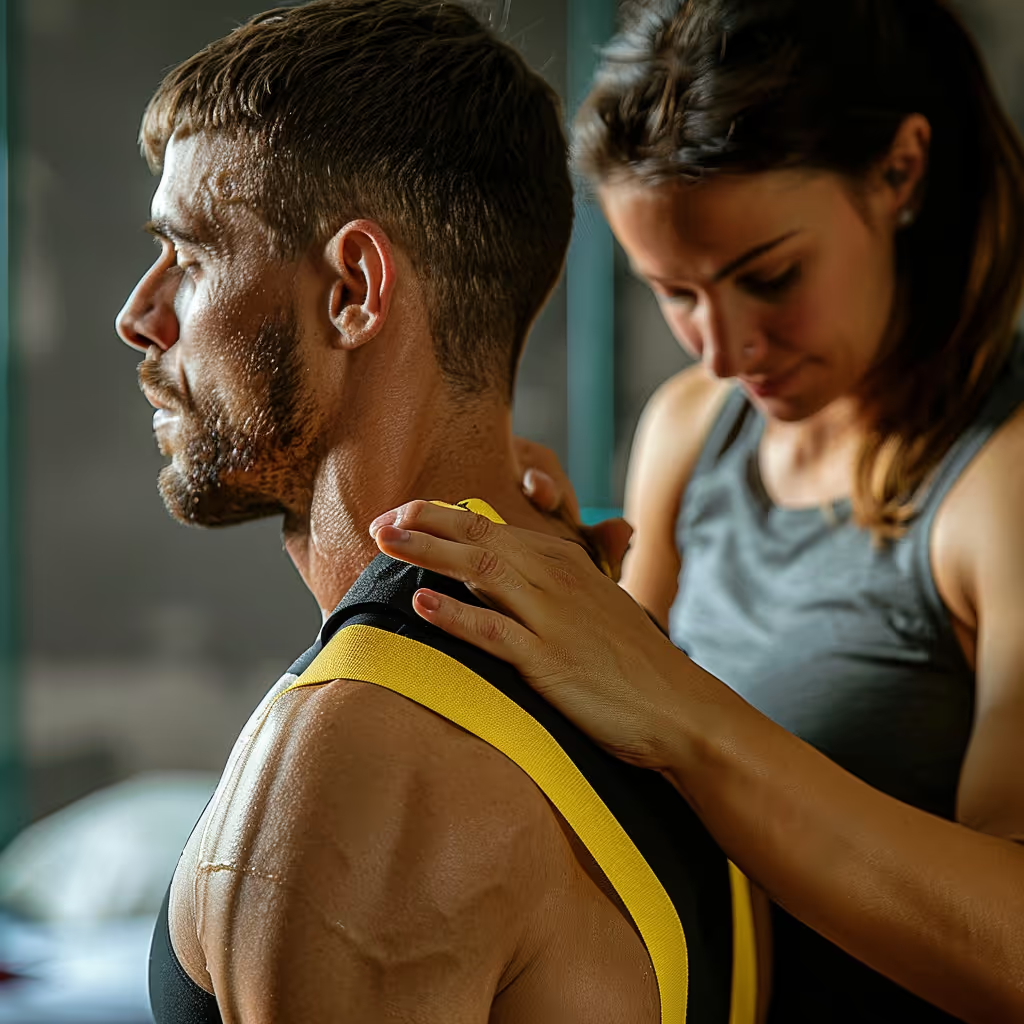
Shoulder dislocation
This occurs when the upper arm bone (humerus) comes out of the shoulder joint following a trauma. In simpler terms, it's when the shoulder 'pops out'. If the shoulder only partially pops out, it's called a subluxation. If the shoulder comes completely out, it's called a complete dislocation.
.png)
.png)
.png)




Shoulder Dislocation: How to Recognize and Treat It?
A shoulder dislocation is characterized by sudden pain, deformity, or marked difficulty moving the arm; treatment begins with an urgent evaluation and, while the shoulder is still dislocated, reduction by a healthcare professional. Recovery then depends on the type of dislocation, associated injuries, age, activities, and the chosen treatment. The American Academy of Orthopaedic Surgeons describes the evaluation, treatment, and rehabilitation1. Our physical therapy guide for shoulder dislocation explains the follow-up care.
This article explains the signs, emergency care, rehabilitation, and factors associated with new dislocations.
What is a Shoulder Dislocation?
A shoulder dislocation occurs when the head of the humerus—the upper arm bone—completely slips out of the glenoid cavity, the socket in the shoulder blade that forms the joint. The shoulder blade is a flat bone located at the top of the back. In Quebec, people often use the expression “l’épaule a débarqué” (the shoulder has come off), which is a fairly accurate description of what happens.
The shoulder joint allows for a wide range of motion. Its high degree of mobility makes movement, strength, and stability key factors in the evaluation, but it does not, on its own, predict a dislocation.
10 Quick Tips to Understand Your Pain
One tip a day for 10 days to help you better understand your pain. About a 2-minute read.
Significant deformity or limited range of motion in the arm warrants urgent evaluation. The appearance, pain, and range of motion vary depending on the dislocation and any associated injuries.
A dislocation can be anterior, when the head of the humerus moves forward, or posterior, when it moves backward. In the anterior type, which is the most common, the bone moves forward. The healthcare professional assesses the injuries based on the clinical context and the physical examination.
Who is Affected by Shoulder Dislocations?
Shoulder dislocations can affect people of all ages, with varying profiles depending on the population and activities. Age, gender, and sports participation may be associated with risk in certain groups, but none of these factors alone predicts an individual’s risk.
Active young adults
The first dislocation often occurs in young, active men in certain cohorts—that is, groups of people followed in studies. This trend varies depending on the population and context. A Swedish study of people aged 18 to 70 reports a prevalence of at least 1.7% and approximately three times as many dislocations among men.2 This study does not directly measure a peak among active young adults.
The impact of age
A recurrence is a new dislocation that occurs after the first one. The risk of recurrence varies depending on age, the extent of the injury, activities, and treatment. No percentage can predict a person’s risk with certainty.
Athletes
Sports involving contact, falls, or repetitive overhead movements put the shoulder at risk of dislocation. The risk also depends on a person’s medical history, previous injuries, and individual characteristics.
After an initial dislocation, rehabilitation can gradually restore movement, strengthen the shoulder, and prepare the patient for a return to sports. The program is tailored to the specific injury, symptoms, and demands of the activity.
What are the Symptoms of a Shoulder Dislocation?
Symptoms of a shoulder dislocation often include sudden pain, deformity, and significant difficulty moving the arm. The severity of these symptoms varies, but a suspected dislocation requires prompt evaluation.
Some people report a sensation of displacement or a popping sound at the moment of the injury. These sensations alone do not confirm a dislocation.
The shoulder’s appearance may change, but the deformity is not always obvious. The shoulder may appear more square or lower, and an unusual lump may appear under the skin. The person may have great difficulty lifting, rotating, or extending the arm.
Signs That Warrant an Urgent Evaluation
A cold or discolored hand, numbness, or an inability to move the fingers warrants an urgent evaluation.
These signs are used to check for a problem involving the nerves or blood circulation; on their own, they do not reveal the cause.
Under what circumstances can a shoulder dislocation occur?
A shoulder dislocation can occur after a fall, a blow, a twist, or an accident. It can also occur in people with hypermobility—that is, joints that move more than average—or due to instability without any obvious trauma.
A description of the movement helps the healthcare professional understand the context. This description alone is not sufficient to determine the specific injuries present.
What factors are associated with recurrence?
Injuries following a first dislocation vary. A Bankart lesion—a tear in the labrum, the cartilage rim at the front of the joint—may be present, but it is not universal. A systematic review of 1,920 shoulders reported a Bankart lesion in 59 percent of shoulders following a first dislocation and in 66 percent following a recurrent dislocation.3 This review, published in 2022, includes 22 studies. A medical evaluation and imaging may be indicated depending on the presentation.
Injuries to the capsule—a layer of tissue surrounding the joint—the labrum, and the bone vary following a dislocation. A Hill-Sachs lesion, a small indentation in the head of the humerus, may be observed, but its presence alone does not predict whether a person will experience a recurrence. The same review reports a Hill-Sachs lesion in 71 percent of shoulders after a first dislocation and in 85 percent after a recurrent dislocation, indicating an association with recurrence rather than an established individual predictive value based on this single measure.3
The forces and movements associated with a new dislocation vary. Some people report an episode occurring during an ordinary activity, without this indicating the same injuries or a common mechanical threshold.
The reassuring message is that your body is not defective. Recurrences depend on several factors, including age, activity level, hyperlaxity, and certain injuries; an individualized assessment helps determine the appropriate treatment.
What to Do Immediately After a Dislocation?
If you suspect a dislocation, immobilize the arm in a comfortable position and go to the emergency room. The healthcare professional will determine whether an X-ray is necessary before reduction—that is, before putting the joint back into place.
If you think your shoulder has dislocated again, have it evaluated right away. After an injury, signs of a possible dislocation described by the NHS include an inability to move the arm, a misshapen shoulder, pain, bruising, or swelling4. Do not attempt to put your arm back in place, and do not drive yourself. Have someone accompany you, or call 911 if you cannot get to the emergency room.
If It's Your First Dislocation
A healthcare professional must perform the reduction and check for circulation, nerve function, and the possibility of a fracture. A study conducted in the emergency department involving 334 people with an anterior dislocation found a significant fracture in 25.5% of the participants. Being 40 years of age or older, a first-time episode, and certain injury mechanisms—including motor vehicle accidents—were associated with this risk.5
In Quebec, a physical therapist who holds the required certification may order certain X-rays when the official criteria are met and medical follow-up is planned.
While Awaiting Medical Care
While waiting for medical care, support your arm with a sling or towel and avoid moving your upper arm. After the injury has been set, use the sling and resume movement as directed, since injuries and treatment needs vary. A pharmacist or doctor can advise you on medications based on your health condition and other treatments you are taking.
Practical Tips for the First Few Days
Choose a comfortable position and support according to the instructions you received.
When sleeping, choose a position that’s bearable and provides comfortable support. Sleeping in a more upright position with pillows may be more comfortable during the first few nights. Advice from Cambridge University Hospitals6 also explains how to manage discomfort.
How Does Physiotherapy Treat a Shoulder Dislocation?
Physical therapy addresses limitations that persist after reduction by focusing on mobility, strength, control, and a return to activities. The program takes into account the individual’s injuries, medical recommendations, and goals. Our comprehensive guide to shoulder pain also describes other issues that can affect this joint. Our physical therapy guide for shoulder dislocation covers assessment, exercises, and returning to sports.
Controlled immobilization
After reduction, a splint or sling may be used for a specific period of time, depending on your age, any associated injuries, and the medical team’s instructions. During this phase, your physical therapist will assess your range of motion and activities, introduce exercises according to the instructions provided, and teach you how to protect your shoulder.
Restoring Mobility
After the immobilization period, the physical therapist selects guided movements or manual techniques based on the patient’s stability, injuries, symptoms, and goals. The therapist also adapts the exercises—including those that target the nerves (see our page on nerve mobilization techniques)—to the medical recommendations and the patient’s response.
Strengthening and Stabilization
This phase aims to restore range of motion, strength, and control before a gradual return to activities. The program can strengthen the muscles of the shoulder and shoulder blade, then gradually incorporate work- or sports-related movements. The physical therapist selects the resistance, speed, and movements based on the patient’s abilities and goals—for example, with a standing shoulder stabilization exercise. The American Academy of Orthopaedic Surgeons1 describes this general progression.
Shoulder control exercises, as well as strength and endurance exercises, are tailored to the specific task at hand.
Back to Activities
The return to sports is planned based on the type of dislocation, the injuries, the treatment, the athlete’s abilities, and the demands of the sport. The timeline is adjusted based on the observed response.
Rehabilitation aims to improve range of motion—that is, the extent of movement—as well as strength, control, and tolerance for activities. The goals and pace of return to normal activities depend on each person’s individual situation.
Our clinic can provide an evaluation and a program tailored to your abilities and goals. Our guide also explains how physical therapy can help with shoulder pain.
Why Do Some Shoulders Dislocate Repeatedly?
Recurrences cannot be attributed in every individual to a labral tear or to persistent stretching of the joint capsule.
Recurrence Statistics
In the cited sources, estimates of recurrence vary depending on the population, age, and follow-up period.7 A national registry study followed individuals after a second dislocation. In the cited cohort, 44% of individuals experienced a third dislocation following the second; in this national registry study, the risk of a third dislocation did not differ statistically by age or sex.8
Among young adults, the risk of a recurrent dislocation is high, but there is no consensus on a single rate.7 A 2016 review compiled follow-up studies and found rates ranging from 19% to 88%.9 The variation stems from the populations studied, the duration of follow-up, and the methods used. Young age emerges as the most significant factor, especially before age 20.
Recurrences may occur early or later; their frequency and timing vary depending on the population, the type of dislocation, the treatment, and follow-up care.
10 Quick Tips to Understand Your Pain
One tip a day for 10 days to help you better understand your pain. About a 2-minute read.
Risk Factors
In some cohorts, age, sex, hyperlaxity, and certain lesions are associated with the risk of recurrence. Olds’ 2015 review—a meta-analysis, which is a study that combines the results of multiple studies—includes ten studies and 1,324 individuals who had experienced a first traumatic dislocation caused by an injury. It reports associations with male gender, age 40 or younger, and joint hypermobility.7 It reports a total recurrent instability rate of 39%. In its analysis by age, the rates are 44% among individuals aged 40 or younger and 11% among those over 40.7 These factors describe group trends and do not, on their own, predict an individual’s risk.
The same journal calculates an odds ratio of 13.46 for younger individuals. An odds ratio compares the probability of a recurrence to that of no recurrence; the ratio then compares these odds across groups. This result does not, therefore, mean a risk that is thirteen times greater. The percentages reported describe the groups studied; they do not predict your personal risk or the duration of your recovery.
Your age: In a series of 154 first traumatic dislocations, the recurrence rate was 68% before the age of 20 (Vermeiren et al., Int Orthop 1993).10 The follow-up period for this series of 154 cases lasted an average of 4.5 years. A case series tracks a group of patients who have already been treated, without comparing them to another treatment. The figure of 68% therefore describes a specific group and cannot be applied as is to all individuals under the age of 20. This association does not establish a specific strengthening protocol or a rate of progression based on age. The duration of rehabilitation remains tailored to the specific injuries, symptoms, and targeted activities.
Men have higher rates of recidivism than women in Olds' review.7 The odds ratio of 3.18 measures this association. As with age, this figure does not imply a threefold increase in risk. Age, activities, and other factors may also differ between the groups.
In this same meta-analysis, a fracture of the greater tuberosity—a bony protrusion near the top of the humerus—was associated with fewer recurrences.7 The healthcare professional interprets this finding in conjunction with other injuries, activities, and the patient’s progress.
The timing of recurrence varies depending on the population, treatment, and follow-up. The time elapsed alone does not predict individual risk.
Rehabilitation can focus on mobility, strength, control, and a return to activities. The program is tailored to the specific injury, symptoms, and target activities. Exercises to prevent recurrence are described in our physical therapy guide for shoulder dislocation.
The Warning Sign
Any apprehension or sensation of slippage warrants evaluation. These symptoms alone do not indicate mechanical instability or the need for surgery.
Knowing When Surgery Becomes Necessary
A surgical consultation may be considered based on the number of episodes, the nature of the injuries, bone loss, the individual’s activities, response to rehabilitation, and personal preferences.
Main Surgical Options
Arthroscopic Bankart repair, a surgical procedure performed through small incisions, repairs the labrum—the detached cartilage rim at the front of the joint. The technique and its indication depend on the nature of the injury and the surgeon’s judgment. A systematic review of studies published from 2008 to 2018 reported a recurrence rate of approximately 17.4% following this surgery, but the definition of failure varied widely among the studies.11 This result does not predict an individual’s outcome.
After surgery, the time it takes to return to work and sports varies greatly from person to person and should be planned in consultation with the surgeon and physical therapist.
If the shoulder dislocates again, an evaluation can help determine the appropriate course of treatment, though it does not guarantee that it will not happen again. In the long term, changes visible on X-rays are more common after repeated episodes without surgery, but they can still occur even without another episode, and surgery does not appear to eliminate this risk.12 After 25 years of follow-up, 39 percent of shoulders that had a recurrence without surgery showed moderate to severe joint changes visible on X-rays, compared with 18 percent of shoulders without recurrence. The group treated with surgical stabilization had fewer of these changes than the group that had a recurrence without surgery.12
What symptoms should you watch for after a shoulder dislocation?
After a dislocation, it is especially important to monitor for fractures, nerve or circulatory damage, and injuries to the shoulder tissues. The healthcare professional selects the appropriate examination and imaging based on the symptoms. Articles on rotator cuff tears, ligament pain, and joint pain explain some of the associated conditions.
Other causes of pain may coexist following an injury. The evaluation distinguishes , in particular , between shoulder bursitis and an acromioclavicular sprain at the top of the shoulder when these diagnoses are consistent with the symptoms.
When to Consult a Professional?
After an episode that resolved on its own or a recurrence, a medical or physical therapy evaluation may be recommended depending on the level of pain, limitations in daily activities, or nerve-related symptoms, such as numbness or weakness.
An orthopedic consultation may be considered depending on the type of instability, recurrent episodes, associated injuries, activities, goals, and preferences. The number of dislocations or the patient’s age alone is not sufficient to warrant surgery.
Physical therapy can help address the limitations that arise after a dislocation. Our guide explains how physical therapy can help manage joint pain.
How can you get help for your shoulder dislocation?
Physioactif's physical therapists can assess movement and activities following a dislocation and refer patients to a doctor when necessary. We offer programs tailored to mobility, strength, control, and individual goals.
A dislocation can limit certain activities. The Physioactif team can assess your symptoms, your range of motion, and certain factors associated with recurrences. They can then tailor your return to activities or refer you for a medical evaluation and imaging when necessary.
Need professional advice?
A physical therapy evaluation can document movements, restricted activities, and signs that require medical attention.
Make an appointmentSources
- American Academy of Orthopaedic Surgeons (AAOS). Shoulder Dislocation. OrthoInfo. ↩ Back to text: 1st, 2nd references
- Hovelius L. Incidence of shoulder dislocation in Sweden. Clin Orthop Relat Res. 1982(166):127-31. ↩ Back to text
- Rutgers C, Verweij LPE, Priester-Vink S, van Deurzen DFP, Maas M, van den Bekerom MPJ. Recurrence in traumatic anterior shoulder dislocations increases the prevalence of Hill-Sachs and Bankart lesions: a systematic review and meta-analysis. Knee Surg Sports Traumatol Arthrosc. 2022;30(6):2130-2140. ↩ Back to text: 1st, 2nd citations
- National Health Service (NHS), United Kingdom. Dislocated shoulder. ↩ Back to text
- Emond M, Le Sage N, Lavoie A, Rochette L. Clinical factors predicting fractures associated with an anterior shoulder dislocation. Acad Emerg Med. 2004;11(8):853-8. ↩ Back to text
- Cambridge University Hospitals (CUH). Shoulder Dislocations. Patient Information. ↩ Back to text
- Olds M, Ellis R, Donaldson K, Parmar P, Kersten P. Risk factors that predispose first-time traumatic anterior shoulder dislocations to recurrent instability in adults: a systematic review and meta-analysis. Br J Sports Med. 2015;49(14):913-22. ↩ Back to text: 1st, 2nd, 3rd, 4th, 5th, 6th citations
- Kao JT, Chang CL, Su WR, Chang WL, Tai TW. Incidence of recurrence after shoulder dislocation: a nationwide database study. J Shoulder Elbow Surg. 2018;27(8):1519-1525. ↩ Back to text
- Wasserstein DN, Sheth U, Colbenson K, Henry PD, Chahal J, Dwyer T, et al. The True Recurrence Rate and Factors Predicting Recurrent Instability After Nonsurgical Management of Traumatic Primary Anterior Shoulder Dislocation: A Systematic Review. Arthroscopy. 2016;32(12):2616-2625. ↩ Back to text
- Vermeiren J, Handelberg F, Casteleyn PP, Opdecam P. The rate of recurrence of traumatic anterior shoulder dislocation. A study of 154 cases and a review of the literature. Int Orthop. 1993;17(6):337-41. ↩ Back to text
- Kennedy MI, Murphy C, Dornan GJ, Moatshe G, Chahla J, LaPrade RF, et al. Variability in Reporting Recurrence After Arthroscopic Bankart Repair: A Call for a Standardized Study Design. Orthop J Sports Med. 2019;7(5):2325967119846915. ↩ Back to text
- Hovelius L, Saeboe M. Neer Award 2008: Arthropathy following primary anterior shoulder dislocation—223 shoulders prospectively followed for twenty-five years. J Shoulder Elbow Surg. 2009;18(3):339-47. ↩ Back to text: 1st, 2nd mentions
Our physical therapists defined the research strategy, plan, and clinical content of this article. An AI tool assisted with the literature review and text editing to ensure consistency in content and writing style.
Other conditions

Hip osteoarthritis is the normal wear and tear of the hip joint. It is often said that osteoarthritis is the wear and tear of the cartilage between our bones. That is true, but it involves more than just the cartilage. Cartilage is a tissue that acts as a cushion between the surfaces of our bones and allows our joints to glide smoothly and move fluidly.
This is normal wear and tear of the knee joint. It’s often said that osteoarthritis is the wearing down of the cartilage between our bones. That’s true, but it’s more than just the cartilage. Cartilage is a tissue that acts as a cushion between the surfaces of our bones and allows our joints to glide smoothly and move fluidly.
It is an inflammation of the subacromial bursa in the shoulder joint.
A bursa is a small, thin sac filled with fluid that is found in many of the body's joints. This small sac acts as a cushion within the joint and lubricates the structures that are subject to increased friction.
It is a tissue that surrounds the shoulder and helps keep the shoulder bone in place within the joint. The capsule helps keep the joint stable.
In both types of injury, pain is felt in the neck and then radiates into the arm, or vice versa.
It is a severe strain or tear of the muscle fibers in the groin or inner thigh.
Make an appointment now
We offer a three-pronged quality assurance approach: optimized treatment time, a second opinion from a physical therapist, and ongoing expertise to ensure effective care tailored to your needs.

Customer satisfaction is our top priority
At Physioactif, excellence guides everything we do, but our patients are the best ones to tell you about it. Take a look at their verified reviews to get a real sense of their experience.






Discover our physical therapy clinics
We have locations in several areas to better serve you.
Blainville
190 Bas-de-Sainte-Thérèse Road, Suite 110,
Blainville, Quebec
J7B 1A7
Located in Blainville, near Rosemère, the Physioactif clinic is easily accessible to residents of the area and the surrounding communities
Boucherville
690 Rue de Montbrun, Suite S,
Boucherville, Quebec
J4B 8H2
Located in Boucherville, the Physioactif clinic is easily accessible to people in the area
Laval
3224 Jean-Béraud Ave., Suite 220, Laval,
QC H7T 2S4
Located in Chomedey, in the heart of Laval, the Physioactif clinic is easily accessible to people in the area
Montreal
8801 Lajeunesse Street,
Montreal,
QC H2M 1R8
Located in Ahuntsic, near Villeray, the Physioactif clinic is easily accessible to residents of both neighborhoods
Saint-Eustache
180 25th Avenue, Suite
201 Saint-Eustache
QC J7P 2V2
Located in Saint-Eustache, the Physioactif clinic is easily accessible to residents of the area and the surrounding communities
Vaudreuil
21 Cité-des-Jeunes Boulevard, Suite 240,
Vaudreuil-Dorion, Quebec
J7V 0N3
Located in Vaudreuil-Dorion, the Physioactif clinic is easily accessible to people in the area
Make an appointment now