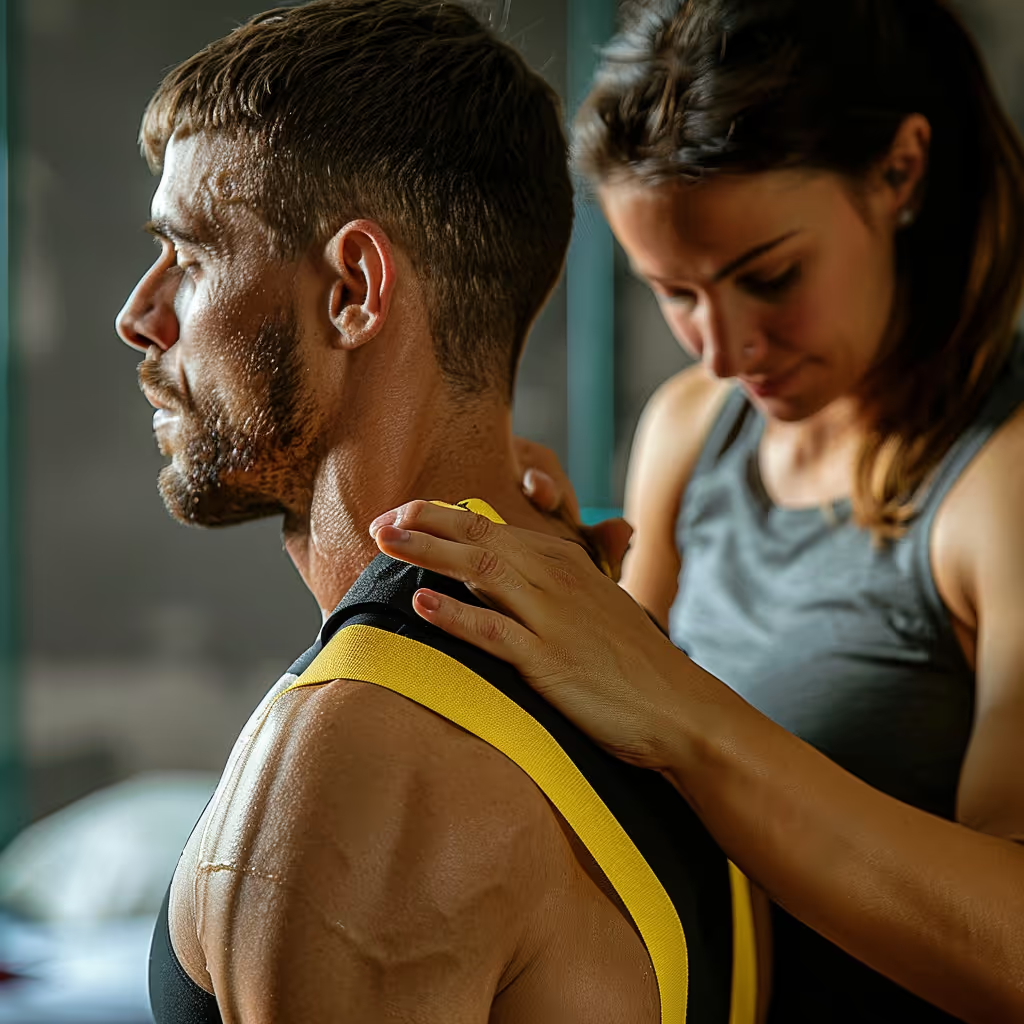
Rotator cuff tendinopathy
In both cases, whether it is tendinitis or tendinopathy, the management is similar. Therefore, we will include tendinopathies and tendinitis as being the same injury.
.png)
.png)
.png)



Rotator cuff tendinopathy is a common cause of shoulder pain. Problems with the rotator cuff—including tendinopathies and tears—account for more than half of the shoulder problems treated by healthcare professionals.1 Progressive exercises can reduce pain and improve function. Their effectiveness varies from person to person: some symptoms persist or recur.
This guide explains this tendon condition, its symptoms, and possible treatments. For an overview of shoulder problems, see our comprehensive guide to shoulder pain.
What is Rotator Cuff Tendinopathy?
Rotator cuff tendinopathy is a tendon condition that causes persistent pain and difficulty with activities that involve the shoulder. A tendon is a strong band of tissue that connects a muscle to a bone. The rotator cuff consists of the tendons of four muscles that help stabilize the head of the humerus—the upper part of the upper arm bone—within the shoulder joint. The diagnosis takes into account your symptoms, your range of motion, and how your condition has progressed over time. An imaging study of the tendon alone is not sufficient to explain the pain.
Tendinopathy can develop gradually. A review notes an association with age but considers the evidence regarding the factors that contribute to its onset to be limited.2A rotator cuff tear may occur following an injury or without any specific precipitating event. Its presence on a medical image alone does not explain the symptoms.3
10 Quick Tips to Understand Your Pain
One tip a day for 10 days to help you better understand your pain. About a 2-minute read.
What is the difference between tendinitis and tendinopathy?
Tendinitis refers to inflammation of a tendon, while tendinopathy refers more broadly to a painful tendon that limits activities. Inflammation is the body’s defense and repair response. The term “tendinopathy” does not imply that this response alone explains the symptoms.
These terms are therefore not strictly equivalent. The choice of treatment depends on the assessment, symptoms, activities, and response to the program.
What are the Four Rotator Cuff Muscles?
The four muscles of the rotator cuff are the supraspinatus, the infraspinatus, the teres minor, and the subscapularis—deep muscles that work together to stabilize your shoulder.
The supraspinatus muscle helps raise the arm out to the side. Its tendon passes through a space beneath the acromion, a bony protrusion above the shoulder. This tendon can be painful or torn. The amount of effort required of the muscle varies depending on the position of the arm and the weight being held. In physical therapy,isometric shoulder abduction exercises are often used to gently reactivate this muscle without moving the joint. One study measured these variations based on angle and weight.
The infraspinatus rotates the arm outward. To visualize this external rotation, keep your elbow close to your body and point your forearm outward. This movement is particularly involved in throwing a ball. The muscle also helps stabilize the back of the shoulder.
The teres minor works with the infraspinatus to rotate the arm outward. It also helps stabilize the joint.
The subscapularis is located on the front of the scapula, the flat bone at the back of the shoulder. It rotates the arm inward, a movement known as internal rotation. This movement is particularly involved in the action of placing one's hand behind one's back. The muscle also helps stabilize the head of the humerus.
These four muscles work together to support shoulder movement and stability. The exam determines which of these movements trigger your symptoms or limit your activities.
What are the Symptoms of Rotator Cuff Tendinopathy?
Rotator cuff tendinopathy often causes pain on the side or front of the shoulder, especially when you raise your arm. It may be accompanied by weakness, nighttime pain, or stiffness upon waking. The pain often develops gradually, over several days or weeks. It may radiate down the side of the arm to the elbow, but rarely beyond that.
Certain movements can trigger the pain, such as raising your arm, reaching for a high shelf, putting on a coat, or placing your hand behind your back. This response alone is not enough to identify a specific tendon or cause.
Shoulder weakness may accompany the pain. You may have difficulty lifting even light objects. The pain may limit your ability to exert yourself during certain tests. The exam also compares strength and movement on both sides.
Pain at night is common, especially when you lie on the affected shoulder. This position makes it difficult to pinpoint the exact cause. If it bothers you, try propping your arm up with a pillow or switching to the other side.
Morning stiffness is often present. Your shoulder may feel stiff upon waking, requiring a few minutes to loosen up before regaining normal mobility.
A "painful arc" may be observed when a specific range of motion in the arm is more painful than others. This sign alone is not sufficient to attribute the symptoms to tendinopathy.
What truly causes rotator cuff tendinopathy?
Rotator cuff tendinopathy can be associated with several factors, with no single known cause. Age is associated with certain changes in the tendons, but these changes do not necessarily lead to pain. The physical therapist compares your recent activities with what your shoulder can tolerate. This comparison helps adjust your activities, though it does not, on its own, explain the cause of the problem.
Symptoms may sometimes be reported following a change in activity. The type, amount, and progression of activities are part of the context that needs to be explored, though they are not sufficient on their own to establish a single cause.
Repetitive movements and working with the arms raised are factors to be considered in the assessment. The available studies do not allow us to attribute tendinopathy to a single exposure.2 The physical demands of the job vary greatly from one person to another.
A period of reduced activity may temporarily alter a person's tolerance for certain types of exertion. This change should be taken into account during the evaluation, but should not be presented as the established cause of the symptoms.
Age and health status are part of the overall picture that needs to be considered. Strength and coordination—how the muscles work together—are assessed in order to tailor the exercises. A difference that is observed is not automatically the cause of the pain.
Symptoms and shoulder function may change over time. A progressive program is designed to help you regain the movements and activities that matter to you. Physical therapy for shoulder pain can support this recovery, depending on your symptoms and goals.
How is Rotator Cuff Tendinopathy Diagnosed?
A physical therapist diagnoses rotator cuff tendinopathy by asking you questions and examining your shoulder's range of motion. This evaluation helps identify the likely cause of your symptoms. Medical imaging is generally not necessary to begin treatment.
Understanding the history of your symptoms is essential. Your physiotherapist will ask detailed questions about when the pain started, which movements trigger it, your recent activities, and how your symptoms have changed over time.
The physical therapist assesses range of motion and strength, checks for painful movements, and examines the shoulder manually. He or she may ask the patient to push against resistance or test certain positions. These observations complement one another: no single test can definitively identify a tendon as the source of pain.
Medical imaging can provide more detail in certain situations. X-rays mainly show bones and calcium deposits, rather than the details of the tendons. Ultrasound uses sounds that are inaudible to the human ear; magnetic resonance imaging, or MRI, uses a magnetic field. These tests can visualize the tendons. They are typically considered after an injury, if a complete tear is suspected, or if non-surgical treatment does not yield the expected results.1
In Quebec, you can access physical therapy directly without needing to see a doctor first. If your medical condition requires a medical evaluation, your physical therapist will refer you to the appropriate specialist.
In a Finnish study of 602 adults aged 41 to 76, MRI scans revealed changes in the rotator cuff in 98.7% of participants. These changes were present in 96% of shoulders without symptoms and in 98% of those with pain or difficulty using the shoulder reported within the past week. The authors suggest that many of these changes are associated with aging rather than disease. This does not mean that all imaging studies are unnecessary; their significance also depends on symptoms and the physical examination.3
How does physiotherapy treat tendinopathy, and is it effective?
Physical therapy primarily uses progressive exercises to reduce pain and improve shoulder function. Explanations, adjustments to daily activities, and sometimes manual techniques round out the program. The benefits and limitations are described below.
How does the treatment work?
The exercises are selected based on the movements you find difficult and the activities you'd like to resume.
A comprehensive evaluation is the first step. The physical therapist assesses mobility, strength, and movement control. Depending on your symptoms, the therapist also checks whether the neck or a nerve is contributing to the problem, particularly by having you assume positions that put pressure on the nerve pathway.
Manual therapies may include joint mobilization and manipulation—movements performed by the physical therapist. Soft-tissue work, such as muscle massage, may also be performed to promote comfort. These treatments are designed to facilitate movement and reduce pain. They may be performed alongside exercises without necessarily having to precede them.
Manual therapy can reduce pain and certain activity limitations. The benefits are primarily documented in the short term, and the added benefit compared to exercise varies across studies.1
Therapeutic exercises are the cornerstone of treatment and follow a progression tailored to your tolerance. The program may begin with comfortable movements, then progress to a greater range of motion, strength training, and targeted activities. The difficulty, number of repetitions, and duration vary depending on how your shoulder responds. Strength and endurance exercises help build strength and sustain effort for longer periods. The order of the steps and the timeline vary depending on your needs.
Explanations and activity adaptations are provided along with the exercises. You’ll learn how to pace yourself, temporarily modify certain movements, and gradually resume your activities.
Complete immobilization and absolute rest are not recommended. Movement and exercises for the stabilizing muscles that help control the shoulder are gradually resumed based on what the shoulder can tolerate and the specific activities involved.
Cortisone injections, an anti-inflammatory medication, are not recommended as a first-line treatment. However, they can provide short-term pain relief in certain situations. Your doctor will discuss their benefits, limitations, and risks with you.1
What benefits do the studies show?
Research supports exercise as a treatment for rotator cuff pain.4 A review of randomized controlled trials shows improvements in pain and functional ability. It also finds an additional benefit when manual therapy is combined with exercise.5 More recent reviews report mixed results for this combination, which has been studied primarily in the short term. The 2025 guidelines recommend exercises and allow for the addition of manual therapy depending on the situation.
The program is tailored to the individual's symptoms, target activities, and response to the exercises. Progress varies from person to person and is tracked through measurable changes in pain, movement, and activity.
Is decompression surgery effective for this tendinopathy?
Decompression surgery does not provide any significant benefit in terms of pain relief or functional recovery compared to a sham procedure for rotator cuff tendinopathy without calcium deposits. This decompression procedure enlarges the space under the acromion. The sham procedure replicates the surgical setting without performing this therapeutic intervention. Therefore, clinical guidelines do not recommend it in this situation.1 This finding does not apply to all shoulder surgeries.
How long does recovery take?
Recovery from rotator cuff tendinopathy can take anywhere from several weeks to several months. Progress varies depending on pain levels, range of motion, and activities; there is no set timeframe that predicts recovery for every individual.
How can I track my progress?
In the GRASP trial, 708 people with a recent episode of rotator cuff pain received either up to six sessions of progressive exercises or a counseling session with home exercises. In each program, some participants also received a cortisone injection. Both groups showed improvement at eight weeks, six months, and twelve months. The primary comparison of pain and activity limitations over the full 12 months did not show a clear advantage for either program. However, the overall impression of improvement favored the progressive exercise sessions at six and twelve months. Some people still had symptoms after one year. Read the GRASP trial.
10 Quick Tips to Understand Your Pain
One tip a day for 10 days to help you better understand your pain. About a 2-minute read.
For workers, the 2022 guidelines recommend revising the plan if progress remains insufficient after a maximum of twelve weeks of appropriate care and exercises.1 This guideline does not predict recovery and does not require you to wait if the pain worsens or if an urgent symptom appears.
The duration and intensity of the program vary depending on symptoms, abilities, target activities, and response to the exercises. The presence of a partial tear on imaging alone is not sufficient to predict the duration of treatment.
In Littlewood’s review, more severe pain, greater difficulty with daily activities, and a history of previous episodes are associated with a less favorable prognosis. These associations do not predict an individual’s outcome. The treatment plan will continue to be tailored to your response and your specific circumstances. Read this review.
Temporarily adjusting painful activities allows you to stay active while keeping the effort at a more manageable level. A single incident does not mean you have slowed down your recovery or damaged the tendon.
The progression of your activities depends on how your shoulder responds and on your goals. A gradual return to activity can improve your abilities, though it does not guarantee that you will not experience a relapse or what the tendon will look like on a future image.
What Can You Do at Home?
You can adapt tasks that cause pain, stick to movements you can tolerate, and try comfort measures at home. For example, place heavy boxes at waist height and break up a long task into short intervals with breaks.
Cold or heat can provide temporary relief. Try whatever works best for you, placing a cloth between your skin and the source of heat or cold, for up to twenty minutes. Stop if your skin becomes painful. These measures are intended to provide comfort; they do not repair the tendon. Read the NHS advice.
When sleeping, choose a comfortable position and prop up your sore arm with a pillow if that helps. Switch sides if the pressure triggers pain. Temporarily avoid putting your arm behind your head if that position bothers you. Also, make sure your neck is comfortably supported.
Gentle movements can help maintain mobility. For the pendulum exercise, rest your pain-free hand on a stable surface, lean forward, and let your other arm make small circles. For the assisted lift, use your other hand to help lift the painful arm. For the wall slide, slide your hand up and down the wall. Choose a comfortable range of motion and reduce or stop the movement if the pain increases significantly. Your physical therapist can adapt these examples to your specific situation.
What constitutes a comfortable position varies from person to person. If a certain movement or position increases your pain, adjust it temporarily. Also, vary your posture to avoid staying in the same position for too long.
When choosing a pain reliever or anti-inflammatory medication, ask your doctor or pharmacist for advice. Temporary relief can make it easier to perform daily activities, but it is no substitute for gradually increasing your activity level.
Persistent pain, marked weakness, or repeated awakenings during the night warrant an evaluation. A physical therapist may check for shoulder bursitis, an irritation of a small fluid-filled sac that helps tissues glide smoothly. They may also check for adhesive capsulitis, which causes the joint capsule to become painful and stiff. Signs that require urgent medical attention are listed below.
Can you treat shoulder tendinitis on your own?
Here's what you can try on your own:On your own, you can temporarily adjust activities that worsen your symptoms, try applying heat or cold, and stick to movements that are comfortable for you. If the pain persists, worsens, or increasingly limits your activities, an evaluation can help you choose and adjust your exercises.
The Role of the Physical Therapist:The physical therapist tailors the exercises and intensity to your symptoms and goals. The evaluation checks for signs that require medical attention and identifies the likely cause of the problem. Your response to the exercises guides subsequent adjustments.
Follow-up with at-home exercises:Our approach combines an assessment, explanations, and an exercise program tailored to your needs.
What other shoulder problems might be associated with this?
Bursitis, calcium deposits in a tendon, and certain tears can cause pain related to the rotator cuff. Other problems, such as a sprain or dislocation, can produce similar symptoms. An evaluation helps distinguish between them.
How can we tell these problems apart?
Shoulder bursitis and problems with nearby tendons can occur together; their symptoms are similar and do not always point to a single source of pain, which is why physical therapy for shoulder bursitis is often helpful as a complement to rotator cuff treatment. Calcific tendinitis of the shoulder involves visible calcium deposits in a tendon. Their presence must also be interpreted in conjunction with the symptoms.
A rotator cuff tear can occur after an injury or without any specific cause; it does not prove that tendinopathy was neglected.A shoulder sprain affects the ligaments—the bands of tissue that connect bones to one another—rather than the tendons. It can occur alongside tendinopathy. A shoulder dislocation, in which the bones of the joint shift out of their normal position, can also injure the rotator cuff.
When should you see a doctor?
You should seek medical attention if the pain persists, gets worse, or limits your activities—without waiting until you finish an exercise program. An evaluation will help determine the right treatment based on your symptoms and goals.
Seek urgent medical attention if shoulder pain comes on suddenly or becomes very severe, if you can no longer move your arm, or if your arm or shoulder is deformed, severely swollen, or feels hot or cold to the touch. Persistent tingling, loss of sensation, pain following an injury or accident, severe pain in both shoulders, a feverish feeling, or general malaise also warrant medical attention. See the NHS warning signs.
If there are no urgent symptoms, the physical therapist can help you resume movement and activities. The exact cause may sometimes remain unclear, but changes in pain and function allow for adjustments to the treatment plan. Seeking early treatment does not guarantee a faster recovery.
Need professional advice?
Our physical therapists can assess your shoulder problem and develop a personalized treatment plan for you.
Make an appointmentReferences
Links open in a new tab.
- Lafrance S, Charron M, Roy JS, Dyer JO, Frémont P, Dionne CE, et al. Diagnosing, Managing, and Supporting Return to Work for Adults With Rotator Cuff Disorders: A Clinical Practice Guideline. J Orthop Sports Phys Ther. 2022;52(10):647-664. (Back to sections: 1, 2, 3, 4, 5, 6)
- Littlewood C, May S, Walters S. Epidemiology of Rotator Cuff Tendinopathy: A Systematic Review. Shoulder & Elbow. 2013;5(4):256-265. (Back to sections: 1, 2)
- Ibounig T, Järvinen TLN, Raatikainen S, Härkänen T, Sillanpää N, Bensch F, et al. Incidental Rotator Cuff Abnormalities on Magnetic Resonance Imaging. JAMA Intern Med. 2026;186(4):406-414. (Back to sections: 1, 2)
- Lewis J. Rotator cuff-related shoulder pain: Assessment, management, and uncertainties. Man Ther. 2016;23:57-68. (Back to section: 1)
- Kuhn JE. Exercise in the treatment of rotator cuff impingement: a systematic review and a synthesized evidence-based rehabilitation protocol. J Shoulder Elbow Surg. 2009;18(1):138-60. (Back to section: 1)
- Cools AM, Dewitte V, Lanszweert F, Notebaert D, Roets A, Soetens B, et al. Rehabilitation of scapular muscle balance: Which exercises should be prescribed? Am J Sports Med. 2007;35(10):1744-51.
Other conditions

Hip osteoarthritis is the normal wear and tear of the hip joint. It is often said that osteoarthritis is the wear and tear of the cartilage between our bones. That is true, but it involves more than just the cartilage. Cartilage is a tissue that acts as a cushion between the surfaces of our bones and allows our joints to glide smoothly and move fluidly.
This is normal wear and tear of the knee joint. It’s often said that osteoarthritis is the wearing down of the cartilage between our bones. That’s true, but it’s more than just the cartilage. Cartilage is a tissue that acts as a cushion between the surfaces of our bones and allows our joints to glide smoothly and move fluidly.
It is an inflammation of the subacromial bursa in the shoulder joint.
A bursa is a small, thin sac filled with fluid that is found in many of the body's joints. This small sac acts as a cushion within the joint and lubricates the structures that are subject to increased friction.
It is a tissue that surrounds the shoulder and helps keep the shoulder bone in place within the joint. The capsule helps keep the joint stable.
Neck pain is a general term used to describe pain in the neck that has no specific cause, such as an accident or a sudden awkward movement. Neck pain is therefore synonymous with “my neck hurts, and nothing in particular happened.”
In both types of injury, pain is felt in the neck and then radiates into the arm, or vice versa.
Make an appointment now
We offer a three-pronged quality assurance approach: optimized treatment time, a second opinion from a physical therapist, and ongoing expertise to ensure effective care tailored to your needs.

Customer satisfaction is our top priority
At Physioactif, excellence guides everything we do, but our patients are the best ones to tell you about it. Take a look at their verified reviews to get a real sense of their experience.








Discover our physical therapy clinics
We have locations in several areas to better serve you.
Blainville
190 Bas-de-Sainte-Thérèse Road, Suite 110,
Blainville, Quebec
J7B 1A7
Located in Blainville, near Rosemère, the Physioactif clinic is easily accessible to residents of the area and the surrounding communities
Boucherville
690 Rue de Montbrun, Suite S,
Boucherville, Quebec
J4B 8H2
Located in Boucherville, the Physioactif clinic is easily accessible to people in the area
Laval
3224 Jean-Béraud Ave., Suite 220, Laval,
QC H7T 2S4
Located in Chomedey, in the heart of Laval, the Physioactif clinic is easily accessible to people in the area
Montreal
8801 Lajeunesse Street,
Montreal,
QC H2M 1R8
Located in Ahuntsic, near Villeray, the Physioactif clinic is easily accessible to residents of both neighborhoods
Saint-Eustache
180 25th Avenue, Suite
201 Saint-Eustache
QC J7P 2V2
Located in Saint-Eustache, the Physioactif clinic is easily accessible to residents of the area and the surrounding communities
Vaudreuil
21 Cité-des-Jeunes Boulevard, Suite 240,
Vaudreuil-Dorion, Quebec
J7V 0N3
Located in Vaudreuil-Dorion, the Physioactif clinic is easily accessible to people in the area
Make an appointment now